
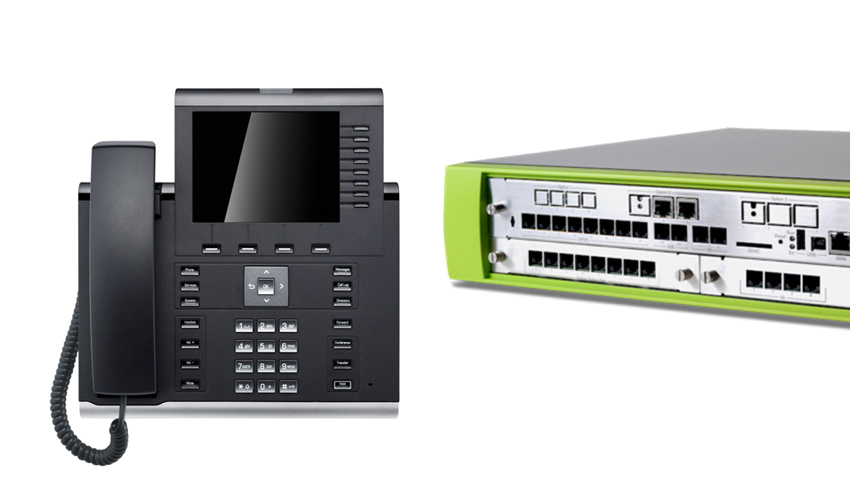
If Telecoms vendors are to be judged in history and pedigree, then Unify’s credentials are hard to beat.
Part of Siemens, Europe’s largest electronics manufacturer, until its takeover by Atos is 2015, Unify can claim a Telecoms heritage which stretches back to the age of the telegraph in the 1840s, and boasts an impressive global reach with a presence in 100 countries.
If Unify’s CV is impressive, so is that of OpenScape, widely regarded as a pioneering brand in the emergence of Unified Communications. Launched in 2003, OpenScape helped to set the precedent for integrated multimedia and multimodal communications channels beyond telephony, the use of SIP and service-orientated architecture (SOA) and convergence with mainframe IT systems through software.
OpenScape Business is the sub-brand focused on the SME market. Available as an on premises hardware solution, or as software which can be run in the datacentre or in a virtual environment, OpenScape Business is focused on delivering a broad range of communications and collaboration options from a single platform.
In this review, we will dig deeper into whether OpenScape’s revered status as a UC pioneer translates into a product which still cuts the mustard in the modern market. We will assess whether the range of communications and collaboration tools it offers still seem as impressive in a world where every vendor has followed their lead, and evaluate how well OpenScape Business meets the needs of small to medium sized businesses.
Please remember, the opinions in this review are those of the author only. UC Today does not endorse, promote or market any particular UC brands or products.
How Does It Look?
OpenScape Business is available in six different hardware units, three wall mountable and three for rack mounting. All three wall systems come in white boxes with dimensions as follows:
- X1 - 470mm x 370mm x 80mm
- X3W - 450mm x 460mm x 130mm
- X5W - 450mm x 460mm x 200mm
The three rack mountable versions all come in 17.5” chassis with attachments for a 19” cabinet. The X3R is a 2U chassis and the X5R a 3.5U chassis. The X8, which can be deployed as a stand alone server or in a cabinet, has dimensions of 490mm x 440mm x 430mm.
What Can It Do?
OpenScape Business offers customers a choice of five different server options - four hardware boxes, the X1, X3, X5 and X8, and OpenSource Business S, the software version. The X3 and X5 are available as both wall and rack mountable units.
In terms of telephone connections, the servers are categorised according to the number of subscribers they offer, the number of ITSP channels and the maximum number of line channels available. The X1 can support up to 30 subscribers and up to 30 line channels. The X3, X5 and X8 all offer up to 60 ITSP channels, with 250 available line channels supporting a maximum of 500 subscribers through IP line sharing. All four also support ISDN lines plus analogue, digital and DECT extensions - the X3, X5 and X8 offer different numbers of each.
The Business S software version offers 180 ITSP channels and up to 1500 IP subscribers, with 250 available line channels. It does not support analogue, digital or DECT when deployed without a hard server. Business S is run on a Linux server, and can also be virtualised in VMware vSphere or Hyper-V environments.
OpenScape Business also uses SIP and IP protocols to facilitate easy networking across multiple sites. A maximum of 2000 users can be linked between sites in this way.
A standard range of VoIP call management features are shared throughout the network, including call status and directory with user presence displayed. A wide range of IP, digital and analogue endpoints are supported, SIP desk phones from Unify’s OpenStage and OpenScape brands. This also includes the OpenStage S5, SL5 and M3 DECT cordless phones, and the WL3 WLAN SIP phone.
UC and collaboration features are available in two packages - UC Smart, a core suite bundled in with the servers, known as UC Smart, and UC Suite. UC Suite is available on all versions except the X1 by purchasing an additional Booster Card or Booster Server, which both also expand the number of UC Smart subscriptions.


