When was the last time you attended an in-person business meeting?
Last week? Last month? Last year?
Incredibly, some recent new starters may answer ‘never’.
Such has been the exponential rise in the popularity of video conferencing.
No longer just for the corporate higher-ups with special dispensation; today it seems that video conferencing is pretty much ubiquitous.
We “jump on a video call” at a moment’s notice; breezily and routinely.
For those that are planned in advance, super-simple invites drop into our digital calendars.
When the time comes - and with just a couple of clicks – we’re in the room.
In fact, of all the very recent consequential bi-products of the global response to the pandemic, you could argue that video conferencing has changed our lives the most.
The psychology alone is fascinating.
The impact on the planet is potentially game-changing.
The effect on the bottom line is truly transformational.
“For me, it boils down to two things – time is treasure, and cost is king,” says Jeff May, UK Sales Director at Swedish-based global audio and video collaboration endpoints giant Konftel, who invented the first (audio-only) conference call more than 30 years ago.
“All of the time now saved as a result of not having to travel physically to attend meetings is obvious to everyone.
“The associated financial savings, in terms of transport costs, hotel costs and the like, are also clear to see.
“Those time and costs savings have always been there for the taking – now everyone gets it.”
Since the explosion, the big question has always been whether video conferencing can deliver the same levels of productivity as meeting face to face.
Can the same level of intensity be achieved in a virtual interaction?
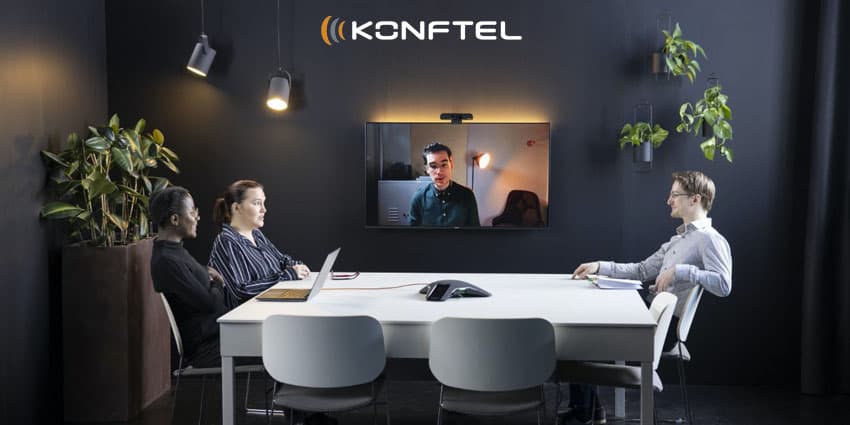
“Cameras can now have really wide fields of view to capture the whole room audience, they can focus on individual speakers or positions as required.
That means a conference is much more inclusive and it is much easier for all attendees to make a positive contribution to the discussion,” says May.
“Picture and audio quality has also hugely improved, meaning engagement levels in conferences have increased. The technology has made the experience so much more dynamic for everyone involved. As a result, productivity is higher”
Convenience, too, has increased.