
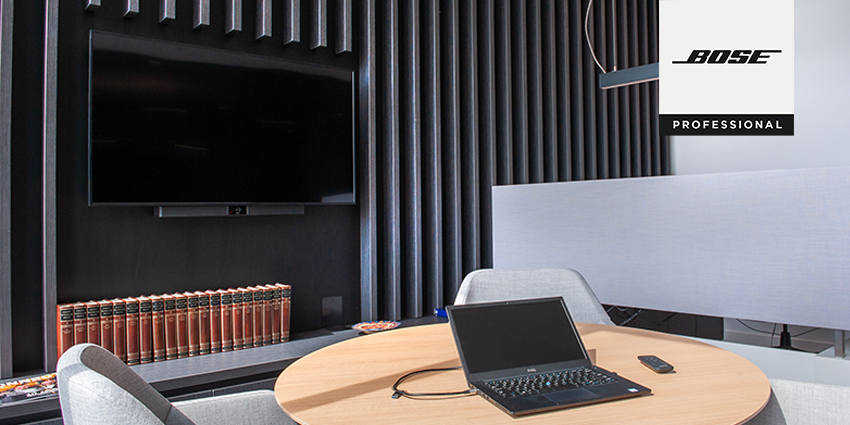
There’s a new way to describe technology: ‘transparent’.
As in users can’t see it.
It’s there doing its thing but is so beautifully discreet that no-one notices.
It’s the kind of technology – whether hardware or software – that is more about quietly enabling an efficient, productive communication experience than it is about brashly drawing attention to itself.
Nowhere is the concept more at play than in the videoconferencing space, where the science of sound and vision ubiquitously bridges the gap between virtual and physical human interaction.
Formal meetings, team collaboration, webinars, event presentations, even the quick one-on-one catch-up: they are all increasingly facilitated via connected audio and video hardware. Indeed, the camera and the speaker are now essential components of any enterprise tech stack; whether as part of employees’ portable ensemble of smart devices or hardwired into increasingly versatile office spaces such as dedicated meeting and conference rooms, booths, huddle spaces, and even connected cafeterias.
Of course, the camera and loudspeakers are there on the table or the wall. However, when their design and technological smarts are of the most superior quality, it’s as if they don’t exist.
“The notion that a virtual interaction’s audio and video quality is ‘good enough’ should not be the basis upon which we assess its effectiveness,” says Adam Shulman, product lead for installed systems business at global-leading AV provider Bose Professional, whose range of enterprise products and solutions deliver big.
“Ultimately, our goal should be that the experience is the same as people talking in person. No background noise or echoes, natural interrupting and double-talking, every element of the vocal spectrum in play. Also, clearly seen and synchronized visual cues that occur naturally in a physical conversation and which play a big part in how we connect, understand, and relate to each other.
“Once this is in place, customers understand and appreciate it fully as the absence of friction between user and technology — as seen in workplace projects like Genera in Chile and LC Packaging in The Netherlands. It’s simple: create a space that provides intuitive ways for employees to have efficient, clear, simple engagements with colleagues and clients around the globe, and the results will be seen in increased productivity and focus, while potentially also leading to reduced meeting time.
“That’s particularly important if those with whom we are interacting are multicultural. In that case, we need to have those visual communication cues that we as social animals naturally give to each other. But we know what these cues are; it is science, not magic.”
In the case of Bose Professional, it is in a unique position to leverage the power of that science.
It recently became independent from the wider Bose Corporation; founded in 1972 and steeped in a history of ground-breaking innovation.


