
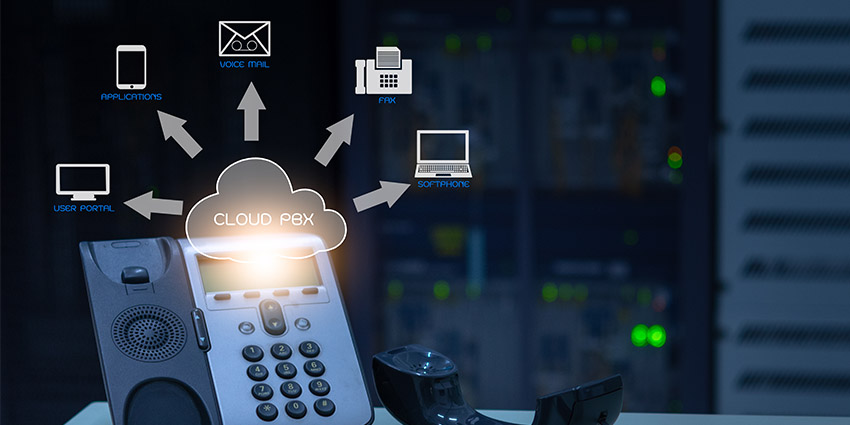
How Does Cloud PBX Work?
Cloud PBX includes all of the capabilities required in an office phone system, such as voicemail, call forwarding, and, of course, calling. However, rather than setting up and maintaining a server, one uses a cloud-based Voice over Internet Protocol (VoIP) service for their business communications, both internal and external. A reliable broadband connection is the only prerequisite to using a cloud-based PBX. All major IP phones, including desk and conference phones and softphones, are supported by this technology.
In other words, cloud PBX is a technology that enables companies to make internet calls using their phones. The user's telephony device is immediately linked to a VoIP modem, connecting incoming and outgoing call requests to the internet. This allows users to make calls over the internet without using a separate device like a VoIP adapter. Importantly, cloud PBX can also connect the user's phone to a traditional PSTN network, VoIP, or both.
Features of Cloud PBX
Here are the key features of cloud PBX:
Call analytics and reporting
Call analytics and reporting allow organizations to see how their company's calls are performing. Organizations can evaluate elements like the average length of a call, the number of calls per day, the number of abandoned calls, the most frequent time for phone calls throughout the day, and who on the team takes the most calls.
This information can be valuable in understanding how your customers interact with your business and where there might be room for improvement. When the user has access to call data, it is easier to spot quick wins or pain points. Unlike a traditional PBX, organizations will know exactly where their employees spend their time.
Free toll-free and local phone numbers
Toll-free and local phone numbers are available with cloud PBX. This is an essential feature for businesses that want to offer their customers a way to reach them without incurring long-distance charges. Toll-free numbers are also helpful for companies with employees who work remotely or for those that have a mobile workforce. Cloud PBX also offers the ability to port your existing phone number to the cloud.
Conferencing through audio and video
When connected with the appropriate endpoints, Cloud PBX offers audio and video conferencing features. This works by generating a virtual meeting room, referred to as a conference bridge, which your team can access using a password. They can participate in the conference using any internet-connected device, such as their softphone, VoIP headset, or mobile phone. Each person can listen in on the conversation, join as needed, and even share their screens to improve collaboration.
Auto-attendant
Auto-attendants are one of the most valuable features of a cloud PBX. Users can set up an auto-attendant to answer calls after business hours and direct them to the appropriate department or employee. For companies with many inbound calls, an auto-attendant can be a lifesaver. After-hours callers can still get the information they need without speaking to a live agent.
An auto-attendant ensures cost savings by removing the need for a human receptionist while increasing customer satisfaction. In addition, auto-attendants present a professional image to incoming callers – a simple greeting that introduces your company and thanks to them for calling can go a long way towards developing confidence.
Interactive Voice Response (IVR)
An IVR is a phone system that interacts with callers through pre-recorded audio messages and touch-tone input. IVRs are commonly used to route calls to the appropriate department or individual. IVRs are suited for enterprises with a high frequency of inbound calls. IVR is a great way to maintain consistency in your company's communications policy. It also enables organizations to provide clients with self-service options.
Pros and Cons of Cloud PBX
Before implementing cloud PBX systems, one should note its advantages and disadvantages. The pros of the technology include:
● Flexibility in all environments and seasons - A versatile phone system can adapt to changing workplace circumstances. Users can customize their phone system to match their specific corporate demands rather than be limited by an old PBX. Small businesses have total command over their phone networks. It is simple to add and allocate business phone lines to the employees, including remote workers.


