
Augmented reality (AR) and virtual reality (VR) are no longer the purview of large enterprises alone. According to research, 35% of small-to-mid-sized companies plan on implementing AR/VR by 2021., investing anywhere between $10,000 and $15,000. In the UK, 40% of small and mid-sized enterprises already use AR and VR for training, communication, and collaboration. Due to COVID-19, AR/VR use among businesses has increased significantly and demand will continue to rise over the next few quarters.
Meta Quest for Business by Facebook (now Meta) addresses this demand with a family of VR apps and software offerings for business users.
Defining Meta Quest for Business
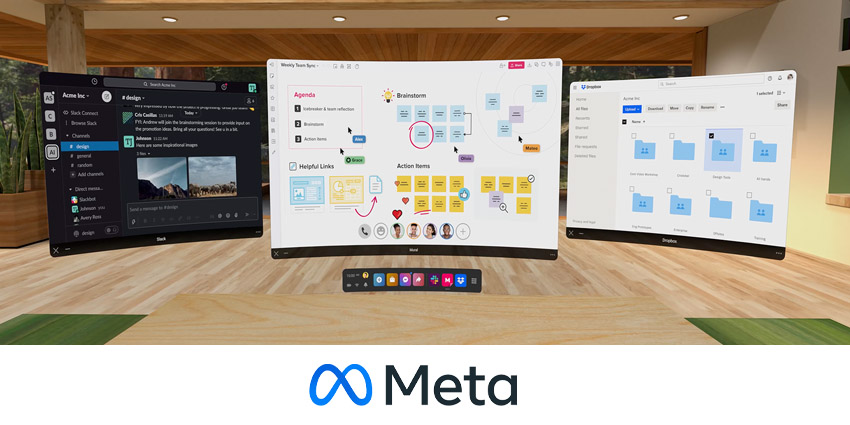
Meta Quest for Business can be defined as a Quest VR program that enables integration with your Facebook work accounts and allows users to gain from a dedicated suite of business-focused apps. Importantly, Meta Quest for Business does not refer to a standalone device or VR headset. Instead, it is a software service that allows business users to maximise their investment in Quest VR headsets – no matter the variant they are using. While there’s no official announcement on what the Meta Quest for Business application suite could include, we expect prominent third-party collaboration companies like Dropbox, Slack, Monday.com, and Mural, among others.
Apart from access to business-focused applications, Meta Quest for Business will make it easier for teams to manage VR devices for work purposes. In an October announcement, Meta announced that it will introduce a new system for Work Accounts that can be administered by businesses, much like a Teams admin or Google Admin can manage employees’ work accounts remotely. Now, devices running Meta Quest for Business can also be remotely managed by an IT admin. The solution will support services like Microsoft Intune, Ivanti Unified Endpoint Manager (UEM), and VMware Workspace ONE for this purpose.
The Original Oculus for Business Has Been Around Since 2017
Despite the new name Meta, Oculus for Business has been around since 2017 and has seen several avatars.
The first Oculus for Business bundle included the Oculus Rift headset, touch controllers, sensors, and facial interfaces, designed for business use. The solution could be ordered in bulk, and was leveraged by leading companies like Audi, DHL, and Cisco. For instance, Audi equipped its dealerships with Oculus for Business devices so that customers could design and “build” their dream cars in VR. DHL used it for immersive learning and Cisco applied the technology for VR collaboration.
Then, in 2019, the company launched its new Oculus for Business at its annual F8 conference. This release expanded the Oculus for Business line up to also include Quest devices, in addition to Rift. it also introduced a suite of tools that would help companies manage VR better and maximise its business potential. This is where IT offerings for device setup, enterprise-grade support, and a new UX for business users entered the game. However, at this time, Oculus for business was still available as a dedicated hardware offering with specifications different from their consumer-facing counterpart.
Finally, in October 2021, Facebook announced that it would be retiring Oculus for Business in favour of Quest for Business – which is now known as Meta for Business after Facebook’s rebranding.
“As we've listened to feedback from our community on the future of work, individuals and businesses alike have told us they want multipurpose VR devices that can be used for work, for gaming, for web browsing, for personal projects, and more—much like how people use smartphones and laptops today,” the company explained in a blog post.
In other words, industry sentiment indicated that business users now want a device that could double-up for work and personal use, rather than have enterprise-only devices.


