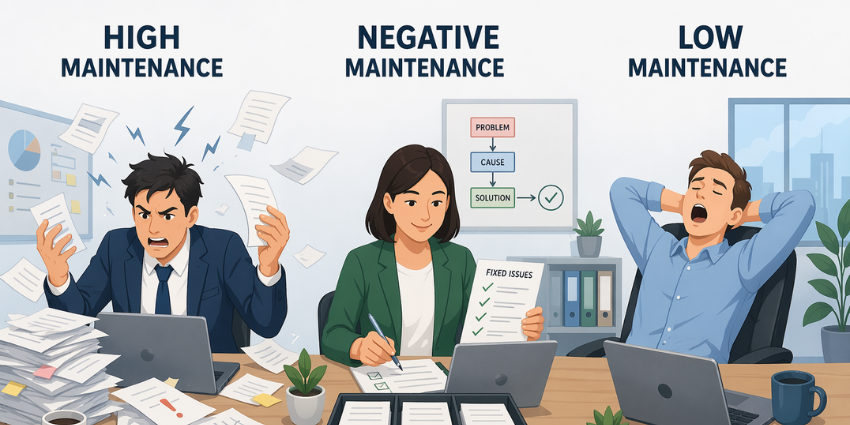
"Most companies aim for low maintenance. We aim for negative." That bold statement captures a new philosophy that is quietly spreading across the enterprise landscape.
Negative maintenance is the practice of improving systems, workflows, documents, and processes so they create less future work for others.
Most businesses just want systems to run quietly. Negative maintenance requires leaving every process in a better state than before. This mindset can reshape how service teams handle requests, remove recurring issues, and reduce avoidable support demand.
Here's how.
What Is the Negative Maintenance Philosophy?
Most employees fall into high maintenance or low maintenance categories. Negative maintenance is a rarer and much more valuable trait. These individuals actively make life easier for everyone around them.
Varun Anand, Co-Founder of sales software provider Clay (valued at over $3bn), explained this in a LinkedIn post. He defined it as:
"It’s spotting ambiguity and killing it before it slows others down. It’s solving problems upstream. It’s quietly improving the system without being asked."
For IT and service management teams, the benefits are practical. Negative maintenance can reduce repeat tickets, shorten onboarding cycles, improve documentation, reduce handoffs, and free technical teams from avoidable work. For employees, it means fewer blockers and faster access to the tools they need.
The term also matters because modern service teams face a scale problem. Every new application, device, workflow, and employee creates more support demand. Traditional ITSM helps teams manage that demand. Negative maintenance asks a better question: how much of that demand should exist at all?
That is a culture shift that can directly enhance overall workplace productivity.
How Serval Uses This Operating Principle
This philosophy is not just a theoretical idea. It drives strong business success for companies that embrace it.
Serval provides a perfect example of this growth, as the service management platform recently reached a billion dollar valuation just two years after being founded. Its service management technology reinvents ticketing and workflow processes, serving global brands such as Notion, Perplexity, Fox, and others.
In a recent company blog post, CEO Jake Stauch and CTO Alex McLeod explained their internal approach to this: "We don't have a culture deck. We have three operating principles."
Negative maintenance serves as their very first operating principle. They explained:
"Every system you touch, whether a team, a process, a doc, a meeting, a line of code, or a hiring loop, should leave the company lighter, clearer, and more reusable than you found it."
Join the conversation and follow UC Today on LinkedIn for the latest enterprise technology insights.