
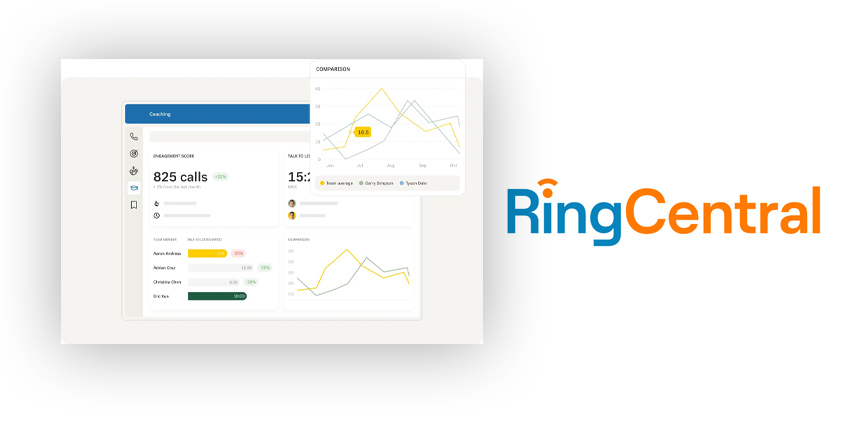
RingCentral is one of the latest companies to delve into generative AI, with a new AI platform: RingSense. This new platform uses voice and natural language processing to draw insights from conversation data by leveraging generative AI, so let’s take a look at what RingSense is, how it works, and what it can bring to businesses.
RingSense Summarized
RingSense is an AI platform from RingCentral that uses generative AI and conversational intelligence to analyze conversations, thus gaining new insights into customers, agent performances, trends, and so on. While it is intended to expand, currently the RingSense AI portfolio consists of RingSense for Sales, designed specifically for sales teams and agents.
RingSense for Sales analyzes interactions between sales representatives and customers or prospects to gain information like performance metrics and customer insights, which can then be used to help train and mentor representatives, help teams improve, and gain more information about what customers are looking for.
There are several AI capabilities built into RingSense for Sales, which we can expect to see used in some form or another in future RingSense solutions:
- AI-generated notes, summaries, and follow-ups that are automatically added to the sales rep’s CRM or productivity suite.
- Rep scores and reporting, designed to help managers quickly search conversations to find customers and reps that need the most attention.
- Keyword and phrase tracking, which can be fine-tuned to focus on entire concepts, products, or competitors.
- Integrations with third-party apps, including CRMs like Salesforce and Hubspot, calendar applications, and a variety of call and video meetings.
These are popular AI features, commonly used to improve productivity and reduce time spent taking notes or searching through recordings, which can prove useful for sales teams using RingCentral.
Along with RingSense for Sales, RingCentral has plans to release RingSense solutions for a wider array of teams and departments, including:
- Revenue Leaders, with custom scorecards, tailored onboarding for new hires, and automated feedback.
- Sales Enablement, featuring custom libraries of sales techniques, sales playbooks based on actual customer data, and insights into individuals and teams.
- Customer Success, through automated summaries of buyer journeys, monitoring for ongoing upsell activities, and reviews of past interactions.
- Marketing, by tracking key moments for customer behavior and customer-driven messaging.
Artificial Intelligence APIs
At the same time as RingSense, RingCentral also introduced AI APIs, designed to let developers access their own data from RingCentral. This is designed to let users extract and analyze their transcripts and interactions across channels to gain a better understanding of their customer interactions and overall sentiment across platforms.
Essentially, this is a way to bring RingSense to RingCentral solutions, APIs, and third-party applications that don’t currently have it. Developers can build private or public apps and integrations using RingCentral’s AI APIs, including such features as:
- Speech-to-text conversions
- Talk-to-listen ratios that identify engagement levels
- Automatic meeting agendas
- Sentiment analysis
This is not RingCentral’s first foray into artificial intelligence, as the company has previously released several AI-powered video meeting capabilities, including AI-powered meeting insights and summaries. Artificial Intelligence APIs are an attempt to extend those capabilities to more solutions and are currently available in an open beta.


