
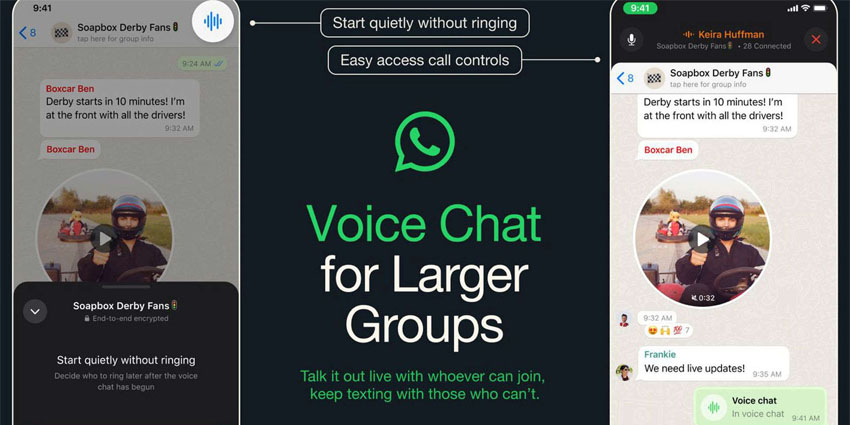
WhatsApp is launching an enterprise-friendly voice chat upgrade, enabling users to host large groups of up to 128 participants in audio calls.
Although similar to a group call, it intends to be less disruptive. Normal WhatsApp group calls ring every member of a WhatsApp group, while this new capability prompts an in-chat bubble on each member's screen that users can then tap to join.
Users can use voice to discuss a topic with whichever participants can join while enabling them to continue messaging those who can’t in the group chat. Users can unmute, hang up or message the rest of the group without leaving the voice chat by selecting the call controls at the top of the chat screen.
Users can start a group voice chat by navigating to a group chat and selecting the audio read-out toggle in the top right-hand side of the screen. There, users will notice the "Start Voice Chat" option.
WhatsApp states this option is only available on a user's primary device, whether Android or iOS. Calls will automatically end the instant every participant leaves. Additionally, they end after an hour if no other participant joins the first or last person in the chat.
Voice chats on WhatsApp are similar in design to features on other UCC platforms like Discord, Slack and Telegram, enabling larger than normal groups of people to connect over voice chat, which could be applicable in business contexts, such as conferences, meetings or large-scale huddles.
WhatsApp will be rolling out voice chats to large groups over the coming weeks, beginning with group chats that include at least 33 participants. As with WhatsApp's other services, the large group voice chats will be end-to-end encrypted.
WhatsApp's Growing Enterprise Functionality
In September, news broke that WhatsApp was working on enabling cross-platform messaging to comply with the EU’s Digital Markets Act, which passed earlier this year.
A WhatsApp for Android beta update (version 2.23.19.8) delivered in September included a “Third-party chats” screen. The screen wasn't functional for users, but its existence effectively confirmed that Meta was working towards making WhatsApp cross-platform compatible.


