
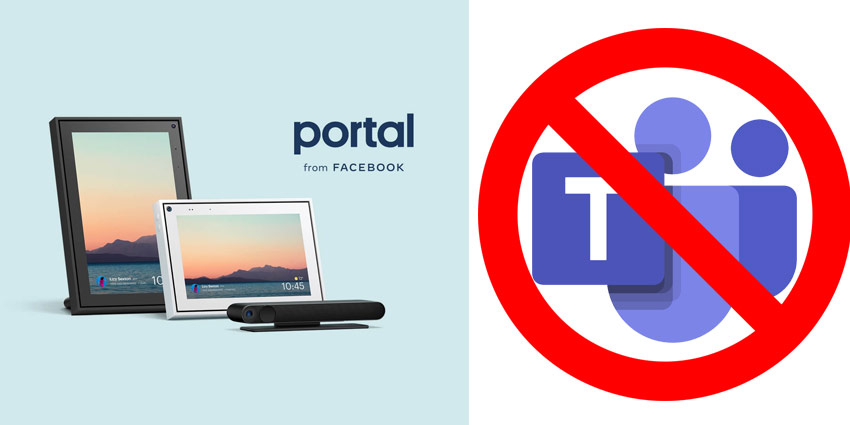
Facebook has been rapidly investing in new solutions for enterprise collaboration and communication lately. The Workplace from Facebook environment for team work is becoming increasingly immersive, with live video streaming and translation features, alongside file sharing and news feeds. At the same time, Facebook is simplifying the way that people can collaborate remotely through its Portal device – a home smart-screen for video calls.
Demand for Portal solutions has dramatically spiked in recent months thanks to the COVID-19 pandemic. Many home workers needed a convenient way to reach their colleagues, and people wanted opportunities to stay in touch with friends and family. Recently, Facebook added new capabilities that would strengthen its position as a remote working tool.
In August, the company announced that it would be integrating with four major services for video conferencing: GoToMeeting, BlueJeans, Zoom and Webex.
So, where’s Microsoft Teams?
Why Not Support Microsoft Teams?
The decision not to support Microsoft Teams as a video conferencing solution seems like an odd one. Currently, Microsoft Teams has over 115 million daily active users, making it one of the most valuable collaboration tools on the market. Yet, Facebook has ignored this solution entirely with its portal devices. The choice has prompted comments from experts like Tim Banting, Senior Principal Analyst at Omdia.
In a tweet, Tim questioned whether it was a deliberate move from Facebook not to include Microsoft Teams in their devices. In a time when we’re moving towards the era of the “universal endpoint” according to Tim, it seems unusual to ignore a solution as big as Microsoft Teams.
Portal could be an intriguing solution for a lot of business owners. It’s an opportunity to free up your computer so you can take notes and view documents during a meeting. It’s also a chance to access advanced features, like smart camera AI functionality to keep people properly framed. However, without access to Microsoft Teams, Facebook could be limiting the number of customers it can reasonably reach.
Trouble with Microsoft Teams
You could argue that the decision not to include Microsoft Teams comes from the fact that Microsoft already has a lot of its own video technology available. Microsoft Teams Displays emerged in August and promise a similar experience to the Portal solution. The Teams displays create a more immersive experience for people on Microsoft Teams.
With a display, remote and home workers can get access to a high-quality camera, microphone, and a set of speakers, or Bluetooth headset. You also get to keep your laptop or PC separate, so you can access other forms of information or browse through chat feeds when you’re in a meeting.


