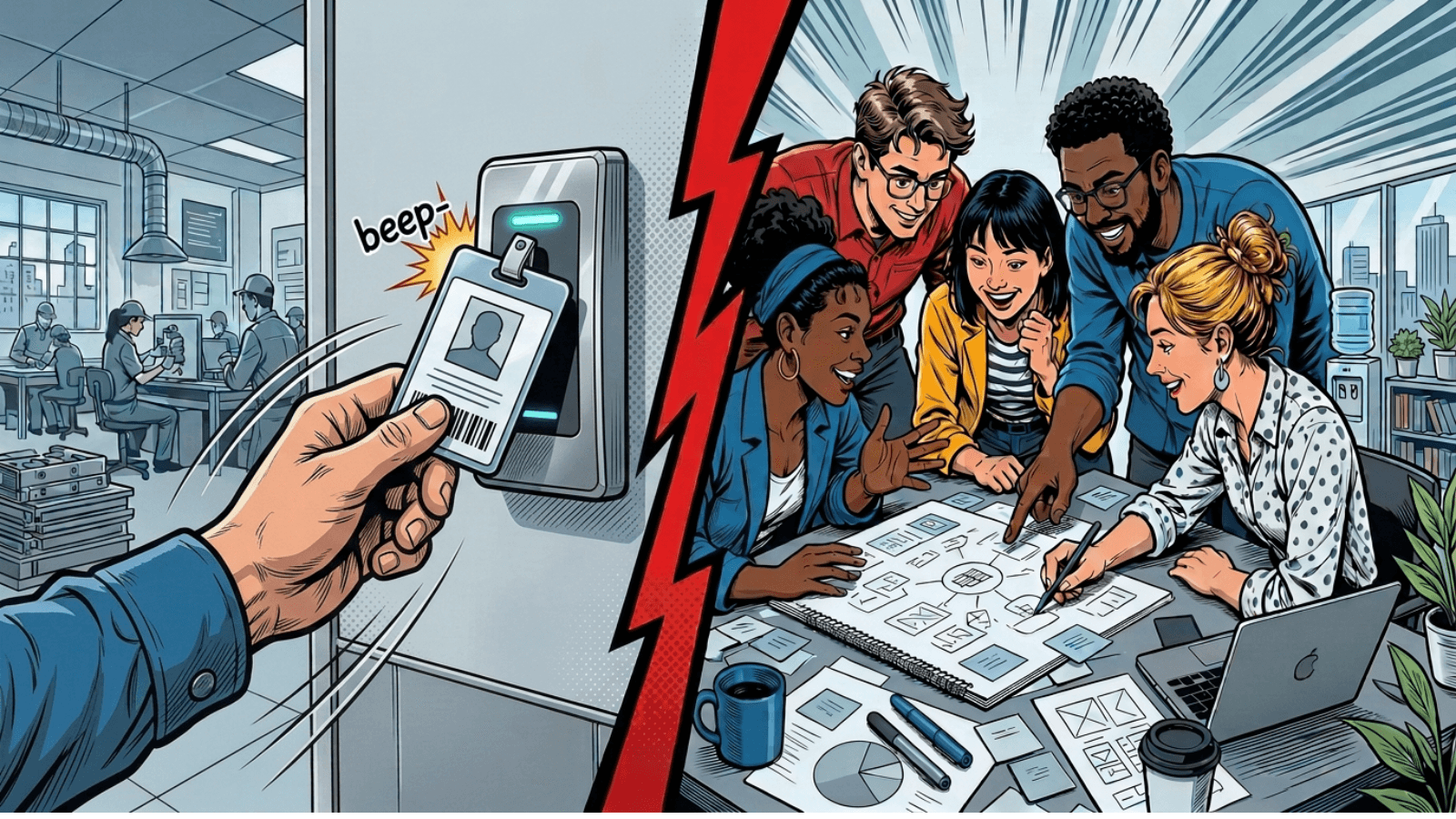
Most return-to-office mandates are built around a single number: how many days someone badges in. It's an easy metric to track and an even easier one to report to leadership. But attendance was never really the goal. It was always meant to be a proxy for something harder to measure: whether people are actually working together when they're in the building.
Mapiq, the workplace management platform, has just rolled out a new feature called Groups, built specifically to close that gap. Rather than tracking who showed up, Groups looks to help employees plan their in-person collaboration.
Read More:
TL;DR
- Mapiq Groups lets employees create their own coordination groups to plan office days around collaboration, not just mandate compliance.
- Workplace strategist Corinne Murray argues most RTO policies conflate attendance with collaboration, when the two are not the same thing.
- Mapiq's Badge Data Importer, a separate new feature, answers the attendance side of the equation, fast, but measures presence only.
- Buyers evaluating workplace platforms should ask what a tool is actually measuring, presence, or the coordination that presence is supposed to enable.
What Is Mapiq's Groups Feature and How Does It Work?
Mapiq Groups looks to enable employees to create and manage their own coordination groups, project teams, mentorship pairs, social crews, so they can see at a glance who from each group is planning to be in the office and when.
Unlike Active Directory-based group structures managed by IT, any employee can create a group that reflects how work actually happens, not just where they sit on an org chart. A project squad, a Friday lunch crew, a mentorship pairing, a cross-departmental initiative team, all become visible, coordinated units inside the platform.
Members can view up to three weeks of each other's planned office days, invite the whole group to a shared booking with one tap, and manage membership without filing an IT ticket.
Groups works natively inside Microsoft Teams and Outlook as well as Mapiq's own app, meaning the coordination happens in the tools employees already have open, rather than requiring a separate login just to check who's in on Tuesday.
Key Takeaways: How Groups Works
- Employees create and manage their own groups without IT involvement or Active Directory dependencies.
- Members see up to three weeks of each other's planned office days and can invite a whole group to a booking in one action.
- Groups works natively in Microsoft Teams and Outlook, alongside Mapiq's own app.
Before Groups, that same coordination happened through a patchwork of workarounds that most workplace teams will recognize immediately.
Why Did Coordinating Office Days Require So Much Manual Effort?
Before Groups, coordinating an office day meant checking individual calendars, sending Slack messages asking who's in, or maintaining a spreadsheet that went stale within days, none of which scaled beyond a small team.
Every one of those workarounds put the burden of coordination on the employee, and every one of them broke down the moment a team grew past a handful of people.
The new solutions aims to replace that patchwork with a single, self-managed view: one glance shows a group's three-week office plan, bookings can be made for the whole group in a single tap, and plans update in real time as members make decisions.
How Are Early Users Actually Using Mapiq Groups?
Mapiq quietly introduced Groups earlier this year, and early adoption shows employees using it for far more than mandate compliance, including project sprints, mentorship check-ins, and purely social coordination.
Reported use cases include product teams syncing sprint planning weeks, mentorship pairs coordinating check-ins, department "anchor days" built around face-time, cross-functional project squads, and purely social groups such as office running clubs, lunch crews, and onboarding cohorts staying connected after their first few weeks.
That range is the clearest evidence that Groups is being used to plan collaboration, not just satisfy a policy. It's no surprise to anyone that running clubs and lunch crews don't originate in spreadsheets - it takes something more in tune with the workplace.
Key Takeaways: Early Adoption Patterns
- Early groups span project coordination, mentorship, department anchor days, and purely social use cases.
- This range suggests genuine collaborative intent, not just mandate box-ticking.
- Groups is a proxy for planned collaboration, closer to the real goal than a simple attendance count, though still a proxy rather than a direct outcome measure.
This distinction, between measuring presence and measuring intent to collaborate, is exactly the gap workplace strategist Corinne Murray has spent over a decade researching.
Why Does Socializing Deserve a Seat at the Table?
Workplace strategist Corinne Murray argues that most organizations invest heavily in three of the four categories of knowledge work while treating the fourth, socializing, as a nice-to-have rather than essential infrastructure.
Murray, who led transformation work at WeWork, American Express, CBRE and more, laid out a four-part framework for knowledge work; individual focus, synchronous collaboration, asynchronous collaboration, and socializing. It's the fourth category, she argues, that quietly holds the other three together.
Speaking on the Fika Friday at the Office podcast, she explained:
"That socializing piece is the connective tissue that makes sure that we all are moving in lockstep with one another, which when you're running a business, it's a pretty essential thing. Otherwise, you might have the same initiative in four different parts of your organization... but you have four of them instead of one because no one talked to one another."
Murray was also direct about why return-to-office mandates so often miss this point entirely:
"A lot of the return-to-office decisions were being made emotionally... the whole premise of a lot of the return-to-office initiatives were around getting butts back into seats in offices. It had very little to do with how do we actually facilitate work in the right ways."
Her time at WeWork adds a more skeptical layer to how any coordination tool should be evaluated. Her team used its headquarters as literal lab space to test how design decisions shaped behavior, including a memorable finding about elevators:
"We could design for such a frictionless experience, call the elevator and it's there within five seconds, but because it wasn't there for an extra five to fifteen seconds, another person came into the elevator lobby going to do the same thing, and they got to go have lunch together... What friction is good friction, what is unhelpful friction?"
This elevator experiment is a reminder that coordination tools carry a real design risk: making planning too frictionless could replace the kind of spontaneous, unplanned overlap that drives genuine connection with purely scheduled, transactional meetups.
A well-designed tool should remove the friction that stops people from bothering to coordinate at all, without engineering away the unplanned moments that happen alongside it.
Key Takeaways: Murray's Framework
- Murray splits knowledge work into individual focus, synchronous collaboration, asynchronous collaboration, and socializing.
- Socializing is the category most organizations underinvest in, despite functioning as the connective tissue that keeps teams aligned.
- Coordination tools should remove unhelpful friction without eliminating the spontaneous, unplanned interaction that drives real connection.
With that framework in mind, it's worth looking at the other half of what Mapiq shipped recently.
What Is Mapiq's Badge Data Importer and What Problem Does It Solve?
Mapiq's Badge Data Importer takes raw, unstructured badge swipe data from any access control system and turns it into clean, standardized attendance and compliance reporting in seconds, replacing a process that previously took days of manual work or a formal IT integration.
Modern offices already generate this data. The problem has never been access to it, it's that the export format varies by vendor, by building, and sometimes by floor, meaning someone has to clean and standardize it before a single useful report can be produced. Mapiq's answer lets workplace teams upload that raw data directly, with the platform's AI standardizing it automatically.
Once imported, the data flows into Mapiq's Insights reports, answering the operational questions workplace leaders are actually asked: is this team meeting its mandate, which locations are over- or under-utilized, and which days are quietest. It works at portfolio scale, across one building or twenty, regardless of which access control systems are in play.
This is a genuinely useful tool for answering the attendance question fast. But it is worth being precise about what it measures. It counts entries. It does not tell you who someone saw once they were there, or whether the day produced anything beyond a headcount, which is exactly the gap Groups is designed to close.
Key Takeaways: Badge Data Importer
- Converts raw badge data from any system into standardized attendance and compliance reports without an IT integration project.
- Offers three privacy levels, from full personal identification to fully anonymous entry counts.
- Works at portfolio scale across mixed access control systems, but measures presence only, not the reason for it.
Taken together, these two features suggest what workplace leaders should actually be asking vendors before buying either type of tool.
What Should Buyers Ask Before Choosing a Workplace Collaboration Tool?
Buyers should distinguish between tools that measure genuine collaboration outcomes and tools that measure coordination intent, and confirm that any platform removes unhelpful friction without engineering away informal, unplanned interaction.
What Buyers Should Validate
- Is this tool measuring actual collaboration outcomes, or coordination intent that may not translate into meaningful in-person interaction?
- Does the tool remove genuinely unhelpful friction, or does it risk over-optimizing away the informal, unplanned overlap that drives real connection?
- Can attendance data and collaboration data be reviewed side by side, or do they live in separate reports that never get compared?
- Does the platform give employees enough control to build groups that reflect real working relationships, rather than forcing coordination through rigid, IT-managed org structures?
What Does This Mean for How Organizations Should Measure RTO Success?
Neither feature alone tells the full story of a successful return-to-office program. Badge Data Importer answers whether a mandate is being met, quickly and at scale, and that remains a genuinely necessary operational function. But mandate compliance was never the goal in itself. It was always meant to be a proxy for something less measurable: the collaboration and connection that Groups is now attempting to make visible and plannable.
Murray was direct about where she believes offices earn their place going forward:
"Offices are not going away... but do we need to be around one another when we're doing our heads-down work? I would argue no. The purpose and function of it is what will evolve."
Workplace leaders evaluating platforms in this category should expect vendors to answer both questions, not just the easier one: are people showing up, and are they showing up for a reason.
What is Mapiq's Groups feature?
Groups is a Mapiq feature that lets employees create and manage their own coordination groups, such as project teams, mentorship pairs, or social crews, to view each other's planned office days and coordinate in-person collaboration.
How is Mapiq Groups different from IT-managed team lists?
Unlike Active Directory-based group structures managed by IT, Mapiq Groups lets any employee create and manage a group that reflects how work actually happens, without filing a ticket or waiting on IT permissions.
Why do attendance metrics fail to measure collaboration?
Attendance metrics, such as badge swipe data, confirm that someone was physically present but do not capture who they interacted with or whether meaningful collaboration occurred. Workplace strategist Corinne Murray argues that many RTO mandates conflate attendance with collaboration, when the two are not the same thing.
What is Corinne Murray's four-part framework for knowledge work?
Corinne Murray, co-author of Work Then Place, divides knowledge work into four categories: individual focus, synchronous collaboration, asynchronous collaboration, and socializing. She argues socializing is the most underinvested category despite functioning as the connective tissue that keeps teams aligned.
What is Mapiq's Badge Data Importer?
Badge Data Importer is a Mapiq feature that converts raw badge swipe data from any access control system into standardized attendance and compliance reports within seconds, without requiring an IT integration project.