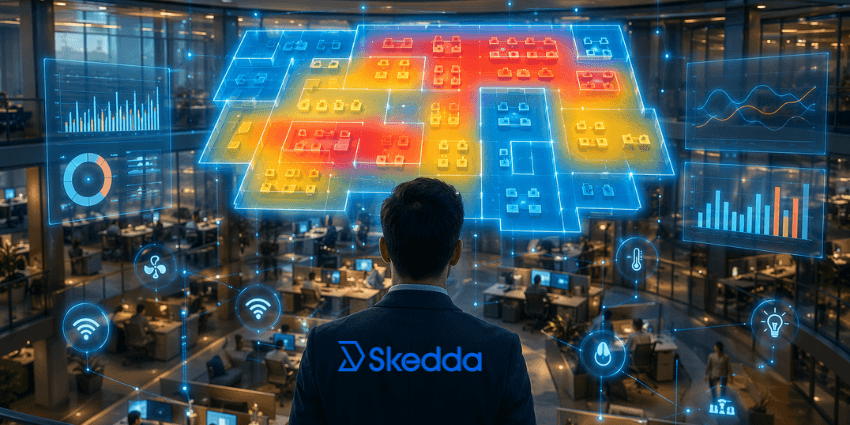
For decades, the Facilities Manager (FM) was largely invisible to the C-suite...until something broke. Today, with corporate real estate among the largest expenses on the balance sheet, the C-suite is no longer satisfied with "gut-feel" observations about office attendance. They demand hard data, predictive strategy, and measurable ROI.
To survive, traditional operators are evolving into a new, highly strategic role: the Facilities Management Analyst. For leaders evaluating their workplace management strategy, mastering workplace utilization data is critical to defending budgets and optimizing the employee experience.
This shift is the focus of a new 2026 report from Skedda, "The Era of the FM Analyst." The space management vendor compiled this guide to help facilities leaders transition from reactive maintenance to proactive strategists. As Matt Tucker, Director of Research at IFMA, notes in the report:
"We have an abundance of data – the challenge is sifting through it and telling the right story."
Read More
Defining the Facilities Management Analyst
A Facilities Management Analyst bridges physical space operations and data science. Rather than just managing vendor contracts, they synthesize data streams to understand exactly how, when, and why employees use the office.
This shifts a workplace management strategy from reactive maintenance to predictive planning. They don't just report 40% capacity; they determine if that 40% was in collaborative spaces or isolated desks, translating physical utilization into financial ROI. As Larry Charlip, Director of Real Estate at Roku, advises in the report:
"Tie your insights back to what executives understand - the bottom line, the P&L, price per share."
Beyond the Badge Swipe: The 6 Essential Data Streams
Historically, organizations relied on badge swipes to measure attendance. But a badge swipe only tells you if someone entered, not their behavior. To build a comprehensive narrative, the analyst must integrate six streams of workplace utilization data:
| Data Stream |
Strategic Purpose |
| Badge & Access Control |
The baseline metric for daily headcount and building entry, though it lacks granular detail on space utilization. |
| Workspace Booking Software |
Intent-based data showing exactly what types of spaces (desks, meeting rooms) employees plan to use. |
| Occupancy Sensors |
Real-time data on actual utilization, crucial for identifying "ghost bookings" where spaces are reserved but empty. |
| Building Systems (HVAC/Lighting) |
Correlates occupancy with environmental systems to power down unused zones and reduce energy costs. |
| Wi-Fi & Network Logs |
Tracks how employees flow through the office, identifying high-traffic areas and dwell times. |
| Employee Surveys |
The qualitative context that explains the why behind the quantitative data, revealing friction points. |
Follow UC Today on LinkedIn for the latest insights on workplace management, hybrid work strategy, and enterprise real estate.
Proving ROI: How Analysts Redefine the Workspace
The true value of a Facilities Management Analyst emerges when data solves real-world bottlenecks. The Skedda report highlighted a number of use cases where this form of FM data analysis had a measurable impact.
When Lighthouse Credit Union consolidated headquarters, legacy 1:1 desk assignments led to empty seats and wasted IT equipment. By analyzing workforce patterns and implementing booking software, they shifted to flexible hoteling. Sean LaBrie, VP of IT Infrastructure at Lighthouse, noted:
"We saved $10K+ worth of equipment by not having to provision all these extra desks"
Similarly, at the Woolcock Institute, leaders needed to know if their high-value clinical spaces were being maximized. By analyzing booking and occupancy data, they discovered that consultation rooms were sitting empty half the time. As Frances Wilson, Information & Governance Manager, explained in the report:
"We can show that certain rooms are only 50% booked and increase our revenue by optimizing our bookings"
In both cases, the solution wasn't expanding the real estate footprint; it was making the existing space visible, reliable, and data-driven. From there, organizations could maximize their business operations while alleviating employee frustrations.
Why the C-Suite Demands It
In the hybrid era, CFOs need absolute certainty that multi-million-dollar leases deliver value. If an organization struggles with fragmented data - with surveys, network logs and badge swipes living in silos - the C-suite cannot make informed decisions.
Without unified data, executives risk funding the wrong real estate strategy entirely. As Melody Brue, VP and Principal Analyst at Moor Insights & Strategy, recently warned during a UC Today roundtable:
"Leaders who are still planning their investments around a full return to office are misaligned with adoption trends... designing for always hybrid is becoming baseline, and we need to have multi-use spaces."
When an analyst breaks down these data silos and proves that consolidating floors or building flexible, multi-use spaces saves millions without impacting productivity, they transition from being viewed as a cost center to a strategic business partner.
Final Takeaway
The future of the office is a data problem, not just a real estate problem. The organizations that will successfully navigate hybrid work empower a Facilities Management Analyst to turn raw workplace utilization data into actionable intelligence. If your team still relies on visual headcounts to justify real estate spend, it is time to upgrade your strategy.
Ready to build a data-driven workplace management strategy from the ground up? Explore our Workplace Management Buyer's Guide to discover the tools, strategies, and technologies your organization needs.
What is a Facilities Management Analyst?
A Facilities Management Analyst is a modern workplace leader who combines traditional facilities operations with data analysis. They synthesize data from various workplace technologies to optimize space utilization, improve employee experience, and prove real estate ROI to the C-suite.
Why is badge swipe data no longer enough for workplace management?
Badge swipe data only records when an employee enters a building. It does not provide granular insights into how long they stayed, what specific spaces they used, or whether the office design actually supported their work.
What are the key data streams used by an FM Analyst?
According to Skedda, an effective analyst relies on six streams of workplace utilization data: Badge/Access Control, Workspace Booking software, Occupancy Sensors, Building Systems (HVAC/Lighting), Wi-Fi/Network logs, and qualitative Employee Surveys.
How does an FM Analyst help with corporate real estate costs?
By analyzing comprehensive utilization data, an analyst can identify underused spaces, eliminate ghost bookings, and provide the C-suite with the evidence needed to confidently consolidate leases, reduce energy consumption, or redesign floorplans, ultimately saving millions.
Why is the C-suite demanding more data from Facilities Managers?
In the hybrid work era, office attendance is highly variable, yet real estate remains one of the largest corporate expenses. The C-suite requires a data-driven workplace management strategy to justify these massive investments and ensure the physical office is actually driving business value.