

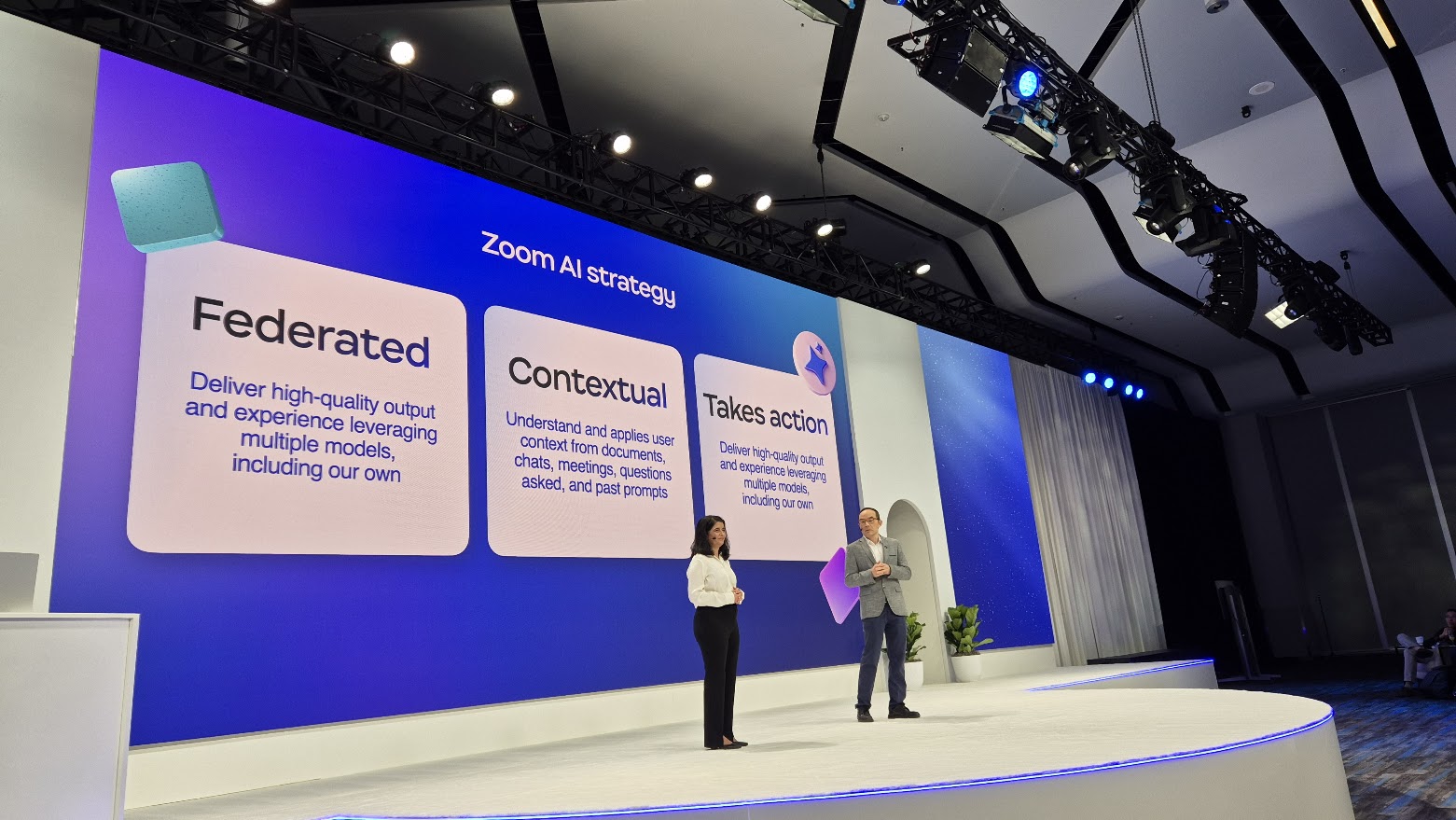
As I sat down with Smita Hashim, Chief Product Officer at Zoom, at Zoomtopia 2024, I couldn’t help but sense the excitement in the air. Fresh off a jam-packed keynote, Smita had a lot to share about Zoom’s latest breakthrough: AI Companion 2.0—a technology that’s poised to redefine the workplace as we know it.
When I asked her about Zoom’s AI evolution, her answer was simple yet powerful:
"We’re moving beyond AI as just a copilot. This is about creating a personal assistant that understands your workflows, preferences, and goals, making your work not just faster, but smarter."
This sentiment resonated with me. While many companies are leveraging AI for task automation, Zoom is setting itself apart by taking personalization to a whole new level.
The Shift from Copilot to Personal Assistant
Smita emphasized that the Zoom AI Companion has evolved far beyond a simple task manager. It’s now designed to learn from individual behaviors and adapt to each user’s unique way of working. "Flexibility in hybrid work is amazing," she said, "but that flexibility can create noise—too many channels, too many tools, and too much information. AI Companion 2.0 cuts through that noise and helps people focus on what matters."
The idea of AI that can act like a human assistant, anticipating your needs, summarizing your meetings in real time, or even nudging you to stay on track with your agenda is more than just a futuristic concept. Zoom has built this capability directly into its Workplace platform, and with integrations across tools like Microsoft Outlook, Google Docs, and ServiceNow, this assistant seamlessly works within the existing tech stack.
Personalized Productivity
Smita shared that AI Companion 2.0 is designed not only to automate but to personalize workflows.
"It’s not just about reducing time on mundane tasks, like drafting meeting summaries or scheduling follow-ups. It’s about freeing up time for creativity and innovation—letting employees focus on the work that really moves the needle."
What struck me most was her point about how deeply integrated this assistant is within Zoom’s entire suite. No matter if you're in Zoom Meetings, Zoom Docs, or Zoom Chat, AI Companion 2.0 is right there with you, offering insights, tracking tasks, and, most importantly, adapting to how you work best.
Smita gave a great example: “Imagine starting your day, and your AI assistant has already combed through your unread emails, summarized key points from last night's chat discussions, and generated a draft for a report you need later. That’s not just AI helping you—it’s AI working for you.” This level of assistance isn’t just about convenience. It’s about making workers more effective, while reducing cognitive overload.
Customization at Scale
One of the most exciting announcements at Zoomtopia was the introduction of AI Studio, a tool that allows businesses to customize AI Companion for their specific workflows. "This is where it gets really powerful," Smita explained. "Every company has its own lingo, its own way of working, and its own data needs. AI Studio lets you train the AI to fit those needs exactly. You can teach it industry-specific vocabulary, integrate it with proprietary systems, and make it your company’s personal AI."
This opens up a world of possibilities, particularly for industries with specialized workflows, like healthcare, education, and finance. Smita mentioned that Zoom has already seen significant interest from clients in these sectors, eager to tailor the AI to their needs. "The feedback has been phenomenal," she said, "especially in sectors where time is critical. Customizing AI Companion to meet the specific demands of, say, a hospital workflow could save lives by streamlining operations and reducing the potential for human error."
The Future: Digital Twins and the Rise of Hyper-Personalization
When I asked about the future, Smita’s eyes lit up. "We’re just scratching the surface. The ultimate goal is to create a digital twin—an AI that doesn’t just assist but becomes a true extension of you. It will know your priorities, your preferences, and your workflows better than your boss does." This vision of AI is far more than a helpful tool; it’s about creating technology that acts as a personal extension of the worker, one that’s not just reactive but proactive.
Smita also hinted at the future of Digital Twins, a concept that takes personalization to its peak. “Think about AI not just responding to your commands but anticipating your needs and actions, learning from your daily behavior to help you even more efficiently. That’s the future we’re building with Zoom.”


