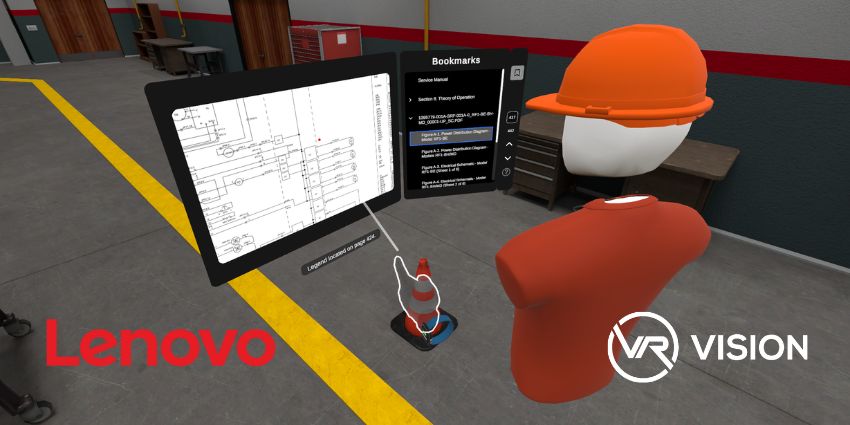
Lenovo is working with partners to combine artificial intelligence and virtual reality to transform how workers learn.
Through its partnership with Canadian immersive learning company VR Vision, Lenovo is helping global enterprises deliver training that adapts to each employee in real time – a step change from the one-size-fits-all models that have dominated corporate education for decades.
The collaboration combines Lenovo’s hardware and enterprise deployment capabilities with VR Vision’s Vision Portal platform which captures and analyzes user performance data to personalize training outcomes.
Together, the two companies are developing a framework that could redefine what corporate learning looks like in industries such as manufacturing, automotive, and energy & utilities.
“We’re seeing a major shift in how enterprises think about workforce development,” says Phillip Ruenprom, Lenovo’s XR Product Manager.
Our role is to make immersive learning accessible and scalable, using AI to ensure every learner gets the right level of support and feedback.
Personalized Learning, Powered by Data
The partnership centers on a key idea: training should adapt to the learner, not the other way around.
At the core of the experience is VR Vision’s Vision Portal, a centralized platform that manages training deployment, real-time analytics, and LMS integration – enabling scalable and measurable learning impact.
These insights allow the system to adjust difficulty levels, offer additional guidance, or fast-track users who demonstrate mastery.
“If a technician struggles with a specific procedure, the AI will recognize that and tailor the next session accordingly,” explains Lorne Fade, VR Vision’s Co-Founder. “It’s like having a personal trainer inside the headset.”
The approach not only accelerates learning but also improves retention by immersing users in lifelike simulations that mimic real-world conditions. The AI backbone behind this model represents the next logical step in enterprise XR – a move from static virtual environments to dynamic, data-driven experiences.
Toyota as a Test Case
One of VR Vision’s most successful deployments has been with Toyota Material Handling, which worked with the company to implement large-scale VR training across more than 300 dealerships. Using XR headsets and software tailored to Toyota’s procedures, technicians were trained on complex mechanical systems in a risk-free virtual setting.
The results were tangible: over 10,000 employees trained and more than $1.5 million saved annually.
Beyond cost reduction, Toyota reported faster onboarding and higher performance consistency across its workforce.
For Ruenprom, examples like Toyota demonstrate the potential of combining Lenovo’s enterprise reach with AI-driven learning tools:
When you scale immersive training across thousands of users, it’s not just about content and hardware. It’s about management, security, and analytics – areas where Lenovo already has deep experience.
Making Global Training Inclusive
AI’s role extends beyond personalization to accessibility. The VR Vision platform supports AI-assisted multilingual translation, allowing employees from different regions to participate in the same training sessions in their native languages.