
Microsoft announced a raft of updates for Teams Rooms and devices at Microsoft Ignite.
With the evolution of meeting rooms set to become more and more important as offices awaken from their pandemic slumber, we’ve rounded up the key news.
Device as a Service Now in the UK
The device as a service (DaaS) financing plan has been extended to new regions after initially launching in December.
The new markets – the UK, Australia, Ireland and Canada – will have access to the offering by the end of March 2021.
Customers still have the option to purchase Teams Rooms hardware as usual, but the DaaS option lets them lease it instead – thereby reducing capital expenditure. Other benefits include continuous warranties and level 1 support from Microsoft.
All hardware in the Teams store will be available for the service, with potential customers needed to undergo a credit check before a purchase can be completed.
Vendors to feature in the store include Bose, HP, Yealink, Shure and Poly.
New Gallery Views for Teams Rooms
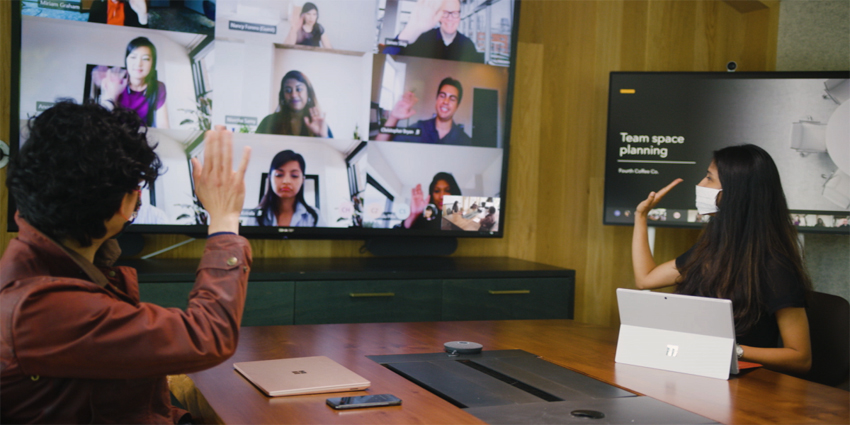
New video gallery views have now been added to Teams Rooms, including together mode and large gallery.
Microsoft said that participants will be able to see meeting content and people joining remotely at the same time, regardless of whether the conference room only has one screen.
The vendor added that the move is designed to make meetings feel more inclusive to people that aren’t in the room, with conference spaces traditionally only designed to cater for people that are physically present.
Together mode, which was introduced last year, pulls together the faces of everyone in the meeting and presents them in a virtual venue such as an auditorium – making it appear as if they are in the same place.
New Intelligent Speakers for Teams Rooms
Two new intelligent speakers have been revealed, created in partnership by Microsoft with Yealink and EPOS respectively.
Microsoft said the speakers can differentiate the voices of up to 10 people talking in a Microsoft Teams room – which makes them compatible with live transcription.
Users have the ability to turn the speech recognition off for privacy and security purposes.


