InfoComm 2026 was full of AI. That was expected.
The more interesting question was whether any of it will make rooms, workplaces and shared spaces meaningfully better.
Across the show floor in Las Vegas, vendors launched the usual mix of cameras, microphones, displays, headsets, room systems and management platforms. But the stronger theme was not product volume. It was the industry’s attempt to move beyond the room as a fixed AV installation and treat it as part of a wider experience.
The meeting room has become one of the most contested spaces in the modern workplace. It is where hybrid work either functions or falls apart. It is where IT, facilities, AV teams and employees all feel the consequences of bad design. And it is where vendors are now trying to prove that intelligence, automation and interoperability can reduce friction rather than add another layer of complexity.
And InfoComm 2026 suggested, AV’s next phase will not be judged by how many devices are in a room, but by whether those devices help people work, meet, learn and communicate with less effort.
More UC Today Coverage from InfoComm 2026
- Infocomm 2026: AI Moves Beyond Note-Taking in UC
- Cisco and Zoom on Certified Hardware InfoComm 2026
- HP Poly InfoComm 2026: The Full Collaboration Overhaul
- AV Meets IT at InfoComm 2026: Transforming the Workplace
The best room is the one users don't have to think about
One of the clearer messages from InfoComm was that the industry is trying to make meeting room technology less visible.
That doesn't mean less technology. If anything, rooms are becoming more sophisticated. But the ambition is to hide more of that complexity from the user.
HP Poly’s InfoComm portfolio was a good example of that direction. The company used the show to introduce and discuss updates across room compute, software, device management and AI-assisted room design, including Studio Room Compute, VideoOS 5.1 with DirectorAI, Poly Lens integration into HP’s Workforce Experience Platform, and Room Visualiser AI.
Speaking to UC Today, Greg Baribault, VP of Product and Portfolio Management at HP Poly, summed up the direction well:
“We want the conference controller, the microphones, the displays and cameras to just disappear. The room makes smart decisions so people can focus on what they’re there to do — have a meeting, have a discussion, have impact.”
That is a more useful way to think about the “smart room” than simply counting features.
For years, meeting rooms have been sold on capability: better audio, better video, better control, better sharing. But users rarely care about capability in isolation. They care whether the room starts quickly, whether remote participants can follow the conversation, whether the audio works, whether the camera frames people properly, and whether they need to call IT before the meeting can begin.
The strongest room technology at InfoComm was not the most visible. It was the technology trying to make itself uneventful.
AI needs to prove itself in the room
AI was impossible to avoid at InfoComm 2026, but the term itself is becoming less useful.
Almost every vendor can now point to some form of AI in a device, platform or workflow. The more important distinction is between AI that improves the room experience and AI that simply gives a product a more current label.
Jenn Heinold, Senior Vice President of Expositions for the Americas at AVIXA, made that point directly in our InfoComm preview.
“The best AI is an enhancement to AV, and not the other way around. The best AI is what’s making AV more proficient, efficient, and personalized.”
That is the right test for the market.
AI in AV should not be judged by how prominently it appears in a booth message. It should be judged by whether it improves framing, audio pickup, room readiness, diagnostics, accessibility, translation, support or space utilisation.
Heinold also pointed to the practical focus of the show’s AI agenda:
“It’s not about AI in theory. It’s really about coming together, doing workshops and working groups on how to put AI into action.”
That distinction matters because workplace buyers have already heard the big AI story. They do not need another abstract promise about intelligent workplaces. They need to know which problems AI can remove from the working day.
- Can it help the room understand who is speaking?
- Can it make remote participants feel less like spectators?
- Can it alert IT before a meeting fails?
- Can it reduce the time spent configuring spaces?
- Can it make workplace data more useful without becoming intrusive?
Those are the questions that will decide whether AI in AV becomes operationally valuable or just another upgrade cycle.
The meeting summary is no longer the centre of the AI story
For UC and collaboration, the first obvious wave of AI was meeting notes, summaries and action items. Useful, but limited.
InfoComm 2026 showed that the conversation is already moving on.
The more interesting direction is AI that participates in workflows while work is happening. Microsoft, Cisco and Zoom are all pushing in that direction, with varying language around agentic AI, workflow orchestration and intelligent workplaces.
As we explored in Infocomm 2026: AI Moves Beyond Note-Taking in UC, the next phase is not simply about producing a better record of a meeting. It is about connecting the meeting to documents, tasks, room systems, business applications and follow-up processes.
Microsoft’s Ilya Bukshteyn framed the shift around agentic co-workers:
“AI is creating a new era of intelligent workplaces for organisations of all kinds. The next evolution of AI is here: agentic co-workers designed to help people multiply their impact.”
That remains a big claim. The practical version is simpler: AI has to move from observing work to helping work progress.
For meeting rooms, that could mean surfacing the right content at the right time, adjusting the room based on what is happening, supporting multilingual participation, or turning a discussion into action without waiting for someone to manually tidy up the meeting afterwards.
The risk is that “agentic” becomes another overused category term before the use cases are clear. The opportunity is that rooms become less passive and more responsive to the work taking place inside them.
Interoperability is now part of the experience
One of the more grounded themes at InfoComm was interoperability.
It is easy to treat interoperability as a technical issue, but for users it is an experience issue. A room that works beautifully for one platform and awkwardly for another is not a great room. It is a conditional one.
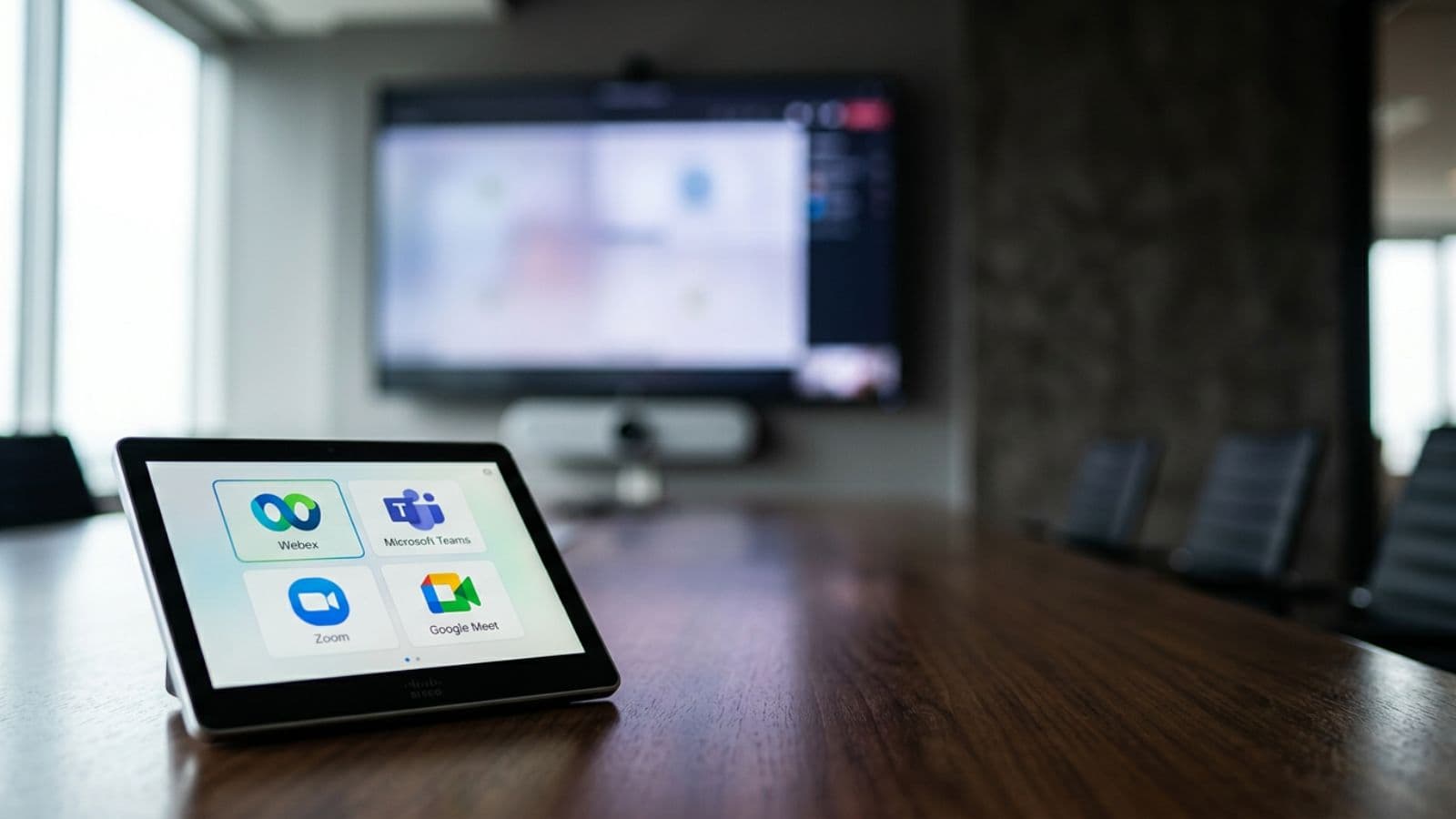
That is a problem for enterprises because most do not live in a single-platform world. Microsoft Teams, Zoom, Google Meet, Webex and other tools all appear across customers, partners, departments and regions. The room has to cope with that reality.
Logitech’s conversation with UC Today at InfoComm focused heavily on this point. The company framed AI-enabled rooms not just around smarter devices, but around rooms that work across the platforms enterprises actually use.
That is where the phrase “experience” becomes concrete. It means fewer failed joins, less user confusion, easier platform switching, more consistent device behaviour and simpler management for IT teams.
The Cisco and Zoom partnership was one of the clearest examples of this becoming a strategic issue rather than a checkbox.
With Cisco Devices for Zoom Rooms, Zoom-standardised organisations can use Cisco hardware while accessing a full Zoom Rooms experience. The partnership also brings Cisco device intelligence, edge AI, ThousandEyes diagnostics and workplace management capabilities into the discussion.
Espen Løberg, VP and GM for the Collaboration Devices business at Cisco, positioned the opportunity as broader than the meeting room:
“It also goes beyond what they can do now in their meeting rooms. It’s about what they can now do across their workplace, the other outcomes they can unlock with Cisco devices, built on top of the Cisco network, the Cisco Assurance capabilities, Cisco Spaces, Cisco Cloud Control.”
Jeff Smith, Head of Product, Workplace at Zoom, said the move was driven by customer demand: