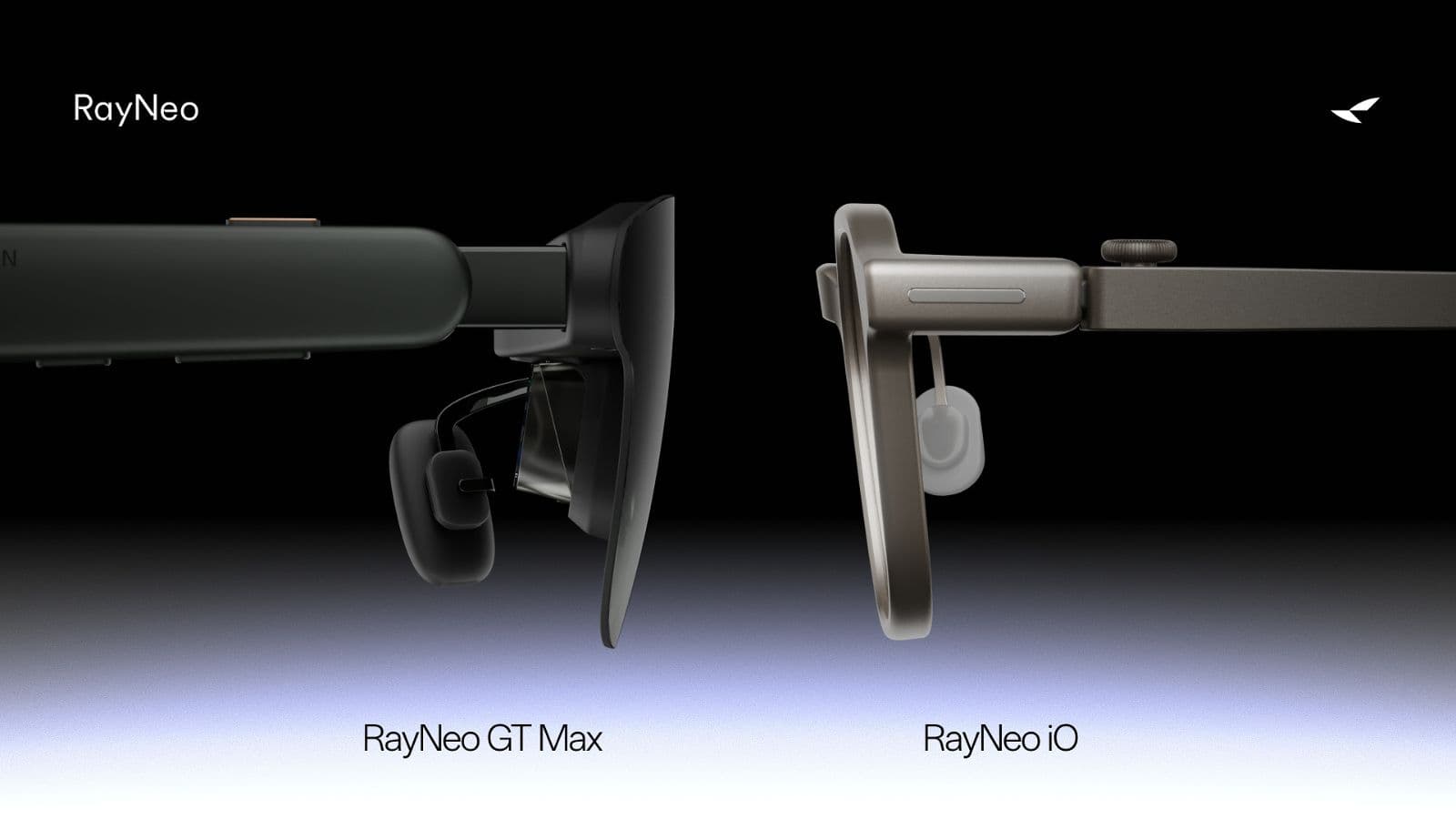
RayNeo is taking a different approach to the smart-glasses market with its new iO Smart Glasses: no camera, no speakers and no attempt to turn eyewear into a content-creation device.
Instead, the Chinese smart glasses company is pitching the 33g iO as an everyday, AI-enabled productivity tool. The glasses pair a small monochrome green display with voice capture and contextual AI features, targeting workers who want hands-free access to information without the social friction of wearing a camera on their face.
That distinction matters – camera-equipped glasses, including Meta’s Ray-Ban range, have drawn attention for their ability to capture photos and video discreetly.
RayNeo’s iO removes that concern entirely. It cannot record visual content, making it potentially easier to introduce in offices, meetings and customer-facing environments.
“RayNeo iO and the GT Series represent a fundamental commitment to purpose-built spatial hardware,” said Howie Li, Founder and CEO of RayNeo.
“Rather than compromising with a single device that tries to do everything, we designed two dedicated experiences: the iO as an invisible, all-day assistant for heads-up productivity, and the GT Series as an uncompromising personal cinema for travel and entertainment."
The iO display is designed for short, text-led interactions rather than immersive content. Users can view live captions, notifications, translation and teleprompter prompts through a 23.5-degree field of view. RayNeo says the display can reach 1,300 nits of brightness.
For workplace use, the key feature is likely to be transcription. The glasses include a quad-microphone array and a bone-conduction sensor intended to isolate vocal vibrations and improve voice capture in noisy environments. RayNeo says the iO can support real-time translation across 55 languages and 109 accents, with around one second of latency.
Audio AI Raises New Workplace Privacy Questions
The company is also introducing an “Ambient AI Productivity Suite,” which it says can listen to conversations, extract action items and suggest calendar updates.
Another feature, “Ambient AI Life Log,” is designed to build long-term contextual memory of users’ habits and workflows, enabling more tailored summaries and assistance.
This is where RayNeo’s privacy proposition becomes more complicated.
The iO may avoid the stigma associated with always-available cameras, but an AI device that continually captures and processes conversation audio presents a different challenge.
RayNeo says an LED indicator illuminates when recording or translation is active. Yet, for employers, the device would still require clear rules around when recording is permitted, how consent is obtained, where transcripts are stored and who can access AI-generated summaries.