
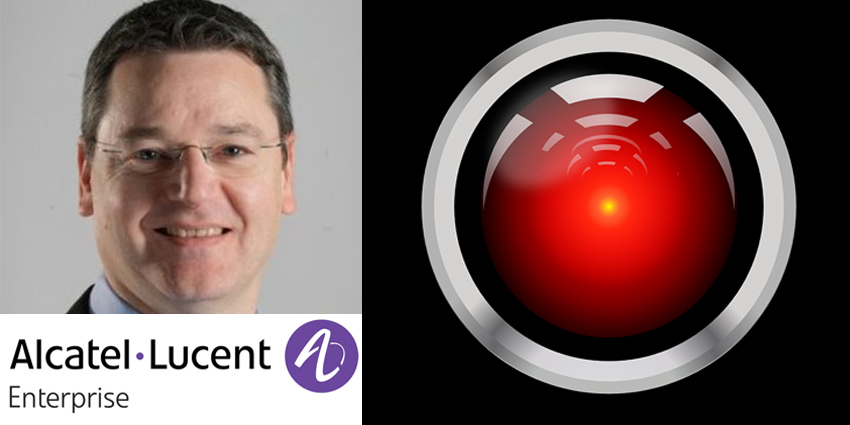
With the wave of personal assistants, such as Siri, Cortana and Google Assistant, and new startups leveraging AI and analytics to build personal companions, it’s becoming clear we are moving toward a new voice-controlled relationship with technology. As we have already seen in the consumer market, it is all but a given that these voice-activation systems will eventually make it into the enterprise environment, as the potential benefits of these systems could be tremendous in simplifying and automating activities. Craig Walker, Director Cloud Services at Alcatel-Lucent Enterprise, explains that, although it may be a long time before we see the full likenesses of “HAL” from “2001: A Space Odyssey”, the technology is already here that can improve the ways businesses operate.
Lights, camera, action!
Think how much easier it would be for a physician to just say “System: update Mary Smith’s chart with the following: “Patient experiencing abdominal pain, issue pharmacy order for 200mg of ‘SuperAntiGas’, signed Dr. FeelBetter.” Or in a conference room, instead of the struggle to figure out which remote control puts on the projector and the screen, a simple voice request “System: turn on projector, turn on TV and dim lights.”
The challenges
So, where are we on the road to voice-first? Voice analytics firm, VoiceLabs, has provided a view on the various layers needed to support a voice-first approach in the consumer world. However, to move from the simple consumer-based use cases to providing a more voice-first environment in the enterprise world, a few things will need to happen.
Security will be critical if we are to start having our enterprise systems relying on voice commands – should anyone be able to command critical equipment or systems just by speaking? The answer, clearly, is no. Privacy too is a top concern, and while the physician example above seems simple enough, we need to think about this in context of regulations. Are a patient’s rights – as per HIPAA regulations in the US – violated if these verbal commands expose the patient’s medical information to third parties?
Secure access
We are already seeing the next step of voice recognition systems where the technology is able to support secure access.
Banks are among those introducing voice authentication to their telephone banking systems. While this may leave some customers a little concerned over the security of their account, my feeling is that it will follow the adoption cycle we saw in e-Commerce where the initial concerns for credit card fraud needed to be overcome before we saw the meteoric rise in online purchasing.
We will continue to see continued innovation in voice recognition systems and improvements that will enable voice system security to be viable in an enterprise environment and ensure that only authorised users with the right privileges can perform the associated actions.
And whereas your microwave might not be spying on you, some devices will be always-on, always listening and potentially recording. A few well publicised cases of privacy invasion, commercial espionage or legal jeopardy could stall adoption. This suggests that a big On/Off switch or function needs to be included in voice-first products, so that users may get the benefits without risking the downsides of constant monitoring. Secure software access would also need to be in place in the products to prevent and detect hacking efforts.
Building even more effective voice recognition systems
The first use cases are primarily around voice response systems – whether from a call centre perspective or those implemented in our cars and smartphones. But as many of us know from firsthand experience, this works marginally at best. Recognition and contextualisation need to be refined through technological developments before we can realistically think about enterprise-wide adoption.
Research programmes such as Carnegie-Mellon University’s Sphinx project continue to enhance language recognition capabilities. An Internet Trends report by Mary Meeker indicated that in 2016, Google’s voice recognition system could recognise over five million words with around 90 per cent accuracy – but that’s still not extensive or accurate enough. Is 90 per cent accuracy good enough to interact with a life support system in a hospital or a utility provider’s network?


