
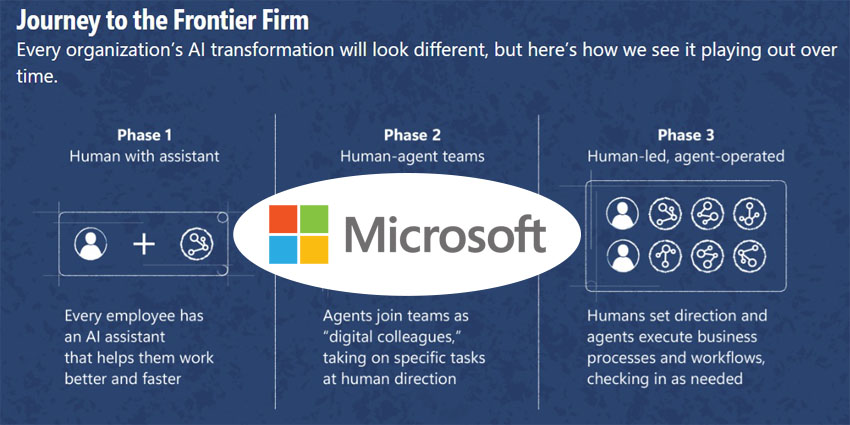
Microsoft has outlined its vision for the future of work as being typified by a new form of organisation—"Frontier Firms" built around complementary human-agent units, "intelligence on tap", and every worker adopting a new role as an agent boss.
Revealed as part of Microsoft's 5th Annual Work Trend Index for 2025, the Redmond-based giant conveyed several compelling trends and figures. According to Microsoft, 71 percent of employees at these Frontier Firm organisations believe their company is thriving, nearly double the global average of 37 percent. This stark contrast highlights the accelerating transformation in how work is structured and delivered worldwide.
In response to these changes, 82 percent of business leaders recognise 2025 as a defining moment to re-evaluate foundational strategies and operational models, signalling a widespread commitment to adaptation and innovation.
The Work Trend Index report reads:
As a result, a new organisational blueprint is emerging, one that blends machine intelligence with human judgment, building systems that are AI-operated but human-led. Like the Industrial Revolution and the internet era, this transformation will take decades to reach its full promise and involve broad technological, societal, and economic change."
For the 2025 Work Trend Index, Microsoft conducted a comprehensive analysis combining insights from 31,000 employees across 31 countries, real-time LinkedIn labour market trends, and what it calls "trillions of Microsoft 365 productivity signals". The company added that the research was enriched by conversations with AI-first startups, leading academics, economists, scientists, and industry visionaries to cultivate a multidimensional view of where work is heading and how organisations can prepare.
AI (Unsurprisingly) Dominates Microsoft's Work Trend Index 2025
Although Microsoft is hardly a passive observer in framing AI as the dominant force shaping the future of work, it's hardly wrong, and it presents multiple compelling arguments about how the technology is reshaping everything in the enterprise.
Microsoft stresses that on-demand intelligence is emerging as a critical growth driver amid growing economic and shareholder expectations. While more than half of business leaders (53 percent) say boosting productivity is imperative, four-fifths of employees report being too stretched to meet current demands.
Microsoft states that the average worker faces interruptions from meetings, emails, or chat notifications every two minutes, eroding focus and efficiency. To overcome what the vendor describes as the “Capacity Gap,” over four-fifths of executives surveyed plan to augment their workforce with digital labour over the next 12 to 18 months.


