Google is doubling down on extended reality, and this time it’s doing so with a familiar name in AR hardware.
The tech giant has announced a multi-year extension of its partnership with XREAL, officially naming the AR glasses maker a lead hardware partner for the Android XR ecosystem.
The move signals Google’s clearest push yet to bring Android XR beyond headsets and into lightweight, optical see-through smart glasses designed for both consumers and enterprises.
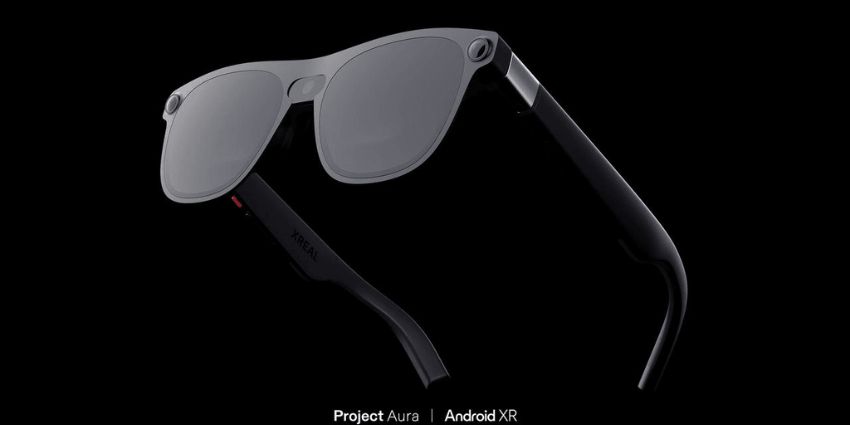
At the centre of the announcement is Project Aura, XREAL’s upcoming Android XR-powered AR glasses, slated for a consumer launch in 2026.
While Aura has been known for some time, Google’s renewed commitment elevates the device – and XREAL’s broader hardware roadmap –into a cornerstone of Android XR’s future.
Android XR Meets Optical See-Through AR
Android XR is Google’s answer to a fragmented XR landscape, aiming to unify augmented reality (AR), mixed reality (MR), and virtual reality (VR) development under a single platform.
Until now, much of the attention around Android XR hardware has focused on immersive headsets, with Samsung emerging as an early flagship partner.
By naming XREAL a lead hardware partner, Google is explicitly expanding Android XR into optical see-through devices – glasses that layer digital content directly onto the real world rather than blocking it out. This is a crucial distinction.
Optical see-through AR is widely seen as the long-term future of spatial computing, particularly for productivity, navigation, industrial workflows, and everyday wearable use.
In a joint statement, the companies said the extended partnership aligns XREAL’s “long-term hardware roadmap with the Android XR platform,” and commits both sides to bringing Android XR to wired XR glasses and other optical see-through form factors.
Project Aura: XREAL’s Flagship Android XR Glasses
Project Aura is shaping up to be the most ambitious device XREAL has built to date – and potentially the first optical see-through AR glasses to run Android XR.
The glasses feature a 70-degree field of view, the largest optical see-through display XREAL has ever delivered. That wider FOV is key for immersive mixed reality applications, enabling larger virtual workspaces, more natural media viewing, and spatial interfaces that feel less constrained.
Under the hood, Aura uses a distinctive split-compute architecture. The glasses themselves house XREAL’s proprietary X1S spatial computing chip, while a separate, tethered compute puck contains a Qualcomm Snapdragon XR2+ Gen 2 processor along with the main battery. This design allows XREAL to keep the glasses lightweight and wearable, while still delivering high-performance XR features.
The system supports 6DoF tracking, hand and eye tracking, and spatial mapping – capabilities typically associated with much larger headsets.
XREAL CEO and co-founder Chi Xu framed Project Aura as a milestone not just for the company, but for XR as a whole: