

Enterprises largely standardized on a handful of meeting, chat, and voice platforms, and Google never became the default UCaaS endpoint for most large organizations.
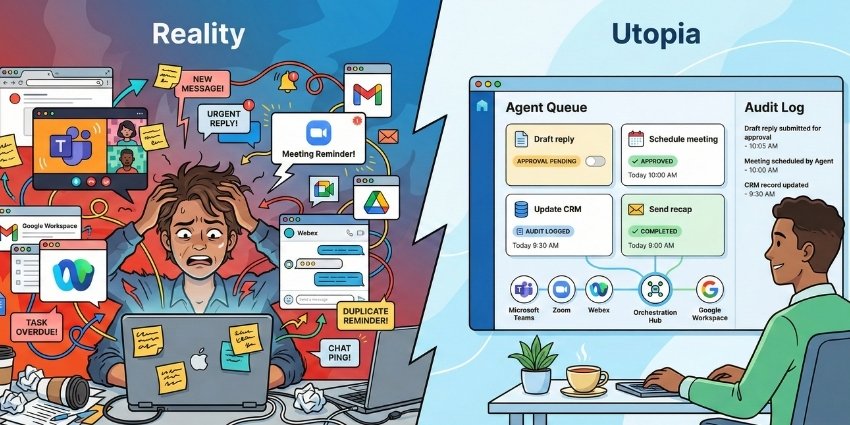
But the market is shifting toward agentic AI, where the new value is an orchestration layer that understands context and can take actions across tools—email, calendars, chat, meetings, and line-of-business systems.
That shift only works in production when data access, governance, and evaluation are solved—otherwise copilots stall after the demo.
If Google can make Gemini and agent workflows the layer that coordinates work across platforms, it can capture the highest-value outcomes layer while UCaaS becomes increasingly interchangeable infrastructure.
“Gemini Enterprise is designed on the premise that true business transformation in the era of AI must go beyond simple chatbots.” — Sundar Pichai, CEO, Google
Why Google’s UCaaS “Loss” Doesn’t Matter If Gemini Becomes the Control Plane
UCaaS procurement still looks familiar on paper.
You renew calling plans. You negotiate meeting licenses. You argue about room systems, PSTN, compliance recording, and the usual list of “must-haves” that change slowly and price aggressively.
But the behavior of work is changing faster than the behavior of procurement.
Agentic AI is pulling value away from the meeting grid and into the layer that can:
- understand the intent behind a message, calendar entry, or document
- find the right context across systems
- take multi-step actions (with guardrails)
- keep work moving without forcing humans to “swivel-chair” across apps
We're in a disruptive phase: the rise of agentic AI, where systems move from reactive prompting to proactive goal execution across applications, based on permissions and guardrails. In that framing, autonomy—not eloquence—is the differentiator.
So what would it look like for Google to “win” without winning UCaaS?
It looks like this: Google becomes the orchestration layer that sits across the tools your enterprise already standardized on.
In UC Today’s coverage, Gemini Enterprise is positioned as a subscription service aimed at embedding AI agents into enterprise workflows, including agents that can draw on data from tools such as Box, Microsoft 365, and Salesforce—without requiring coding.
Google Gemini Enterprise and Workspace Studio: The No-Code Agent Factory Strategy
Google is pushing two messages at once:
- IT wants governable agent rollout.
- Business teams want to build automations without waiting for IT.
Gemini Enterprise is pitched as the managed, subscription-based path to deploy agents across departments, with a governance story. UC Today highlights Model Armor as a safety layer that inspects/filters potentially unsafe or noncompliant prompts and responses—positioning it as a way to scale AI access while keeping centralized control.
Workspace Studio pushes the same concept deeper into the daily surface area of work. UC Today frames it as a no-code agent builder embedded into Gmail, Drive, Chat, and other Workspace apps, where users describe what they want and the system generates steps.
“With Workspace Studio, you can build agents in minutes… from simple tasks to complex workflows — no coding…” — Farhaz Karmali, Product Director, Google Workspace Ecosystem
Related Stories
- Google bets on AI agents to transform enterprise workflows
- Zoom claims AI crown with benchmark victory over OpenAI and Google
- Google Workspace pushes proximity automation and AI tooling in latest update
- Google launches Workspace Studio as firms push for practical AI automation
Zoom, Google, and the Fight to Be the Cross-App Work Surface
It’s tempting to treat “AI in collaboration” as a feature race: better summaries, better search, better meeting notes.
But the more revealing competition is architectural: who becomes the layer that routes work across everything else?
UC Today’s Zoom benchmark story is useful because it describes a federated approach where Zoom routes queries to specialized models from multiple providers based on the task, with deployment options tied to compliance requirements. It’s a strategy that implicitly says: the future isn’t one model; it’s orchestration.
“Our success reinforces a fundamental belief: the future of AI is collaborative, not competitive.” — Xuedong Huang, CTO, Zoom
Google’s strategy aims for a similar outcome via embedded agent creation and governance inside Workspace, while also messaging cross-suite connectivity.


