
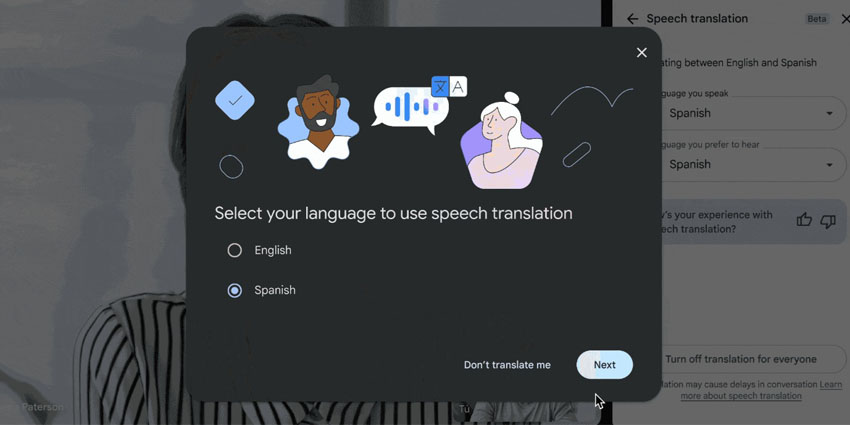
Following a successful rollout for desktop users earlier this year, Google has announced that bidirectional speech translation is launching on the Google Meet applications for iOS and Android. This update effectively turns the everyday smartphone into a real-time translator. This allows participants to speak in their native language while colleagues hear the translation on their mobile devices in real time.
At launch, the mobile feature supports bidirectional translation between English and five critical global business languages: Spanish, French, German, Portuguese, and Italian.
To maintain system stability and translation fidelity, Google has instituted specific architectural parameters for this deployment. Crucially, only one language pair can be active in a meeting at any given time. Furthermore, a limitation exists in hybrid environments that use dedicated conference room hardware. While users physically present in the room will hear the translated audio from remote participants, speech originating in the conference room will not be translated outward.
For IT admins, the deployment is intended to be frictionless, with the feature turned on by default but easily managed at the organizational unit level. The mobile rollout is currently underway, with Rapid Release domains seeing gradual visibility starting April 8, 2026, and Scheduled Release domains following on April 23. The capability is available across a premium range of Workspace tiers, including Business and Enterprise Standard and Plus, Frontline Plus, and various Google AI consumer and education add-ons.
- Beyond the Language Barrier: How Real-Time Translation Is (and Isn’t) Changing Video Conferencing
- Google Meet Launches Update to Better Screen Suspicious Bots
Building on the Google Meet Speech Translation Desktop Foundation
This mobile expansion closely follows the capability’s graduation from a limited alpha program to general availability for web users, which began on January 27, 2026. The underlying technology relies on advanced real-time speech-to-speech translation models that go far beyond traditional closed captioning.
"Unlike translated captions, which only display text, speech translation preserves the flow of conversation by creating an audio translation dubbed over the original speech that mimics the speaker’s tone and speaking cadence," Google's blog on the feature revealed.
This nuanced approach to audio dubbing is designed to maintain the emotional context and expressiveness of a conversation, which is naturally a vital component of complex business negotiations.
The Economics of Borderless Collaboration
From a market analysis perspective, the expansion of Google Meet Speech Translation to mobile endpoints may signal the maturation of AI from a generative novelty into a tangible, embedded operational utility. For multinational corporations, language barriers are not merely cultural hurdles. They are measurable macroeconomic drains that inflate third-party translation budgets, slow time-to-market, and introduce risk through miscommunication.


