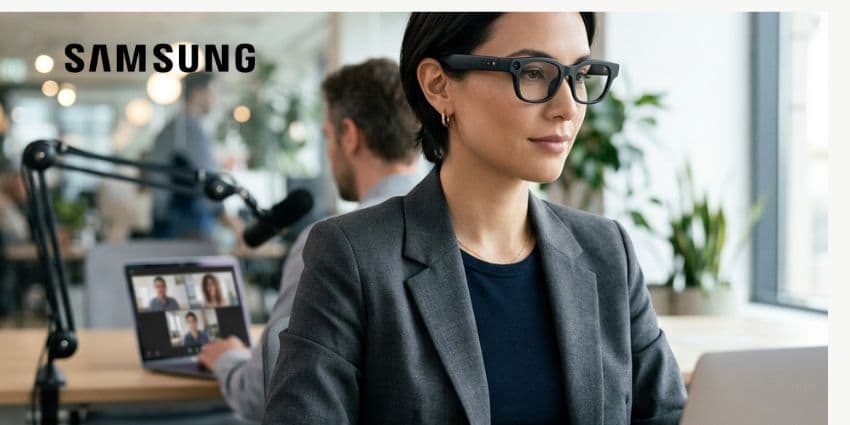
Samsung has offered its clearest look yet at the AI smart glasses it is developing with Google, Gentle Monster and Warby Parker, confirming a fall 2026 launch window for the first collections.
Shown at Samsung Galaxy Unpacked in London, the display-less glasses run Android XR and use Google Gemini for hands-free, context-aware assistance.
They can take calls, play music, capture photos and video, summarise messages, translate languages, support navigation and use the wearer’s point of view in Google Meet calls.
The announcement moves Samsung from preview and rumour into a more direct challenge to Meta, whose Ray-Ban smart glasses have established the early market for camera-and-audio wearables.
But for workplace technology teams, the bigger question is whether Samsung and Google can turn an attractive consumer device into a manageable collaboration endpoint.
AI First, Display Later
Samsung’s first glasses are not augmented-reality glasses in the traditional sense.
There is no display in the lenses, meaning there are no floating prompts, visual navigation directions or real-time subtitles placed in the wearer’s field of view.
Instead, Samsung is presenting the product as “intelligent eyewear”: an audio-first AI interface designed to reduce the need to pick up a phone.
The glasses use the Snapdragon AR1 Gen 1 platform, a chip built specifically for lightweight smart glasses, and connect to a smartphone for wider compute and connectivity. Users can interact through voice, touch-sensitive temple controls and connected devices.
Gemini is central to the pitch. Samsung demonstrated the glasses using the built-in camera to understand a whiteboard and organise its contents into Samsung Notes, while other cited use cases include summarising long messages, providing real-time translation, assisting with local navigation and helping a user follow a recipe.
For UC professionals, the most relevant feature may be first-person video in Google Meet. That could make the glasses useful in field work, inspections, support scenarios and other situations where an employee needs to show a remote colleague what they are seeing without holding a phone.
“As agentic AI reshapes mobile experiences, the next step is to make those experiences more intuitive and responsive to each user’s context,” said Won-Joon Choi, Chief Operating Officer of the Mobile eXperience (MX) Business at Samsung Electronics.
“Intelligent eyewear creates a new point of interaction, bringing more personalized AI assistance naturally into the moments that make up everyday life.”
However, Samsung has not yet explained how those experiences will be administered, secured or integrated into enterprise collaboration policies.
A Fashion-Led Bet on Wearability
Samsung has made eyewear brands a visible part of its strategy.
Gentle Monster brings a more fashion-forward aesthetic, while Warby Parker is expected to provide more familiar, everyday optical styling. Samsung and Google are betting that the success of smart glasses depends as much on whether people will comfortably wear them in public as on the quality of the AI experience.
Early hands-on reporting suggests the frames are relatively thin and light, an important consideration for all-day use. Samsung says the glasses will deliver up to nine hours of mixed use on a charge, with the case providing up to seven additional full charges.
That specification matters. Smart glasses will struggle to become a credible workplace tool if staff need to ration use between calls, AI queries, media capture and navigation. As ever, real-world battery performance—particularly when the camera and AI are used frequently—will be more telling than a quoted mixed-use figure.
Privacy Is the Enterprise Test
Samsung is also foregrounding privacy safeguards. The glasses include an LED indicator when the camera is active, and sensors designed to disable the camera when the device is removed or when the recording indicator is obstructed.
Those controls address a basic social concern around smart glasses: whether people nearby know they are being recorded. They do not, on their own, answer the governance questions that matter to employers.
Organisations considering camera-equipped AI wearables will need clarity on where image, audio and interaction data is processed and stored; whether Gemini requests can be governed through enterprise identity and data-loss-prevention controls; how recordings and AI-generated notes are retained, shared and deleted; and whether administrators can manage camera use by location, role or policy.
Samsung has said the glasses are intended to work within the Galaxy ecosystem, and reporting points to integrations with applications such as Maps, Interpreter and Samsung Notes. But there is no published enterprise management framework, data-retention policy or detailed breakdown of on-device versus cloud AI processing.
That is the gap Samsung will need to close before the glasses can move beyond individual experimentation in regulated or security-conscious environments.
Samsung’s Ecosystem Advantage
Samsung’s potential advantage over Meta is not merely hardware. It is the combination of Android XR, Gemini, Galaxy smartphones, Wear OS watches and potentially the Galaxy Ring.
Samsung is reportedly exploring gesture controls through watches and the Ring, while the glasses themselves can be controlled by voice and touch. If the experience works reliably, this could create a broader hands-free computing layer across the Galaxy ecosystem.
Google’s role is equally significant. Gemini can potentially do more than answer questions: it can understand visual context and take actions across apps. That makes the device more relevant to productivity workflows than a simple camera, headphones and voice assistant combination.
Still, Samsung is entering a market Meta already leads. CNBC reported that Meta held 69.2% of the smart-glasses market in the first quarter of 2026. Samsung has not announced pricing, a precise launch date, market availability, prescription-lens options or a detailed enterprise proposition.
The Bottom Line
Samsung’s Unpacked reveal confirms that AI glasses are becoming a serious new device category, even before display-equipped AR products arrive at scale.
For now, these are best understood as phone-connected, camera-and-audio AI wearables rather than full mixed-reality devices. Their value for enterprise collaboration could emerge in frontline communication, translation, remote support and contextual note-taking – but the practical barriers are significant.
The company has made a credible case that smart glasses can look like normal glasses. The next test is whether it can make them behave like an enterprise-ready endpoint.