

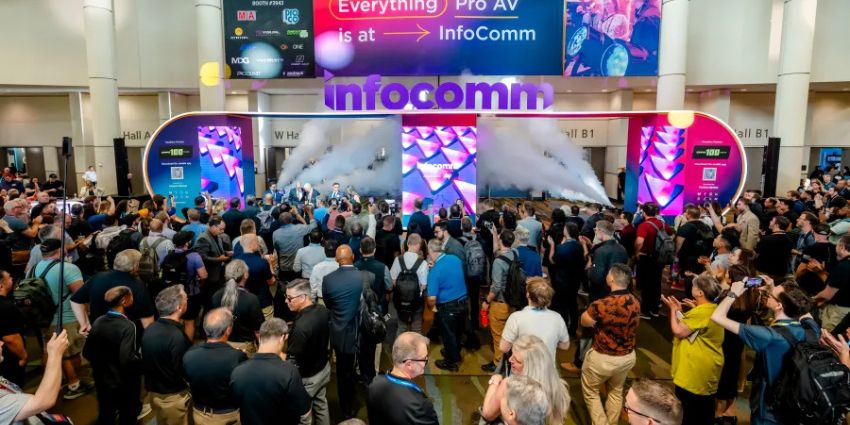
Each year, InfoComm brings together the pro AV and unified communications industry for a week that tends to set the agenda for the twelve months that follow. This year, however, the show lands at a particular moment of pressure. Vendors have spent the past few years talking about AI. Buyers are now asking what it actually does, what it costs to run at scale, and whether the hardware they already own can support it. As a result, those questions are baked into this year's programme from the keynotes down to the show floor activations.
InfoComm 2026 runs June 13–19, with the exhibit hall open June 17–19. AVIXA is expecting more than 30,000 attendees and over 750 exhibitors, making it the largest pro AV gathering in North America. For anyone working in enterprise collaboration, hybrid workplace technology, or AV integration, it is the one show worth building a travel budget around.
With that in mind, this guide covers the keynotes worth attending, the sessions worth protecting in your diary, the new show floor experiences built around real deployment, and the exhibitors you should not walk past.
The four big themes
AI in production. The debate about whether to adopt AI is largely over. The harder conversation, the one that will run through most of this show, is about running it reliably across thousands of rooms, endpoints, and dispersed workforces. Expect case studies over concept work.
Unified infrastructure. Beyond the AI layer, Cisco's headline vision, echoed by others, is that AV and IT can no longer be managed as separate disciplines. AVoIP, workplace analytics, and intelligent meeting features only work well when the underlying network and device stack are treated as a single platform.
Meeting equity. Ensuring that remote participants have a genuinely equivalent experience to those in the room has become a real design requirement. Intelligent cameras, adaptive audio, and AI-driven framing are the tools vendors will point to. In practice, the Smart Workplace Hub (more on that below) puts them in a live environment you can actually walk through.
Managing estates, not just rooms. Finally, a growing part of the conversation at this show is about what happens after installation: lifecycle management, remote monitoring, and firmware updates across hundreds or thousands of devices. Several sessions address this directly, and it reflects a maturation in how enterprise buyers are thinking about collaboration infrastructure.
Keynotes
Microsoft: Ilya Bukshteyn
Wednesday 17 June, 1:30–2:30 PM | Opening Keynote Corporate VP, Teams Calling, Devices and Premium Experiences
Session: "Exploring the Future of AI-Powered Collaboration and Connected Workplaces"
Bukshteyn's session is the one most people will be planning their Wednesday around. Microsoft has been trailing what it calls agentic AI: meeting systems that don't wait to be asked, but surface documents mid-conversation, assign action items in real time, and coordinate room systems (lighting, cameras, climate) based on what's happening in the meeting. Whether that lands as a product announcement or a roadmap preview is the thing to watch.
In terms of scope, the session covers the full Teams portfolio, from Teams Phone and Teams Rooms through to Teams Premium. Microsoft's argument is that software updates alone can't deliver this kind of experience. It has to be built into the physical environment. We've covered the direction Microsoft's AI features are heading in depth, and this keynote is where that roadmap meets the show floor.
Watch for: Concrete product availability over vision slides. Any Teams Rooms hardware partnerships or Teams Premium developments are worth noting. Additionally, the "agentic co-workers" language Microsoft has been using in pre-show materials is worth probing. Plenty of what gets announced on stage in Las Vegas doesn't ship until Q4 at the earliest.
Cisco: Espen Løberg
Thursday 18 June | Vision Stage, Booth C7872 VP and GM, Collaboration Devices
Session: "Connected Intelligence: Powering the Modern Workplace"
Løberg's keynote deals with a frustration that comes up repeatedly among enterprise IT teams: AV and IT infrastructure that evolved separately, now creating complexity and inconsistency across sites. Cisco's framing is Connected Intelligence, a converged architecture that brings together devices, networks, collaboration platforms, and AI under one management layer.
Also worth paying attention to is the partner list. Løberg will discuss work with NVIDIA, Microsoft, Zoom, Apple, and Samsung, which is Cisco's way of positioning Connected Intelligence as something that works regardless of which platforms a customer has already committed to. Cisco has been building this interoperability argument for some time, but whether it holds up in practice is a reasonable thing to investigate. We also recently looked at the Cisco vs Logitech question for enterprises weighing those two ecosystems.
Watch for: New Webex device announcements. The NVIDIA angle is particularly substantive: on-device AI processing, running inference in the room rather than routing it through the cloud, is where several vendors are competing seriously. Any specific interoperability commitments with Teams or Zoom will be of direct interest to customers running mixed environments.
Beyond the product keynotes: Mariana Atencio at the AVIXA Women's Breakfast
Thursday 18 June, 7:30–9:00 AM Peabody Award-winning journalist, author, and media entrepreneur
Session: "Authentic Leadership in the Age of AI"
Atencio is a journalist by trade and a good one. Her session is about leadership in organisations where AI is taking on more cognitive work, and she brings an outside perspective that the product keynotes don't offer. Sponsored by AVI-SPL, FORTÉ, and Q-SYS, the breakfast is primarily a networking event for the industry's women's community, though the subject matter travels well beyond that audience.
Watch for: Atencio tends to produce strong quotes. Her take on how AI is changing the way people manage and lead is likely to be the most human moment of the week.
New for 2026: The Smart Workplace Activation Hub
The Smart Workplace, powered by FORTÉ with Shure as the headline technology partner, is one of the more interesting additions to this year's show floor. Unlike a standard vendor booth, it's a functioning office environment: an executive boardroom, a huddle space, and a town hall configuration, all running live with real systems.
Shure's enterprise audio runs directly into the AI layers in Microsoft Teams and Cisco Webex. Intelligent camera framing, adaptive audio mixing, presence-aware lighting, and meeting analytics operate in real time across all three spaces. Crucially, none of it requires custom coding. You can walk in, see it working, and understand what it would take to specify something similar for a client.
The emphasis on workplace audio quality here is deliberate. The argument being made at this show, by Shure and by others, is that AI meeting features are only as reliable as the audio capture underneath them. Poor DSP means poor transcription, poor attribution, and limited value from every AI layer above it.
If you're attending the Microsoft keynote on Wednesday afternoon, therefore, visit the hub first. It gives you a practical reference point for everything Bukshteyn is going to describe on stage.
Priority session schedule
More than 100 hours of education run across the week. The sessions below are the ones most relevant to enterprise UC and collaboration. Sessions marked (Priority) are the ones to protect if the diary gets tight.
Monday 15 June — Pre-show
1:00–4:30 PM | HETMA Higher Education Summit, Day 1 (Priority) Location: W322–W324. Headline sponsors: Logitech and ScreenBeam. Higher education is a growing market for UC platforms and tends to get less coverage than enterprise. Good for context on campus-scale deployments and how institutions are approaching hybrid learning environments.
Tuesday 16 June — Pre-show
All day | Integrated Experience Tour: UNLV Dreamscape Learn (Priority) A 4,000 sq ft immersive VR learning environment with a 16-seat classroom, collaborative spaces, and a production studio. Register before you travel. It will fill and it's worth seeing: the scale of the AV deployment is genuinely impressive and makes good editorial context.
2:00–4:30 PM | NSCA Town Hall, Session PW03 Location: W303/W304. Speaker: Tom LeBlanc. The integrator community tends to have a more grounded view of the market than the vendors presenting on stage later in the week. What's actually getting specified and purchased is often a different story to what's being announced. Worth the time on Tuesday to calibrate.
Wednesday 17 June — Exhibits open
8:00–9:00 AM | AI-Powered Editing, Captioning and Translation Tools, Session PV02 Speaker: Luisa Winters. AI tools for accessibility and content creation are becoming standard in enterprise UC platforms, and this tends to be an under-reported area. Worth an hour.


