
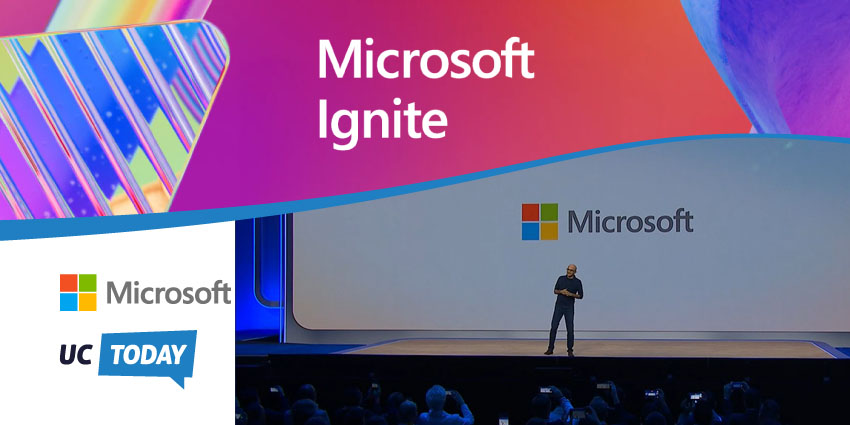
This week, at Microsoft Ignite 2024, CEO Satya Nadella unveiled a Microsoft future powered by and dedicated to advanced AI, focusing on innovations intending to reshape workplace productivity and collaboration.
His keynote highlighted major updates to Microsoft's product ecosystem, with a spotlight on the enhanced capabilities of Copilot, new Copilot devices, transformative advances in Azure AI, and other AI announcements. Nadella's vision is clear: a more connected, intelligent, and efficient work environment underpinned by AI.
Nadella and Microsoft Remain Steadfastly Committed To AI's Potential
"It's not about tech for tech's sake, but it's about translating it into real outcomes. Today, I want to focus on AI and this transformational power as it drives growth in business. It improves efficiency. It improves operating leverage. To do that, we are building our three platforms: Copilot, Copilot devices, and Copilot and AI stack. That's it. Those are the three platforms."
Nadella opens his keynote by observing the wider debate about AI and whether its scalability is plateauing. While Nadella says he welcomes healthy debate about AI in its "middle inning", as he describes it, he unsurprisingly disagrees before outlining Microsoft's three platforms: Copilot, Copilot devices, and Copilot and AI stack.
Nadella references Moore's Law, the notion that computer chips get faster, are more energy efficient and are more cost-effective to create at a predictable rate. specifically that the number of transistors in a chip roughly doubles every two years. He naturally compares this to AI before arguing that AI's progress has left Moore's Law in the dust and that "we are seeing the emergence of a new scaling law with test time or inference time compute". He says that AI is advancing roughly every six months.
Nadella's Law?
Nadella and Microsoft's Security Push After A Tough Year
"We continue to invest in security. You can see the updates we are making and the tons of announcements you'll hear about across the security stack. The one thing, though, I want to point out is that Purview is probably the product for this conference because, in the age of AI, data governance takes on an even more critical, central, and important role."
"In Purview, we're introducing updates to prevent everything from oversharing and risky use of AI, such as malicious intent detection, prompt injections, and misuse of protected materials."
Nadella's notable emphasis on security comes after a challenging year for Microsoft in that sphere. The digital world is still reeling from July's global IT outage, which was traced to a faulty update from cybersecurity firm CrowdStrike. Given that many Microsoft solutions were impacted, this incident initially panicked onlookers about a potential Microsoft-targeted mass cyberattack by bad actors before the cause could be confirmed as CrowdStrike’s own responsibility.
This time last year, Russian hackers penetrated Microsoft’s defences, gaining access to the email accounts of several senior leadership team members and stealing source code. The breach went unnoticed by Microsoft for nearly two months, with the intrusion only being discovered in January.
Then, in April, the US Cyber Safety Review Board (CSRB) asserted that Microsoft should have been better equipped to prevent Chinese hackers from breaching US government emails through its Microsoft Exchange Online software during the Storm-0558 cyberattack in July 2023.
To combat this, Microsoft is tying security efforts to the performance review of every employee and that it was linking the fulfilment of security goals with executive compensation in an expansion of its Secure Future Initiative (SFI), first announced last November. It has “the equivalent of 34,000 full-time engineers” working on its SFI project to significantly bolster its security infrastructure.
Nadella's highlighting of its security focus in his keynote, particularly around AI, appears to reinforce Microsoft's commitment to its security goals.
Copilot Is Undergoing An Evolution, Not A Revolution
"We think about Copilot adoption in three fundamental ways. The more employees use Copilot and Copilot agents, the faster they'll be able to realize value. A second aspect is how you ground Copilot or extend Copilot in your world, in your ecosystem. So Copilot is a platform you can extend with agents to scale what you can do, right? So if you have one employee, one Copilot, and one Copilot can have thousands, thousands of agents. And finally, it's about measuring ROI."
Microsoft's soft rebranding of Copilot as agents, or at least as a spinoff of Copilot, doesn't necessarily appear to be a radical overhaul from the fundamental productivity assistant Copilot was introduced as at last year's Ignite. It's a refinement of its purpose—an evolution rather than a revolution. It still intends to boost productivity and cut costs, but it does so with a more sophisticated and tailored skill set.
These include agents for SharePoint, Planner, and an Employee Self-Service Agent who addresses workplace policy questions. Meanwhile, specific to Teams, the Facilitator agent in Teams meetings takes real-time notes and shares key insights; it is currently in preview. Set for early next year, the Interpreter Agent will provide real-time translation in Teams.


