
With developments in technology moving at the pace they do, nothing stands still for very long anymore in the world of telecommunications. The old certainties have gone, and the market seems to be in a near constant state of disruption and flux.
It would be easy for old industry stalwarts like Canada’s Mitel to be left behind by the new order. As it is, Mitel has done just the opposite. By embracing all things IP, mobile and multi-platform, the one time telephony specialist has actually been in the vanguard of ushering in the Unified Communications era. $1bn in global revenues says it has made a pretty good fist of things.
And so we come on to Mitel’s MiVoice MX-ONE. Developed originally by Aastra, which Mitel bought in 2013, as an IP telephony server with a software-only option, Mitel now describes MX-ONE as “a fully integrated SIP-based communications solution.” Phrases like ‘voice’, ‘IP PBX’ and ‘telephony’ are conspicuous by their absence in Mitel’s marketing materials - instead, terms like ‘Unified Communications and Collaboration (UCC)’, ‘full-featured communications’’ and ‘multimedia’ come very much to the fore.
Mitel has also built considerably on Aastra’s original software-only deployment option. Nowadays, MX-ONE is primarily a software solution. If you want it to be run on a physical server, it can be. But central to the offering is the ability to run MX-ONE in the datacentre, in a virtualised environment, or as a cloud-based service.
With the MX-ONE, Mitel fully embraces software-based, cloud-ready SIP solutions. Amongst the benefits this offers customers, the company talks about MX-ONE ‘opening up’ the closed architectures of proprietary based systems, offering greater flexibility to adapt and rationalise communications systems than ever.
Mital also talks about the future facing possibility of SIP standards, how the ready integration of voice, IM, collaboration and especially video is what mainstream of business communication will look like in a few years. With the MX-ONE, could Mitel be preparing for the end of telephony’s reign as king of comms?
Here we’ll ask how opening up communications architectures can benefit the customer, and whether software focused options like MX-ONE really are paving the way for UC to overtake voice. As always, the views expressed in this review are solely those of the author only. UC Today does not endorse or promote any particular brands or products, offering a completely independent service to vendors, resellers and buyers in the UC industry.
How Does It Look?
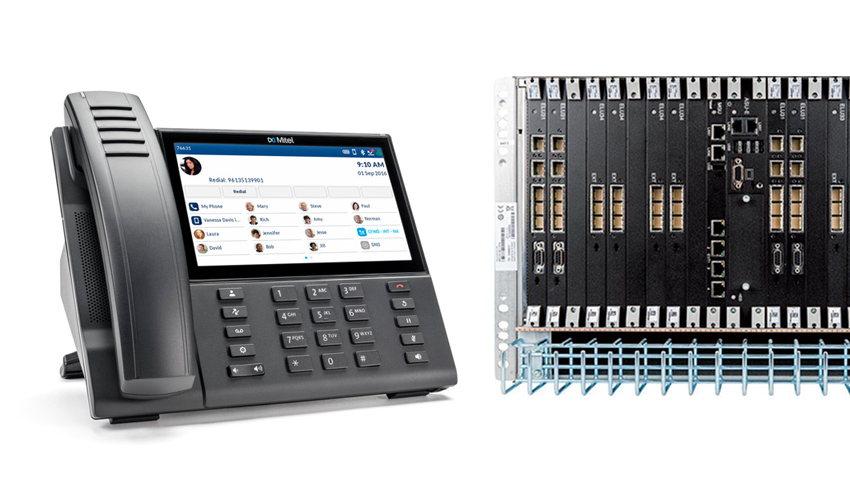
MX-ONE is available in hardware form in one of two classic 19” rack mountable PBX chassis originally developed by Aastra - the MX-One Lite, a 3U chassis, and the MX-One Classic, a 7U chassis. On their own, these chassis now only provide media gateway functions, but server functions can be added via one of two Intel-based server boards, the ASU or ASU Lite. The ASU can also be purchased as a 1U chassis without a media gateway, and there is also a separate, media gateway only MX-ONE 1U chassis,
What Can It Do?
At the core of the MX-ONE architecture is the concept of communications convergence - voice, video, text, collaboration and data shared together over a single network infrastructure, whether on premises or mobile, single site or distributed worldwide. Moreover, however you deploy MX-ONE solutions, it offers sweeping flexibility to configure and combine functions the way you want, with flexible application licensing.
MiVoice MX-ONE is made up of three distinct components - a MiVoice MX-ONE Service Node, MiVoice MX-ONE Media Gateway (hardware) / Media Server (software) and the MiVoice MX-ONE Management Suite. MX-ONE Service Node is the server software which drives the system. As a single configuration, it can support up to 15,000 SIP users and 15 media gateways. As a virtual server in VMware environments or when deployed as an SaaS solution, it can support up to 500,000 users.
The three available media gateway chassis all provide digital signal processing functions, including transcoding between TDM and IP/SIP telephones to offer backwards compatibility with legacy phone systems. The software media gateway equivalent, the MX-ONE Media Server, provides RTP media resources and manages protocol conversion between the likes of SIP and H.323, ensuring broad compatibility between a wide range of multimedia and multiplatform communication functions.
The MX-ONE Manager Suite provides three system administration consoles:
- MX-ONE Service Node Manager is a web-based interface for system administrators;
- MX-ONE Provisioning Manager is another browser-based GUI for users to manage applications and endpoints;
- Mitel Performance Analytics, which can be downloaded onto a datacentre or accessed via the cloud, offers proactive fault detection and performance management tools for the whole system.
[caption id="attachment_5638" align="alignleft" width="256"]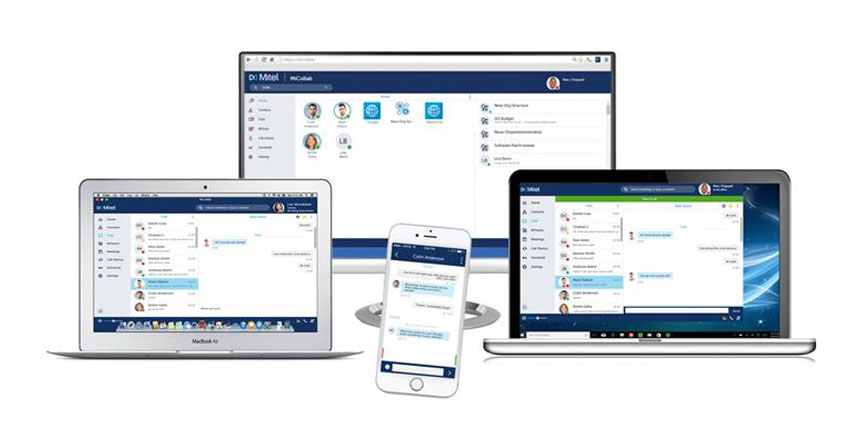 The Mitel MiCollab UC suite is among the software solutions which can be virtualised as part of the MX-ONE system.[/caption]
MX-ONE provides access to Mitel’s full suite of UCC software products, including MiCollab, MiCollab Audio, Web and Voice Conferencing, MiCollab Advanced Messaging, MiVoice Call Recording, Mitel InAttend and MiContact Centre Enterprise.
 Mitel 6940[/caption]

