
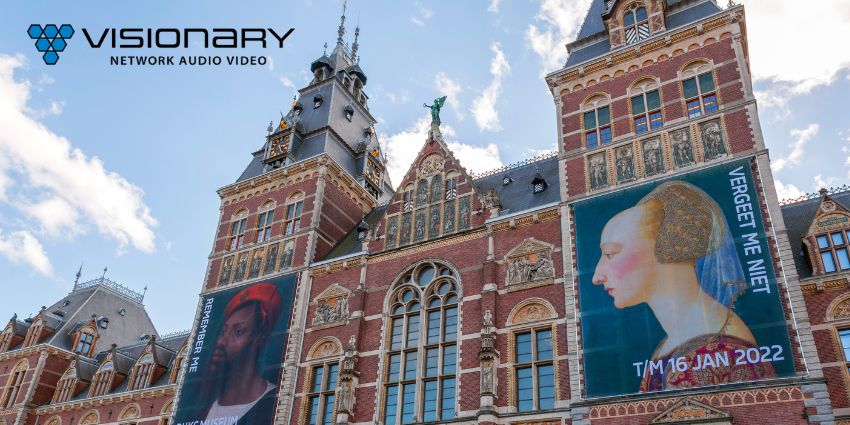
Rijksmuseum has introduced Visionary’s PacketAV Matrix Series as its central AV-over-IP solution to simplify user experiences.
- Sennheiser Solves Oxford University College’s Audio Challenge
- Crestron Modernises New York Giants’ Draft Room
- Crestron Releases New Wireless Touch Screen Controller
The audiovisual systems integrator, NFGD Audiovisual, was selected by the museum to modernise its auditorium legacy system and improve the AV quality of lectures, films, conferences, and performances.
NFGD Audiovisual collaborated with the AV designer and distributor IDM Solutions to assemble a solution that incorporated AV-over-IP alongside audio and video technologies.
In turn, IDM Solutions chose to implement Visionary’s PacketAV Matrix Series, plus 18 PacketAV Encoders and eight PacketAV Decoders that could be quickly integrated into existing network resources to distribute the multi-channel Dante/AES67 AV-over-IP.
Stephan van Veldhoven, Team Leader of Projects and Technology for NFGD Audiovisual, outlines the kind of audiovisual solution the museum was searching for: “Situated within this historic museum, famous for iconic artworks like The Night Watch, the Rijksmuseum’s auditorium attracts a diverse range of sponsors and clients who utilize the space for presentations.
“The auditorium, accommodating 200 people, serves as a venue for both internal meetings and corporate events.
“We were privileged to work on the auditorium project at the renowned Rijksmuseum.”
Van Veldhoven continued:
“The existing audiovisual system in the auditorium was outdated and required an upgrade. Our solution focused on providing intuitive control.
“They sought a setup where a single operator could manage the entire system efficiently, even during larger events requiring the support of a few technicians.”
Visionary’s PacketAV Matrix Series
According to van Veldhoven, this was the company’s first time integrating Visionary’s PacketAV Matrix Series Solutions for a customer. It had used Visionary demo kits in the past, but this was the first complete implementation of one of its products.
He describes the setup as having been “straightforward” and the overall performance for live productions was “reliable” due to the strength of its connection to the QSC system.


