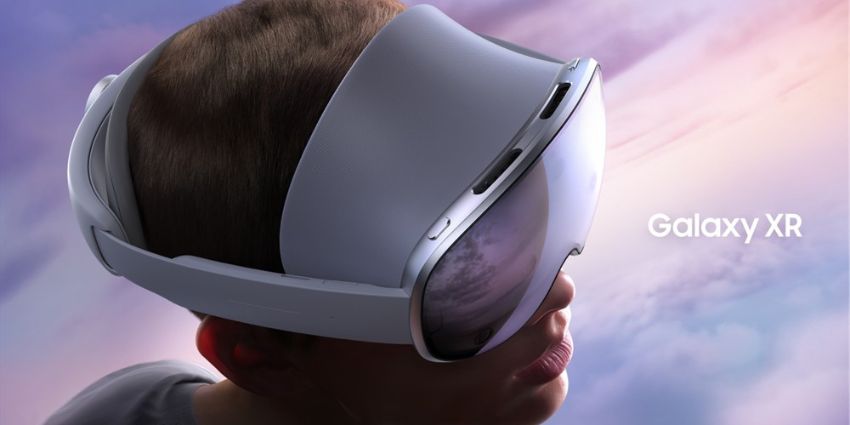
Samsung has finally thrown its hat into the mixed reality ring with the Galaxy XR, the first headset running Android XR, Google’s new operating system for spatial computing.
The timing is significant: Apple’s Vision Pro, intended to usher in a new era of headsets, stumbled with high prices and limited practical utility.
At $1,800 – roughly half the Vision Pro – Samsung is making a bold play for a more open, AI-powered alternative.
The Galaxy XR looks familiar: a large visor, multiple external sensors for hand and eye tracking, and an internal array for face and iris recognition.
“With Galaxy XR, Samsung is introducing a brand-new ecosystem of mobile devices,” said Won-Joon Choi, Chief Operating Officer of Mobile eXperience (MX) Business at Samsung Electronics.
“Built on Android XR, Galaxy XR expands the vision for mobile AI into a new frontier of immersive and meaningful possibilities, allowing XR to move from concept to everyday reality, for both the industry and users.”
"Galaxy XR gives you an infinite screen to explore your apps, with Gemini by your side," said Shahram Izadi, VP for Android XR, Google.
"It lets you switch between being fully immersed in a virtual environment and staying present in the real world, and you can navigate the interface naturally with your voice, hands and eyes."
AI at the Helm
Android XR borrows familiar elements from mobile Android, but adds depth with spatial AI and Gemini, Google’s context-aware assistant.
Voice commands work naturally – no wake word needed – and Gemini can organise apps, adjust settings, or surface information based on what you’re looking at.
The platform also blends the old and the new. Standard Android apps like Google Photos, Maps, and YouTube are fully supported.
Google Photos can turn flat images into layered, quasi-3D scenes, while Maps allows you to explore streets or businesses in stitched-together 3D spaces. YouTube gains a dedicated spatial tab for immersive 180° and 360° videos.
Under the hood, Samsung relies on Qualcomm’s Snapdragon XR2+ Gen 2, paired with dual micro OLED displays delivering 3,552 × 3,840 pixels per eye at 90Hz.
Not as fast as the Vision Pro’s 120Hz, but the sharper resolution and vivid colours make a compelling case for image quality.
Battery life runs two to two-and-a-half hours, with pass-through charging available.
Iris recognition simplifies logins, and built-in spatial audio rounds out the immersive experience.
The Galaxy XR doesn’t project your face externally like Apple’s, but that omission feels inconsequential; Samsung has clearly prioritised practicality over spectacle.
Communications and Collaboration
A distinguishing feature of Galaxy XR is its potential for remote collaboration. Gemini can organise multiple apps, surface relevant information in meetings, and support spatialized co-working scenarios.