
Before the arrival of Samsung Communications Manager, the OfficeServ 7000 series was the South Korean conglomerate’s flagship range of IP PBX servers.
The electronics giant conceived of the five units in the 7000 range as offering many things to the business telecoms market. For one, it envisioned delivering a continuous architecture of scalable platforms for four users up to 480 at a single site, with easy plug in continuity from one server to the next for multisite expansion.
It also placed a lot of stock in the OfficeServ 7000’s ability to integrate wireless and mobile technologies into an on premises telephone system, opening the door to the flexible communications of the future.
The OfficeServ 7200 is the middle product in the range, aimed at small to medium sized customers. With the 7200, Samsung really began to flex its muscles, offering high level VoIP and data convergence plus a broad range of UC features.
The positioning and offering behind the 7200 is straightforward - Samsung argues that it helps businesses to reduce the total cost of ownership of their telecoms systems by bringing everything together into a single, easy to manage unit. In addition, the ready integration with the rest of the OfficeServ range, with common modular network and software architecture, makes scaling up and extending to new branches straightforward and affordable.
Finally, the OfficeServ 7200 is billed as offering businesses the flexibility to run their communications systems as suits them. With hybrid support for IP telephones and legacy analogue and digital endpoints, the 7200 allows users to mix and match old hardware. And with in office WLAN support for wireless handsets, remote connections for IP phones and mobile integration, the OfficeServ 7200 promotes mobility for everyone - in the office, for working from home, and on the road operations.
In this review, we will unpick in detail exactly what the Samsung OfficeServ 7200 is capable of, what its best features are for growing small and medium sized businesses, and just how much flexibility it has on offer. Please remember, the views expressed in this review are solely those of the author. UC Today provides an independent news and insight service to the UK Unified Communications industry, and is not involved in endorsing or promoting any particular brand or product.
How Does It Look?
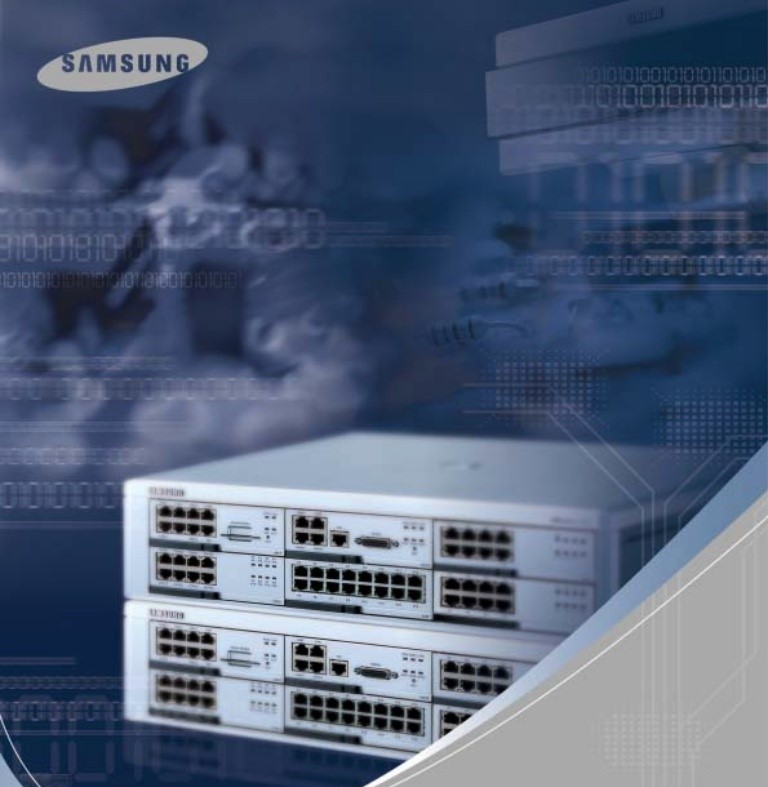
The Samsung OfficeServ 7200 phone system is packaged in a 19” rack-mountable silver chassis with a relatively high 5” front profile. This front panel is divided into six ‘virtual chassis’ slots, each containing a variety of extension and trunk ports, plus LAN, WAN and DMZ ethernet ports. A maximum of two chassis can be stacked together.
What Can It Do?
The converged features of the OfficeServ 7200 are intended to to offer an all in one solution for small to mid sized business telephony and data communication needs. The features offered include VoIP and TDM telephony, Unified Messaging Service (UMS) including voicemail, wireless communications, computer telephony integration (CTI) and data routing and switching functions. It functions as a SIP, mobile roaming and Authentication, Authorisation and Accounting (AAA) server, based on a Linux IP server platform.
As an IP PBX, a single OfficeServ 7200 deployment can support up to 128 users, which can be shared between IP, digital, analogue and wireless endpoints. There are 64 available SIP trunks, plus 60 trunks for SPNet networking, analogue or PRI digital. Licenses are required for all but analogue and digital deployments. In terms of supported desk phone models, the OfficeServ 7200 can be used to run Samsung’s SMT-i5343, SMT-i5243, SMT-i5230, SMT-i5210 and SMT-i3105 IP Phones, DS-5021D, DS-5014D and DS-5007S digital phones, or the SMT-W5120 WiFi phone.
The 7200 offers a comprehensive range of business class call handling and management features. It includes integration of Layer 2 and Layer 3 Quality of Service (QoS), ensuring high call quality alongside data communications through priority processing, Class based Queuing (CBQ) and on demand WAN management.
The web-based Unified Messaging Service (UMS) integrates TDM and IP telephone, email, voicemail and fax, allowing users to access all of their messages together wherever they are via an IP connection. Voicemail can be sent to email, and vice versa through Text-To-Speech Responses, which converts IM and email into voice so users can listen to them through their phones. Each OfficeServ unit supports up to 20 voicemail connections, which can be configured to group mailboxes and to deliver personal auto attendant services. Each voicemail connection offers large scale recording capacity.


