powering productive workplaces
Front page
NewsWorkspace Tech1 Dec 2025 · 3 min read

Shoei’s New Smart Helmet Shows How AR Could Transform Workplaces

Shoei’s new GT-Air 3 Smart AR helmet shows how HUD tech could support logistics, manufacturing and frontline workers.

Shoei smart helmet AR workplace transformation

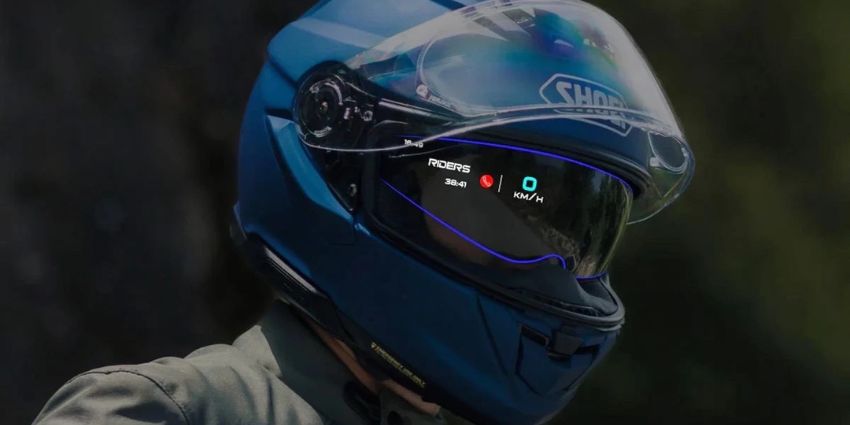
Japanese manufacturer Shoei has unveiled its GT-Air 3 Smart: a full-face helmet with a heads-up display (HUD) and integrated communications which may extend beyond motorcycling.

The helmet’s AR capabilities, safety certification, and hands-free communication could stretch to enterprise settings – from logistics and manufacturing to field service and frontline operations.

The devices hint at the future of wearable XR in professional contexts, where real-time data and safety are equally critical.

AR in Motion: From Roads to Worksites

The GT-Air 3 Smart uses a nano-OLED HUD embedded into the visor. It projects navigation, calls, and alerts at a distance of three metres.

For motorcyclists, this improves situational awareness.

In industrial or logistics settings, similar displays could overlay instructions, equipment status, or safety warnings directly into a worker’s field of view.

Early studies suggest that AR overlays reduce reaction times by more than 30 percent.

In warehouses, factories, or construction sites, a helmet HUD could reduce cognitive load. It allows staff to act on information without diverting attention to handheld devices.

The combination of the integrated HUD and long battery life – over 10 hours – makes continuous operation feasible for professional shifts.

Beyond AR, the helmet features a universal intercom system with mesh networking for offline or online operation.

It supports voice assistants such as Siri and Google Assistant and incorporates active noise cancellation.

In noisy industrial environments, this allows teams to coordinate in real time without handheld radios. As a result, both efficiency and safety improve.

Market Context and Enterprise Potential

Shoei’s entry into smart helmet technology comes amid growing interest in AR for workplace efficiency.

Competitors include Sena, whose Phantom helmet integrates Bluetooth intercoms, and Cardo, which provides similar communication features at a comparable price point.

Both lack AR HUDs, which highlights Shoei’s differentiation.

Other early entrants, like Skully and CrossHelmet, experimented with AR displays and cameras. However, issues with production scale and safety certification limited adoption.


Shoei’s GT-Air 3 Smart combines full DOT and ECE 22.06 certification with an integrated HUD, offering a product that is both market-ready and workplace-compliant.

Analysts note that enterprise adoption will depend on workflow integration.

Custom software and secure connectivity may be required to translate consumer-grade AR into actionable data in factories, logistics hubs, and field operations.

Nonetheless, the helmet illustrates the potential for consumer XR technologies to transition into industrial applications.

Strategic Significance for Enterprise XR

The GT-Air 3 Smart suggests a broader trend: consumer-grade AR devices can act as proving grounds for professional tools.

Organisations exploring wearable XR for training, task management, and remote collaboration could benefit from devices that combine safety, hands-free communication, and real-time visualisation.

In logistics, couriers could receive route updates and delivery confirmations without stopping or pausing their tasks.

In manufacturing or maintenance, technicians might access step-by-step guidance overlaid on machinery. They could also consult remote experts in real time.

For field services, HUDs could display schematics, sensor data, or work instructions directly in view. This may reduce errors and improve productivity.

The premium price – around US $1,199 – may initially limit widespread adoption.

Yet for niche enterprise applications, the combination of safety, AR, and integrated communications provides a compelling case for early trials.

Outlook

The device highlights the intersection of AR, wearable technology, and enterprise utility.

While its primary market remains motorcyclists, the helmet shows how consumer XR devices can influence workplace efficiency, safety, and connectivity.

As industries increasingly explore wearable AR, devices like the GT-Air 3 Smart may serve as a template for multifunctional enterprise gear.

The helmet’s integration of HUD, intercom, and certified protective shell points to a future where frontline and industrial workers rely on AR-equipped headgear to streamline operations and enhance situational awareness.

rate this story
helps rank stories across uc today
The discussion0 takes · attributed & checked

Does this reflect your experience?

opening the room…
Read nextordered by techtelligence · every pick explained
same beat · Workspace Tech

The 365-Day Stadium: How Crestron Powers Matchday at Espai Barça

12 Aug 2026
matches this topicMeta Glasses Face Growing Privacy Scrutiny Across Europe5 Aug 2026matches this topicSnap Q2 Earnings: CEO Says Its AR Glasses May Not Go Mainstream For Years4 Aug 2026