From automating meeting summaries to providing real-time language translation and intelligent call routing, AI copilots and assistants are becoming increasingly integral to modern business comms.
As organisations grapple with hybrid work environments and growing customer expectations, AI assistants offer a competitive edge—elevating efficiency while reducing manual tasks. However, questions around security, implementation, and user trust remain.
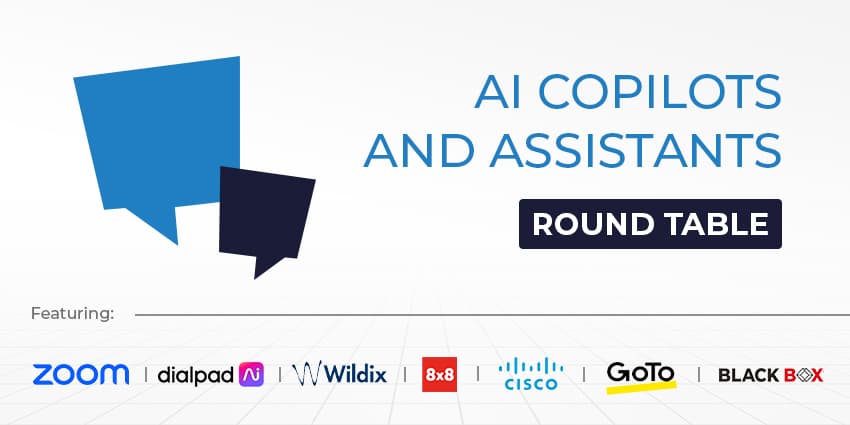
With our latest UC Round Table subject, “AI Copilots and Assistants”, we spoke with experts and executives from Zoom, 8x8, Wildix, Dialpad, Cisco, GoTo and Black Box about the hurdles businesses face when implementing AI copilots in their UC stack, how AI copilots can be designed to enhance the user experience, how IT and security leaders should approach governance, privacy, and compliance risks, and how they see AI copilots and assistants reshaping the future of UC and collaboration over the next five years.
What are the biggest technical and operational hurdles enterprises face when implementing AI copilots in their UC stack?
Jeff Smith, Head of Product - Workplace AI, Meetings and Spaces at Zoom
Smith suggests that when implementing AI, it’s important to have seamless integration across different communication tools and workflows without causing too much disruption.
"Additionally, organisations should make sure the AI can access the right data (with appropriate user access control), such as meeting data, to provide actionable insights, empowering employees to get more done," Smith added. "Operationally, leaders should focus on providing their employees with adequate training and change management to drive adoption."
"We've designed Zoom AI Companion to work natively within the Zoom Workplace app that users already love and trust, with no additional complex setup required."
Joel Neeb, Chief Transformation and Business Operations Officer at 8x8
Neeb asserted that for all that we read and hear of cutting-edge companies being in the cloud and fully SaaS enabled, the reality is that many organisations—especially in the public sector—are still using legacy systems that are on-premise or are from an earlier age when the tech was optimised for AI.
"That, right there, is a huge blocker to progress," Need said. “The first thing that should always be considered is cost vs. ROI, ensuring that AI copilots not only enhance collaboration but also improve productivity in measurable ways. That means doing your homework and research, both into your own business but also what solutions are out there and how partners can help.
"As we saw during the start of COVID, many organisations rushed into buying platforms that didn’t meet their needs and felt both operational and financial pain because of it. They can’t make that mistake again."
Neeb elaborated by arguing that AI copilots need to be able to access and analyse communication data across multiple platforms to achieve the best results.
Another technical hurdle he highlighted is latency and scalability. "For the best results, AI copilots must process real-time conversations without delay, which means high-performing cloud infrastructure and intelligent caching mechanisms," Neeb said. "These things need to be factored in when budgeting for AI usage."
“On the operational side, change management is a key issue. Employees and IT teams must be trained on AI-driven workflows, and leaders must set realistic expectations for adoption instead of just thinking that they just flick a switch that says 'turn AI on' and the job is done. You need to start small and build up, ensure data accuracy and don’t forget context: AI copilots must be trained on industry-specific terminology and organisational nuances to avoid errors.”
Emiliano Tomasoni, CMO at Wildix
Tomasoni outlines that one of the biggest challenges is data readiness and structuring.
"AI copilots are only as effective as the data they have access to, yet many businesses have disorganised, outdated or siloed information," he said. "Just as a new employee needs onboarding, AI copilots require well-documented processes and structured knowledge to deliver meaningful value."
Additionally, Tomasoni emphasised that businesses often struggle with integration across diverse ecosystems, as many AI copilots are closed ecosystems, forcing businesses to commit to a single vendor.
"A more scalable approach is to allow enterprises to use multiple AI models, whether leveraging privately hosted LLMs, third-party assistants like OpenAI, or a combination of different AI engines for different tasks," Tomasoni explained. "This approach gives businesses control over privacy, customisation and performance optimisation."
"From an operational standpoint, adoption and cultural change are equally critical," he continued. "While some organisations assume they need a dedicated AI team, the reality is that AI integration is a company-wide responsibility. AI copilots are most successful when knowledge management becomes part of everyone’s role, ensuring that employees contribute to keeping AI models updated, clean and effective."
Hilary Burcell, Product Marketing Director at Dialpad
Burcell affirmed that AI is only as valuable as the data it accesses, and software has the most significant impact when it supports an organisation’s key use cases.
"This means that teams must focus first on integration and scalability when incorporating AI agents into collaboration workflows," Burcell said. "How does AI fit into your tech stack from a use-case perspective?"
Secondary considerations Burcell underlined would include change management and cost management. "How long will it take for employees to learn to use AI, add it to workflows, and realise benefits?" she suggested. "Is the cost of using the AI copilot greater than the benefits you expect to realise? Every copilot has a different onboarding process and pricing structure that will impact your company’s ROI."
"Finally, any AI solution needs to meet high standards of trust. Is data kept secure and private? Are compliance standards met? These fundamental software requirements must extend to AI."
Ben Receveur, Director of Product and Solution Architecture, Modern Workplace Technologies, at Black Box
For Receveur, one of the biggest hurdles in AI implementation is ensuring data quality.
"Accurate, complete, and properly formatted data is crucial for the effectiveness of AI systems," Receveur said. "Another significant challenge is the complexity of integrating AI with existing systems, which can be technically demanding and resource-intensive."
"Additionally, there is a high demand for specialised AI skills, making it difficult to find and retain the necessary talent. Successfully implementing AI also requires managing organisational change and securing buy-in from all stakeholders."
Mark Rankin, DSE at Cisco
Rankin conveyed that successfully implementing AI copilots in an enterprise environment requires tackling several critical challenges.
"A top priority is addressing data security concerns," Rankin expanded. "AI copilots manage large volumes of sensitive and proprietary information, making it essential for organisations to implement strong safeguards to protect their intellectual property and prevent both internal and external breaches."
Rankin suggested that next comes access and control: "It is essential that AI copilots provide the right features and privileges to the right users, with comprehensive audit trails to ensure a transparent and compliant usage environment."
"Lastly, there’s a need for education and training," he added. "AI copilots will only deliver value if users understand how to make the most of them. Enterprises must invest in equipping employees with the skills to unlock the full potential of these tools, as adoption can stall if users are unclear on how these systems can benefit their workflows."
Joseph George, General Manager of IT Solutions Group (ITSG) at GoTo
George asserted that one of the biggest hurdles for enterprise teams aiming to deploy AI copilots is overcoming siloed data and ensuring broad data accessibility.
"AI copilots rely on access to resources like chat logs, meeting transcripts, customer histories, and other information to function effectively," he said. "However, this becomes particularly challenging when the data is spread across disparate UC tools. At the same time, granting access to this sensitive information introduces potential concerns around data privacy and regulatory compliance."
"To mitigate the risk of security breaches during copilot implementation, enterprises need to enforce robust access controls, ensuring data is protected from leaks or any actions that could compromise privacy."
How can AI copilots be designed to enhance the user experience for knowledge workers, frontline employees, and IT teams?
Joseph George, General Manager of IT Solutions Group (ITSG) at GoTo
Goerge affirmed that when AI copilots are deployed alongside IT teams, they play a valuable role in eliminating mundane admin tasks and providing live data analysis and insights.
"For example, AI copilots can help streamline the reporting process following a remote support session," George said. "Traditionally, after a session has ended, the IT agent has to summarise ticket resolution steps before they can close the ticket and potentially create or update a knowledge base article to track the activity and resolution."
"AI copilots can take on this task, automating the process and even resolving future issues based on the developed knowledge base article, which frees up time for IT professionals and provides actionable insights for team members on a faster timeline."
Mark Rankin, DSE at Cisco
Rankin highlighted that today’s AI copilots are built using foundational LLMs, with precise tuning, prompt engineering, and incorporation of mechanisms like retrieval-augmented generation (RAG) and guardrails. "However, these technologies are still evolving. At Cisco, we see a huge opportunity in tailoring AI copilots to align with the diverse needs of specific roles and industries," Rankin caveated.
"For instance, what a knowledge worker requires — such as drafting documents or building presentations - differs greatly from the priorities of a healthcare frontline worker," he continued. "To address this, future solutions will involve leveraging multiple models within the same organisation, including custom LLMs trained on verified, industry-specific datasets."
Looking ahead, Rankin suggested we will see a world where enterprises have the "flexibility to securely integrate and scale AI copilots from multiple vendors, ensuring secure, role-specific solutions that adapt to the unique needs of users – whether that be knowledge workers, frontline staff or IT professionals".
Joel Neeb, Chief Transformation and Business Operations Officer at 8x8
Neeb stressed that it’s vital for copilots to be sold to people from day one as something that is making their lives easier but is not there to replace them.
"I’m a firm believer that people probably won’t lose their jobs to AI, but there is a very possibility they could lose their jobs to someone else who is using AI and using it well," Neeb elaborated. "Show, don’t tell, the benefits. AI copilots must blend into existing workflows, providing assistance in a way that is seamless and non-disruptive while also learning and improving over time based on user behaviour."
Neeb also emphasised that AI copilots must be context-aware, proactive, and intuitive to drive real value for different user groups.
"For knowledge workers, copilots automate meeting summaries, provide real-time transcription, and offer contextual recommendations—such as surfacing relevant documents or past discussions to streamline decision-making. But this is barely scratching the surface of what these tools are capable of and provide marginal value if they’re only utilised to summarise conversations. There’s so much more to them."
Neeb added that the real value comes when AI helps us interact with data dynamically, ask better questions, and uncover trends—not just summarise.
"For example, at 8x8, we are extracting insights from all of our customer interactions to better serve the business needs they are pursuing," he explained. "AI augments every activity within our organisation, and we’re delivering exponentially more exciting outcomes because of the thought partnership we’ve integrated with our AI tools."
“For frontline employees, AI copilots should focus on accessibility and speed. Features like voice-to-text commands, sentiment analysis, and automatic ticketing can help field workers, retail associates, and customer service reps stay productive without manual data entry."
Neeb stressed that IT teams need AI copilots that reduce administrative overhead by automating common troubleshooting tasks, detecting anomalies in network performance, and providing proactive security alerts. "AI can also enhance self-service capabilities, helping employees resolve routine IT issues without submitting tickets," he continued.
Jeff Smith, Head of Product - Workplace AI, Meetings and Spaces at Zoom
Smith asserted that organisations should look for AI that’s purpose-built for different users and use cases.
"For knowledge workers, Zoom AI Companion provides meeting summaries, content generation, scheduling help, and more," Smith outlined. "For frontline workers, our forthcoming AI Companion-based Zoom Workplace for Frontline will offer mobile-first tools for on-shift communications and work management capabilities, including push-to-talk, shift swapping, task management, and shift summaries."
"Having a consistent, easy-to-use interface across collaboration modalities (meetings, chat, documents, etc.) is essential to reducing complexity and increasing adoption, and IT teams can benefit from AI-powered admin dashboards that provide usage insights and system health monitoring."
Emiliano Tomasoni, CMO at Wildix
Tomasoni affirmed that effective AI copilots must feel like experienced colleagues rather than technical tools.
For this to happen, Tomasoni outlined that three things are key. First is good and clean data. "AI copilots need accurate, structured and industry-specific data to provide meaningful insights," Tomasoni argued. "Poor data quality is a bottleneck for AI adoption, and many companies underestimate the effort required to clean and maintain their knowledge bases."
A second factor is context-aware AI: "The assistant should understand the industry, the user’s workflow, and common pain points. A contact centre agent, a retail associate and an IT manager all have very different needs. AI copilots should customise responses based on role and context rather than providing one-size-fits-all assistance."