Most of us have seen people go quiet in meetings for reasons that had nothing to do with confidence. They try to speak up and stop mid-sentence because they’re not sure if anyone can hear or understand them.
That’s why it’s odd how meeting equity conversations tend to drift straight to cameras. Visuals matter if you want an inclusive workplace. But workplace audio technology is what decides whether people stay in the conversation at all. When audio quality slips, participation slips with it.
That’s how we end up with a workplace where 43% of remote employees and 44% of hybrid employees don’t feel included in meetings. The tech is silencing them, not management.
We don’t usually say it out loud, but audio quality is already sorting people in the workplace. Some voices cut through. Others struggle. And over time, that difference shapes who gets noticed and whose ideas carry weight.
Related Articles:
Which Workspace Tech Is Worth Buying in 2026?
Why AV Systems Are Key for Meeting Equity – and How They Actually Work
Five Proven Workspace Technology Use Cases That Deliver ROI
Is Workplace Audio Technology Just Microphones and Speakers?
A lot of companies still have a pretty simplistic view of what “workplace audio technology” actually is. It’s more than just the ceiling microphone in a boardroom or a video bar on the wall. It’s the full chain of sound people rely on to do their jobs without friction, and that chain stretches across the entire workday. The better way to look at it is as three overlapping layers.
The “Me Space” Technology
Headsets. Speakerphones. Laptop mics. Docks. Bluetooth connections that work flawlessly one day and completely betray you the next. This is where most hybrid calls really take place, at desks, kitchen tables, hot desks, and spare bedrooms.
Thanks to BYOD, personal devices have become the front door to enterprise meetings, which explains why workplace audio quality varies wildly even inside the same team.
The “We Space” Tech
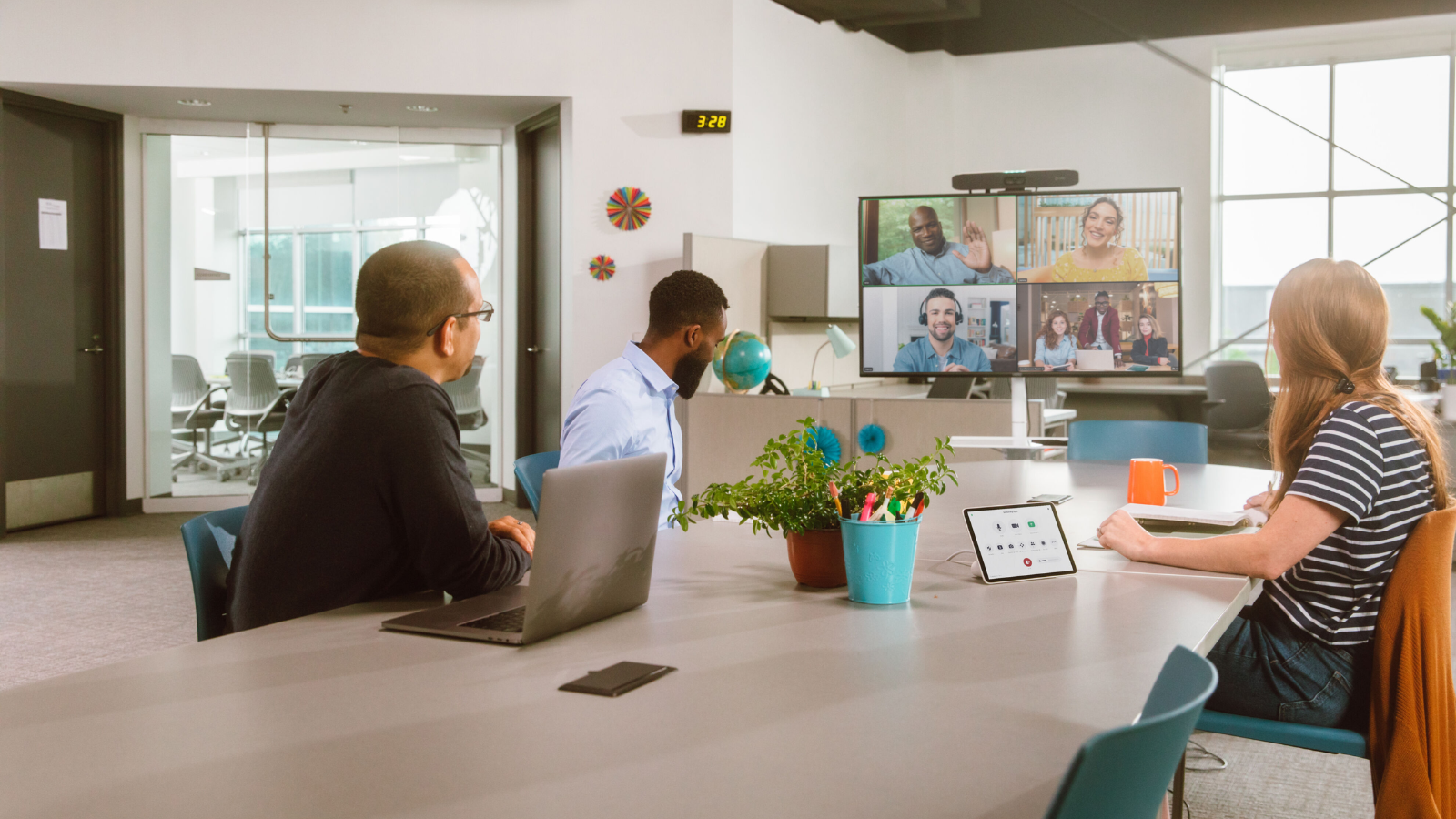
Meeting rooms. Huddle spaces. Training rooms. Ceiling microphones. Table mics. DSP boxes. Speakers. Video bars. Displays with built-in mics and speakers. This is the layer IT usually focuses on, because it’s visible and budgetable. In collaborative spaces, better room audio doesn’t just help remote listeners, it stabilizes conversation flow for everyone.
The In-Between Spaces No One Designs For
Open offices. Phone booths. Hallways. Shared desks. Places where people take calls anyway, even when the acoustics are working against them. This is where hybrid work audio solutions frequently succeed or fail.
Microsoft’s research shows employees are interrupted roughly every 1.75 minutes, and 57% of meetings are ad hoc, often scheduled minutes before they start. That reality makes audio quality optimization a workplace system problem, not a room-by-room upgrade project.
Why is Workplace Audio Technology So Unpredictable?
Honestly, in most workplaces, audio tech isn’t really “unpredictable”; we just notice the failures more. Video can freeze, and people will tolerate it. Audio glitches force people to work harder just to stay involved.
Most audio failures are small and cumulative. A voice sounds distant. Someone else sounds too loud. Two people talk at once, and neither backs down because they can’t hear the overlap. Ten minutes later, half the group has mentally checked out.
There’s a predictable set of failure modes behind it:
- Microphones favor whoever sits closest, creating instant “room bias”.
- Untreated spaces introduce echo and reverb that no amount of volume fixes
- Bluetooth headsets drop, reconnect, then distort
- BYOD setups default to the wrong mic or speaker, and nobody notices until it’s awkward
- Ad hoc meetings start immediately, so troubleshooting never happens
People don’t raise their hand and say, “The signal chain is compromised.” They just stop trying.
The trouble is that meetings aren’t really set up to be audio-first.
Owl Labs found that 29% of remote participants can’t tell who’s speaking in hybrid meetings. PSNI-backed research shows nearly half of employees disengage when audio distractions pile up, and 60% say conversation flow breaks down once cross-talk starts.
Here’s the key problem: users can’t self-fix this. They can’t tune room acoustics, rebalance mic pickup, or stabilize a flaky endpoint mid-call. So they adapt socially instead, by speaking less.
How Does Workplace Audio Technology Affect Hybrid Meetings?
When workplace audio quality drops, the damage isn’t limited to comprehension. It shows up in who speaks, who gets interrupted, and whose ideas get picked up and carried forward. Audio shapes perception long before anyone labels it a “tech issue.”
There’s solid research behind this discomfort. Studies from Yale and USC, often grouped under “Zoom bias”, show that speakers with degraded audio are judged as less competent, less credible, and less likable, even when the content is identical. That’s brutal. Same ideas. Same preparation. Worse sound. Different outcome.
Shure has pointed to physiological data that makes this worse: low-quality audio raises stress markers like heart rate and muscle tension. Translation: people aren’t just annoyed. They’re working harder to listen, decide when to jump in, and figure out if they’ve been heard. Over time, they burn out.
There’s also a cost here that never shows up on an outage report. Meetings that run long because people repeat themselves. Decisions that stall because half the group missed a key point. Follow-up meetings scheduled just to “make sure we’re aligned.” This is experience debt, and it compounds.
These problems almost never stop work in its tracks. They stretch it. Meetings run a little longer. Decisions need another pass. Eventually, people start sidestepping the tools they’re supposed to use. “Just call me.” “I’ll send a voice note.” “Let’s talk after.”
The impact isn’t evenly spread. It hits remote employees, quieter contributors, non-native speakers, and neurodiverse team members first. In rooms labeled “hybrid-ready,” old hierarchies slip back in through sound. In-person voices take over. Remote ones start to fade out.
Realistically, inclusion isn’t about presence. It’s about access. If the channel makes you sound uncertain, delayed, or hard to follow, your influence shrinks.
Why is the Workplace Audio Technology Problem Getting Worse?
Audio isn’t stagnating; it’s under more pressure than it’s ever been. More meetings, more devices, and more automation listening in. The margin for error is shrinking fast.
Is AI Raising the Stakes for Workplace Audio Technology?
Yes. Unequivocally.
Meetings aren’t just conversations anymore. They’re inputs. Transcripts feed summaries, action items, compliance logs, and performance records. When workplace audio quality slips, the downstream damage multiplies.
AI assistants only work if they “hear every word.” Better audio improves transcription accuracy and speaker identification. Miss a sentence, and it’s not just a human who misses it. The system does too.
That’s how audio quality optimization turns into an equity issue. If the system hears you poorly, your contributions don’t just land weaker in the room. They disappear from the record.
Why Is Intelligence Moving Into the Signal Chain?
Because software can’t rescue bad sound.
Vendors are redesigning hardware itself, with AI noise cancellation at the endpoint (Yealink), mic-driven speaker detection tied to multi-camera systems (Crestron), and standardized audio stacks for scale (QSC).