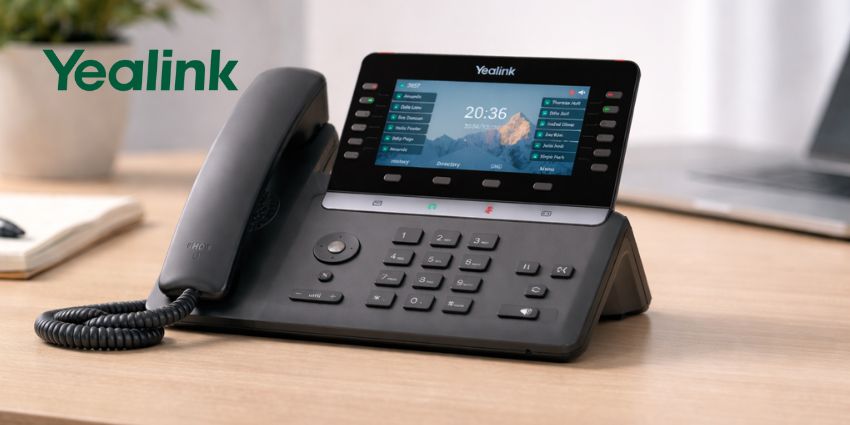
Yealink has introduced its new T7 and T8 desk phone series, adding a redesigned security framework, AI-based noise cancellation, and a refreshed interface aimed at organisations adapting to long-term hybrid work.
The update is one of the most significant changes to Yealink’s desk phone lineup in several years, reflecting a market that is shifting toward higher security standards and smarter audio performance rather than away from physical devices.
“We consistently heard the same three issues from customers: tighter security, clearer audio, and smoother coordination between devices,” said Dawson Cai, VP of Product at Yealink.
Updated Hardware for Changing Enterprise Environments
The two series share the same software foundation but serve different environments.
The T7 line is positioned as the standard device for offices and hybrid desks, while the T8 series introduces more advanced hardware features for public or regulated spaces.
The invisible hinge – a design that allows for wider, clearer viewing angles – and a dedicated emergency button on select T8X models highlight Yealink’s intention to address scenarios where visibility and rapid response matter, including healthcare, education, and public service touchpoints.
One of the more notable engineering shifts is the introduction of AI-based noise cancellation, marking Yealink’s first major move away from traditional DSP algorithms.
Instead of simply reducing background noise, the AI model is trained to distinguish human speech from environmental sound.
This aligns with a broader trend in enterprise audio, where vendors are experimenting with machine learning models at the edge to handle unpredictable acoustics in open-plan offices and hybrid environments.
“In open offices, background noise is the number one complaint,” Cai said.
“The AI model helps isolate human speech with far greater accuracy than earlier approaches.”
Wi-Fi 6 support and a new Device Mode – which lets the phone act as a connected peripheral for PCs and headsets – are an indication of how Yealink expects desk phones to function more as part of a wider ecosystem rather than standalone endpoints.
Security Rises Up the Agenda
Security has become a defining theme across the communications hardware market. With endpoints now spanning meeting rooms, open desks, and home offices, buyers are increasingly applying the same scrutiny to phones as they do to laptops and mobile devices.
Yealink’s new Three Rings framework is its response to that shift.
The model introduces protections at boot level, network level, and communications level, including secure boot, firmware integrity checks, 802.1X, WPA3, SRTP media encryption, and TLS 1.3.
It’s part of a broader industry move toward multi-layered security, driven by zero-trust strategies and regulatory expectations across sectors such as finance, healthcare, and government.