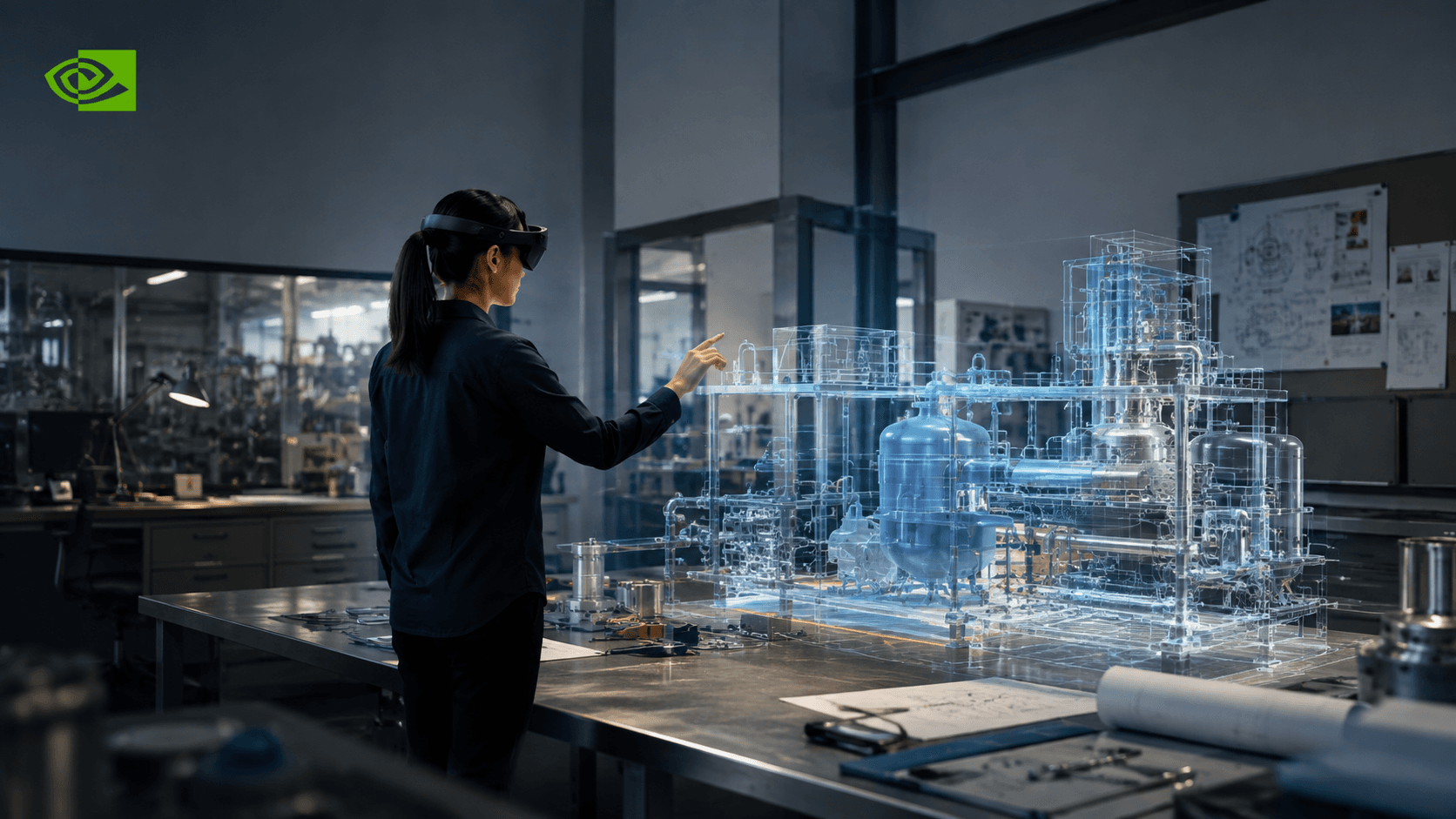
NVIDIA made Omniverse free for production use in July 2026 and is pairing it with CloudXR streaming and a new XR AI framework, betting that enterprise XR infrastructure for factories, labs, and frontline work matters more than another meeting-room headset play.
NVIDIA might seem like it’s putting most of its eggs into the same AI basket right now, but it still has something brewing on the XR side of things. It’s just not as loud about it.
In July 2026, NVIDIA made Omniverse free for production use. That means you can develop XR experiences and redistribute them without the old NVIDIA AI Enterprise subscription requirement. A production path once tied to cited pricing of $4,500 per GPU per year suddenly looks a lot less painful.
That doesn’t, however, mean that NVIDIA’s following the same path to the immersive workplace as everyone else. Look at what the company has actually been doing lately, and you’ll see a lot of overlap between both AI and XR. Physical AI, simulation, industrial digital twins, streamed spatial computing, and AI-guided work.
So, is NVIDIA building a workplace XR product? Or is it actually building the Enterprise XR infrastructure layer underneath the use cases that actually matter: factory planning, lab design, automotive reviews, data center twins, surgical support, and frontline guidance?
Related Articles
TL;DR — Is NVIDIA's XR Roadmap Built for the Immersive Workplace?
- Licensing got cheaper: Omniverse is now free for production use, down from a subscription once cited at $4,500 per GPU per year.
- The delivery problem is solved: CloudXR 6.0 streams heavy 3D workloads to headsets, browsers, and Apple Vision Pro, already used by BMW, Kia, Roche, and Foxconn.
- What's missing: NVIDIA hasn't published Enterprise Support pricing for XR AI, or a graduation date out of public beta.
What Changed in NVIDIA's Omniverse Licensing in 2026?
The licensing change: Omniverse is now free for production use and redistribution, down from a subscription once cited at $4,500 per GPU per year, but formal enterprise support still requires a paid license.
If you're still not familiar with Omniverse, it's the computing platform companies can use to build virtual worlds, digital twins, and training environments, bundled with AI. It lets AI agents, developers, and designers collaborate in real-time through 3D tools.
In 2026, NVIDIA changed the terms behind this toolkit so that users can access Omniverse for development, production, and redistribution without buying a subscription. The old route could mean $4,500 per GPU per year, $22,500 per GPU perpetual, or metered GPU-hour pricing through cloud marketplaces, and that's before accounting for XR content creation extras.
Now, it's worth saying that formal enterprise support does still sit within an enterprise license. Without that, teams get forums and Discord. That's perfectly fine when an engineer is testing a workflow. It's a different risk profile when a factory walkthrough, lab simulation, or design review becomes part of daily work.
Still, this is an interesting roadmap signal. NVIDIA likely made Omniverse easier to adopt because the infrastructure around enterprise XR is one of the main things that separates a real immersive workplace strategy from a failed one.
Too many companies still burn money trying to rebuild the office in VR. New headset, same old meeting logic. NVIDIA's roadmap avoids that mistake.
- Omniverse now drops the production license fee, after previously being tied to reported pricing of $4,500 per GPU per year.
- Formal enterprise support still requires a paid license; without it, teams only get forums and Discord.
What Is NVIDIA Omniverse Actually Used For In The Enterprise?
The technical backbone: OpenUSD, PhysX, and RTX rendering tie Omniverse to robotics, physical AI, and industrial digital twins — and NVIDIA has now extended it into its own AI factory reference architecture.
In the enterprise, Omniverse is usually the tool used for building simulated versions of physical environments, from factories to production lines. Places where a bad layout, missed defect, or late design change costs real money.
OpenUSD helps teams move 3D data between tools. PhysX adds physics behavior. RTX rendering and sensor simulation help create synthetic data for AI training. That's why NVIDIA keeps tying Omniverse to robotics, autonomous vehicle simulation, inspection models, and physical AI.
NVIDIA made Omniverse easier to access, while the surrounding demand points toward GPUs, RTX workstations, AI factories, and Enterprise XR infrastructure.
In March 2026, NVIDIA extended Omniverse straight into that AI infrastructure layer itself. The NVIDIA Vera Rubin DSX AI Factory reference design and the now generally available Omniverse DSX Blueprint let builders create physically accurate digital twins of entire AI factories.
Siemens, PTC, Schneider Electric, Switch, and others are already building it into their own platforms. GE Vernova and Hitachi are using the same reference architecture to plan grid capacity for new AI factories. Phaidra's DSX Max-Q-based cooling agent gives data centers a claimed 10% lift in usable compute without asking for more power. These are vendor-reported figures, not independently audited results, so treat them as directional rather than proven.
- OpenUSD, PhysX, and RTX rendering are the technical backbone tying Omniverse to robotics and physical AI.
- Omniverse sits inside NVIDIA's much larger AI infrastructure push. NVIDIA CFO Colette Kress told analysts in May 2026 that AI infrastructure spending is on track to reach $3 to $4 trillion annually by the end of the decade.
- NVIDIA's March 2026 Vera Rubin DSX reference design and Omniverse DSX Blueprint use the same digital twin stack NVIDIA relies on for its own AI factories, with Siemens, PTC, Schneider Electric, Switch, and Vertiv already building around it.
UC Awards 2026 Categories Announced
UC Today has announced all 25 categories for the UC Awards 2026, recognizing excellence across workplace technology, collaboration, CX, AI, and employee experience.
Explore the full UC Awards 2026 category list
Does NVIDIA CloudXR 6.0 Support Immersive Workplace Use Cases?
The delivery mechanism: CloudXR 6.0 renders heavy 3D workloads on RTX systems and streams them to headsets, browsers, and Apple Vision Pro — already in use across automotive, life sciences, and manufacturing.
NVIDIA CloudXR, announced in March 2026, goes after the bit buyers usually hit too late: enterprise 3D content doesn't fit neatly on the device.
A car model, lab layout, factory twin, airflow simulation, or full-scale design review isn't going to behave nicely just because someone strapped on a headset. NVIDIA CloudXR 6.0 renders that workload on RTX systems, then streams it to headsets, browsers, and Apple Vision Pro.
That changes the buying conversation. The headset is only the front end. The harder question is where the horsepower sits: workstation, cloud GPU, data center, or some messy mix of all three.
The Apple Vision Pro examples are already interesting. Autodesk VRED and Innoactive are being used for automotive design review with BMW Group, Kia, Rivian, and Volvo Group. Roche is using Autodesk Revit, NVIDIA Omniverse libraries, and CloudXR for lab layout simulation. Foxconn has factory-floor walkthroughs. MHP is using it for real-time aerodynamics work. Switch is visualizing an NVIDIA Omniverse Digital Twin of its AI factory infrastructure. Each is a named customer highlight rather than a published case study with measured before-and-after results, so the scale of deployment behind each name is still unclear.
NVIDIA's XR case is getting harder to dismiss. It isn't selling immersion as a party trick. It's giving heavy 3D work a cleaner route to the people who need to inspect it. Buyers still need bandwidth, latency control, GPU capacity, and device rules. At least the workflow is evolving.
- CloudXR 6.0, announced in March 2026, moves the rendering to RTX systems, then streams complex 3D work to headsets, browsers, and Apple Vision Pro.
- Current use cases include automotive design work at BMW, Kia, Rivian, and Volvo, lab simulation at Roche, and Foxconn factory walkthroughs.
What Is NVIDIA XR AI, and Why Does It Matter For Workplace Devices?
The next layer: XR AI is a public-beta developer framework for multimodal AI agents inside AR and XR devices, tied to Metropolis, NeMo Retriever, and Nemotron — exciting for pilots, unproven for regulated deployment.
NVIDIA put NVIDIA XR AI into public beta in June 2026. It's a developer framework for building multimodal AI agents into AR glasses and XR headsets. The agent can take in video, audio, depth, pose, and sensor data, then connect that context to enterprise tools, models, and knowledge sources.
That's genuinely useful, because workplace XR devices need to do more than display a model. A headset in a lab, factory, or operating room has to understand what the user is seeing, what step they're on, and what information should appear without burying them in prompts.
NVIDIA is tying NVIDIA XR AI to Metropolis for visual understanding, NeMo Retriever for enterprise retrieval, Nemotron reasoning models, Cosmos Reason, and its June 2026 Agent Toolkit. So, we're getting AI agents that can see the physical task and help inside the workflow.
Siemens is looking at factory engineer support. LabOS, built by Rana, runs on all kinds of glasses from Rokid, VITURE, and Meta, which matters for buyers wary of hardware lock-in.
VITURE Helix, the first device built on XR AI, adds a 12MP first-person camera, four-microphone array, and 60+ minutes of battery life, aimed at wet-lab, clinical, and life-sciences workflows.
This pushes enterprise XR infrastructure closer to real work. Still, buyers need to keep their heads on. Public beta belongs in a limited pilot, not inside every hospital, factory, or field team by default.
- XR AI entered public beta in June 2026, bringing multimodal agents into AR and XR devices through video, audio, depth, and sensor inputs.
- Siemens is testing it for factory support, LabOS for gene-editing workflows, and UPMC's Surreality Lab for surgical assistance.
- VITURE Helix, announced in June 2026, brings that approach to $600 industrial safety glasses.
Is your immersive workplace strategy solving a real problem, or giving everyone one more system to manage? Find out here.
Does NVIDIA's Immersive Workplace Roadmap Match Buyer Needs?
The evidence: Manufacturing case studies and Deloitte's 2026 adoption data suggest genuine operational pain sits underneath the pitch — though the customer wins are still individual highlights, not audited outcomes.
NVIDIA doesn't automatically become the best XR or immersive collaboration partner for every company based on these updates. Still, it's becoming a more valuable option for places where mistakes have a bigger price tag.
Manufacturing gives NVIDIA the kind of evidence XR vendors usually wish they had. Pegatron cut model training and deployment time by 67% with synthetic data from NVIDIA's Defect Image Generation skill. Delta Electronics improved excess soldering defect detection by 17%. Foxconn lifted first-pass yield by about 3%.
Deloitte's 2026 State of AI in the Enterprise report adds another perspective. It found 58% of companies already use physical AI in some form, with adoption expected to reach 80% within two years. Deloitte expanded its NVIDIA alliance the same year around digital twins, computer vision, and edge robotics.
That's why NVIDIA Omniverse digital twin work feels more credible for factories, labs, data centers, automotive design, healthcare, and industrial training. There's real operational pain underneath the pitch.
The hardware side gives buyers something concrete. RTX PRO Blackwell brings up to 96GB of memory and up to 4,000 AI TOPS to workstation and server-class systems. NVIDIA lists up to 2x previous-generation RT-core performance. SoftServe reported up to 3x productivity gains with AI models, NVIDIA Omniverse, and industrial copilots.
- Pegatron cut deployment time 67%; Delta Electronics improved defect detection 17%; Foxconn improved yield ~3%.
- RTX PRO Blackwell delivers up to 2x rendering performance; SoftServe reports up to 3x productivity gains.
- Deloitte's own research puts physical AI adoption at 58% today, projected to reach 80% within two years, per its 2026 State of AI in the Enterprise report.
Where Does NVIDIA's Roadmap Fall Short For Enterprise XR Buyers?
The gap: No published Enterprise Support pricing, no stated GA date for XR AI, and open governance questions around the sensor data XR devices capture.
The biggest weak spot for now is packaging. NVIDIA Omniverse gives builders a serious foundation, but enterprise buyers don't buy foundations. They buy outcomes, support paths, admin controls, rollout plans, and someone to call when the workflow breaks.
NVIDIA CloudXR 6.0 puts pressure on the plumbing. RTX capacity, bandwidth, latency, network resilience, endpoint management, and security all have to be sorted before the experience feels dependable. NVIDIA XR AI sits earlier on the maturity curve. It's exciting for controlled pilots. It's harder to justify in regulated or safety-critical work until buyers can see the logs, permissions, review process, and failure plan.
XR governance and security could be another gap. XR devices capture rooms, voices, gestures, gaze signals, hand movement, and video. The Apple Vision Pro alone has 12 cameras, five sensors, and six microphones. That is a lot of workplace data walking around on someone's face.
There's also a simpler omission to keep in mind. NVIDIA cut the price of entry for Omniverse, but it hasn't told us what paid Enterprise Support will actually cost once a workplace XR project stops being a pilot, or when NVIDIA XR AI is due to graduate out of public beta. That contrasts with how enterprise XR and AI platforms are typically brought to market: support tiers and pricing are usually published alongside the platform itself, not held back until a pilot scales into daily use.
Compare that to the CloudXR and RTX PRO side of the roadmap, which comes with named partners, dated releases, and measured results. The support and governance side of the story doesn't get the same treatment. That's the test worth applying to any roadmap, not just NVIDIA's: not only what's been announced, but what's been left conspicuously undated.
One read is that this is ordinary sequencing, since support terms often trail technical GA. But NVIDIA priced and dated Omniverse and CloudXR well before either was fully mature, so withholding the same treatment from XR AI and Enterprise Support looks more like a deliberate choice than a scheduling gap.
- Packaging is the weak spot: no published Enterprise Support pricing, and no stated GA date for XR AI.
- XR devices capture heavy sensor data (Vision Pro alone has 12 cameras, 5 sensors, 6 microphones), raising governance questions.
Should Workplace XR Buyers Choose NVIDIA and Omniverse?
The verdict: Worth serious evaluation if your workplace problem has physical, operational, or financial weight — not a fit if all you want is a nicer meeting room.
NVIDIA's technology roadmap is definitely getting more attractive for anyone interested in immersive work. It's worth looking at if your workplace problem has physical, operational, or financial weight.
Design reviews that delay production. Factory layouts that cost millions to change. Lab workflows where a bad setup wastes weeks. Data center planning. Robotics testing. Inspection models. Training that needs muscle memory, not another PDF.
It may not be the thing you're looking at if all you want is a nicer meeting room.
The 2026 roadmap points somewhere specific: Enterprise XR infrastructure tied to simulation, streamed 3D workloads, physical AI, and assisted frontline work. NVIDIA CloudXR 6.0 handles the delivery problem. NVIDIA XR AI hints at the next layer, where headsets and glasses guide people through real tasks.
For some companies, this could be exactly what a serious 2026 immersive workplace strategy looks like, provided the pricing and support gaps close before rollout, not after. Treat Enterprise Support pricing and a firm graduation date for XR AI as open questions until NVIDIA publishes them, rather than assuming they will land on your timeline.
Check out our upcoming Best Immersive Workplace Solution awards to see how that case stacks up against the rest of the field.
Frequently Asked Questions
How should buyers measure ROI from NVIDIA's immersive workplace roadmap?
Measure work before and after the deployment. For NVIDIA Omniverse projects, useful KPIs include design-cycle time, rework avoided, inspection accuracy, training time, escalation rates, layout approval speed, and downtime reduction. Headset usage shouldn't be the only metric you're looking at, it needs to connect to a real operational result.
Which teams should be involved before an Omniverse rollout?
Don't let the pilot team make all the decisions. IT, security, operations, facilities, engineering, procurement, accessibility, and legal need a seat before Enterprise XR infrastructure touches real work. Buyers need answers on RTX compute, network performance, OpenUSD content, identity controls, support ownership, training, and data handling.
Do buyers need Apple Vision Pro to use NVIDIA CloudXR 6.0?
No. NVIDIA CloudXR 6.0 supports a wider device plan through OpenXR, browsers, headsets, and server-rendered experiences. Apple Vision Pro gets attention because the design review and digital twin examples are strong. XR AI already works across Meta, Rokid, and VITURE glasses too, so buyers shouldn't assume one hardware path. The real story is remote rendering for high-fidelity spatial work.
What should buyers ask NVIDIA partners before committing?
Ask who owns support, content conversion, OpenUSD workflows, device management, security review, and post-launch measurement. A partner demo of an NVIDIA Omniverse Digital Twin is useful. Ask specifically what happens once XR AI graduates out of public beta, since pricing and support terms could shift. A delivery plan with timelines, SLAs, rollback paths, and named business KPIs is far more valuable.
What would make NVIDIA's roadmap stronger for workplace XR buyers?
Better enterprise packaging. Buyers need reference architectures for NVIDIA CloudXR 6.0, clearer control guidance for NVIDIA XR AI, and partner-led deployment models that cut down custom build work. Published Enterprise Support pricing and a firm GA date for XR AI would answer the two biggest buyer doubts. NVIDIA has the technical depth. The purchase path still feels too much like an engineering assignment.