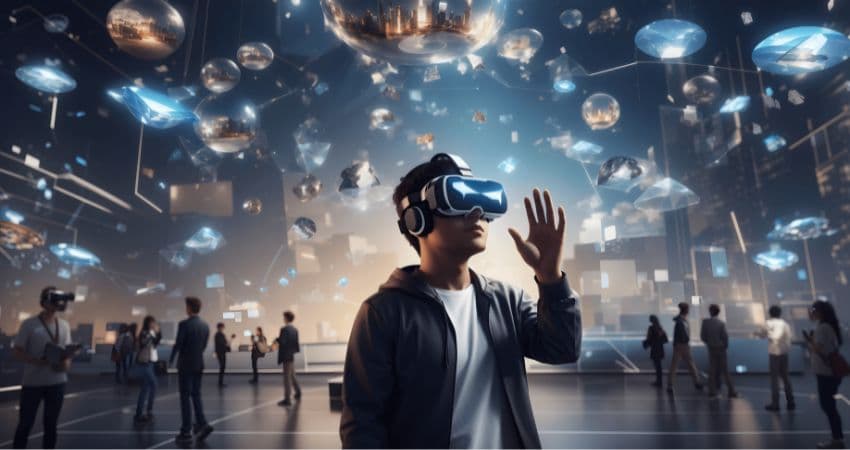
Immersive training is finally getting judged like a business system. The question isn’t whether VR corporate training looks impressive. It’s whether an immersive training platform can move workforce outcomes you can defend in a boardroom: faster time-to-competency, safer performance, higher consistency, and better retention of critical skills.
That’s the tension in most XR learning ROI conversations. Finance often starts and ends with cost reduction. HR leaders tend to care about outcomes—because you don’t “save money” if people ramp slower, make more mistakes, or leave after six months. The best enterprise training technology programmes treat cost as a by-product of performance, not the headline.
Related UC Today reading
- Extended Reality for Business
- Why XR Workplace Pilots Fail and How Leaders Scale Them
- Step-by-Step: How to Integrate XR into Your Business
What Is Immersive Training Technology?
Immersive training technology is any learning approach that places employees inside a simulated environment—so they practise decisions, movements, and judgement rather than passively consuming content. In practice, this includes scenario-based simulations for safety and operations, roleplay-style modules for customer and leadership skills, and spatial walkthroughs for complex environments.
Here’s the important enterprise framing: immersive learning isn’t “content.” It’s a system. You’re choosing a platform that has to support authoring and updates, identity and access, analytics, device provisioning, and a change model that makes training feel normal rather than experimental.
That’s why the strongest programmes don’t begin with a headset. They begin with a workflow: what skill needs to become repeatable, under pressure, across locations?
How Does VR Improve Learning Retention?
Traditional training often fails in a predictable way: people understand something in the classroom, then forget it the moment the real world adds noise, speed, and consequence. VR corporate training closes that gap by letting learners rehearse the “real conditions” safely. That changes what employees remember—not because VR is magical, but because it forces applied practice rather than recognition.
It also improves something HR teams rarely measure well: confidence that maps to performance. When employees practise a task multiple times in a controlled environment, they stop guessing. They build familiarity, then consistency. And consistency is where safety, quality, and customer outcomes come from.
There’s also a less glamorous benefit: VR makes skills easier to standardise. If you run distributed teams, you already know the truth—training isn’t one programme, it’s twenty versions of the programme depending on who delivered it. Immersive modules reduce that variance by giving every learner the same scenario and the same standard.
What ROI Can XR Training Deliver for Enterprises?
If the only ROI you measure is “training cost per learner,” you’ll miss the actual value. XR training can reduce cost, yes—but it also changes the economics of performance. It can accelerate readiness, reduce errors, shorten rework cycles, and increase compliance consistency. Those outcomes show up outside the L&D budget line, which is exactly why they’re often underestimated.
Vendor-reported outcomes can be a helpful sanity check when you’re building the initial hypothesis. For example, Uptale positions its platform as enterprise-ready and explicitly frames it around scalability and security:
“An enterprise-ready platform, ISO 27001 certified, with SSO, dedicated support and seamless LMS integrations.”
More importantly, Uptale publicly highlights customer outcome claims that go beyond “we saved money.” It lists:
- 3x faster operator upskilling (Stellantis)
- 4x faster onboarding time (TotalEnergies, from 1.5 hours to 20 minutes)
- 90% reduction in safety training costs (Alstom)
- x5 increase in employee engagement (L’Oréal)
Take those as directional rather than universal—they’re vendor claims, and your mileage will vary. But they point to the real ROI pattern: immersive learning works best where time-to-competency, safety risk, and performance consistency already matter.
That’s also why HR leaders should treat XR learning ROI as an outcomes model:
- Readiness ROI: faster time-to-competency and higher task confidence
- Risk ROI: fewer incidents, fewer errors, stronger compliance behaviour
- Performance ROI: higher throughput, fewer escalations, better first-time quality
- People ROI: improved engagement, lower early attrition, stronger development signals
Cost reduction still matters. But when you lead with it, you turn XR into a procurement exercise. When you lead with outcomes, you turn it into a talent and performance strategy.
Read the full guide: Extended Reality for Business
How Do Immersive Platforms Integrate with LMS Systems?
This is where many pilots quietly die: the content works, but the organisation can’t operationalise it. If XR training sits outside your LMS and reporting stack, it becomes “extra work,” which means it gets deprioritised fast.
A scalable immersive training platform needs to plug into the systems HR already uses to run capability: learning assignments, completion tracking, role-based access, and performance reporting. In practical terms, that means: