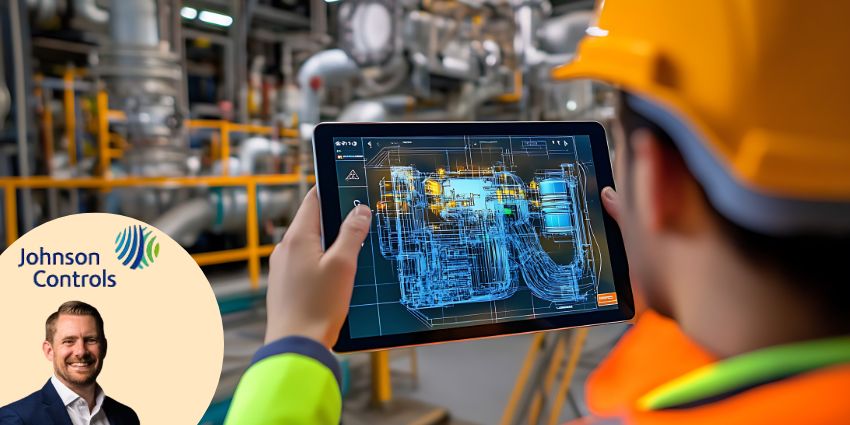
Imagine being able to see every system, every piece of equipment, even every desk and light fitting in a building – all in real time, all digitally.
That’s the promise of digital twins, a technology that’s moving beyond hype and theory into measurable operational impact for businesses and building occupants alike.
Speaking to UC Today on the sidelines of the recent ISE 2026 in Barcelona, Brian Churchard, Senior Digital Solutions Lead at Johnson Controls, explained it simply: “A digital twin is effectively a database of building systems, building features, other technology within that building.
"It really builds a digital package of what’s going on in the building and allows us to interrogate that data set to provide some real core benefits – for occupants, for facilities teams, and even for execs like CFOs and sustainability officers.”
In short, a digital twin is a living, breathing digital replica of a building’s physical and operational systems – giving organisations visibility and insight that was previously available only through manual checks or legacy building management systems.
Operational Benefits: Spotting Problems Before They Escalate
When asked how digital twins are applied in smart buildings, Churchard emphasised their role in asset management.
“A digital twin is very much used if you look at it from an asset management perspective,” he said. “Companies can use that to identify any faults within that piece of equipment, like a chiller or a BMS system, or even to any extent physical systems that you’ve got on site. You can also then start to look at cost-benefit analysis. So, you get to look at the operational cost of your building.”
This capability allows maintenance teams to intervene before small faults escalate into costly failures. From a financial perspective, it provides more precise budgeting and resource allocation, reducing unexpected downtime.
Churchard also stressed that digital twins enhance the environment for building occupants. “It’s providing both operational efficiency, energy efficiency, but it’s also then providing a better environment and a greater environment for our building users and occupants as well,” he said.
Justifying the Investment
Businesses often ask how they can justify the upfront cost of digital twins. Churchard’s advice is pragmatic: focus on data with purpose.
“Not trying to digitise everything, trying to digitise key parts or drive value,” he explained. “That could be everything from the building system – heating, lighting, and cooling – and digitising that and bringing that potentially into a digital twin or a fault detection diagnostic platform or something of that nature.”
By targeting high-value areas such as mechanical equipment, Churchard says organisations can often generate a clear return on investment.