
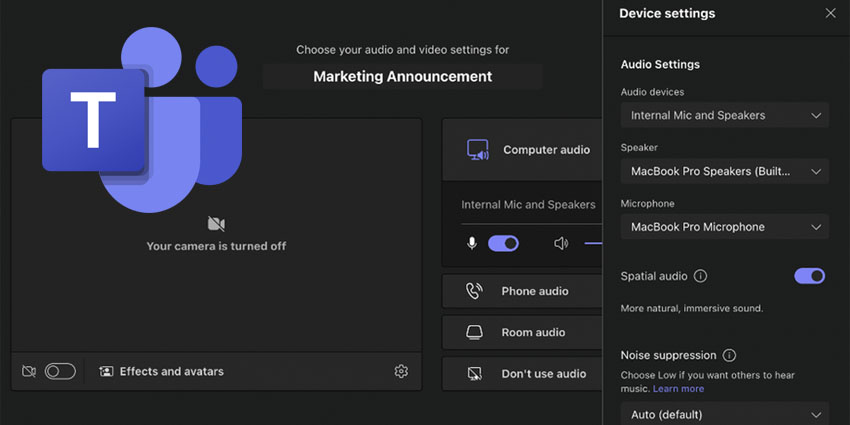
Teams is introducing spatial audio for immersive meetings as part of its end-of-June update.
Among the other specific Teams features introduced by Microsoft are refined chat capabilities, a user toggle to signal whether they're working on-premises or remotely, and customisable captions.
This month Microsoft also announced that its AI-powered productivity Tool, Copilot, will be part of M365 licenses rather than Office365 or E licenses.
Spatial audio is possibly the most intriguing new feature to Teams, as users with either a wired stereo headset or built-in stereo speakers can experience "spatialised" voices of attendees across Gallery's view's meeting stage.
Steven Stein, Senior Product Marketing Manager at Microsoft, wrote in a blog post:
Spatial audio brings a next-generation immersive soundscape to Teams meetings (...) This new audio experience spatialises the voices of attendees across the visual meeting stage in the Gallery view. This helps make conversations more natural, increasing the sense of audio presence, and making the conversation easier to follow when multiple people are speaking together."
To turn on spatial audio, users must select a wired stereo headset or built-in stereo speakers while on the meeting pre-join screen. This is available via Device Settings and then Speaker, where the user can turn on the Spatial audio toggle. During a meeting, users can also navigate to Device Settings and Speaker to turn on the Spatial audio toggle mid-call.
Copilot to be Part of M365 Licenses
This month, Microsoft confirmed that customers would need to step up to the M365, so the ME5 or the ME3 license, to get Copilot, and there will likely be an extra cost on top of that.
Tom Arbuthnot, Microsoft Teams Expert and Co-Founder of Empowering.Cloud, was accompanied by a panel of industry experts in speaking to UC Today for this month's Teams news roundup, including the Copilot license story.
"Microsoft is really hyping Copilot. I mean, everybody's super excited about it and really interested in it," Arbuthnot said. "There are now 600 organizations testing this, and they all paid to get into the pilot. So that shows you the level of appetite and quite significant money as well to get into this pilot."
"So Microsoft is laying the foundation from day one. This is definitely going to be a step up in terms of cost to get into the Copilot club if that's what you want to do."
Scott Riley, Founder at Cloud Nexus, argued that, while Copilot as a product is hugely exciting, its premium cost means Microsoft's collection of packages is starting to look expensive: "There's a Teams premium and Intune premium and now a Copilot premium, I'm going to guess, is what the skew might be called. It just feels like we're adding another $10, $20, $30 per user, and it's starting to feel expensive."
I wonder how much tolerance there is going to be in the partner and the user community for another premium license, another premium license, another premium license."
Simon Leyland, Independent Consultant with Alloquy, added that the sky-high expectation for Copilot is both a blessing and a curse. "I actually think this is Microsoft's biggest launch since Office 365 and the most difficult one actually to land," Leyland said. "the expectation curve is really difficult on this one."


