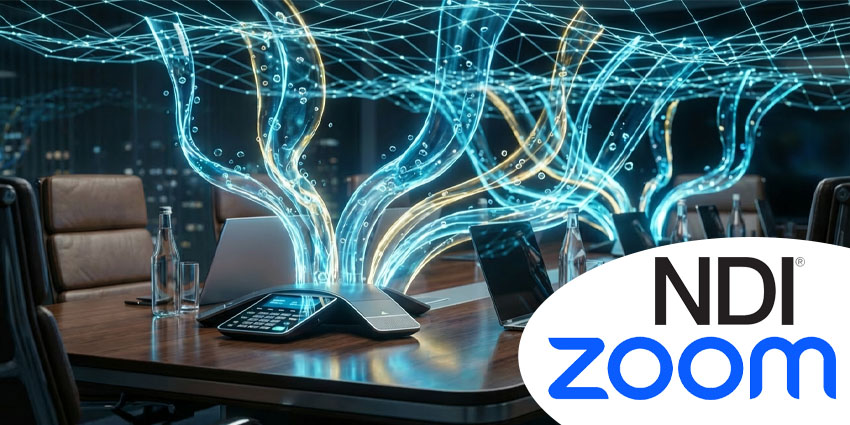

In a move that significantly accelerates the convergence of IT and AV, Zoom has announced a strategic integration with NDI (Network Device Interface), the global standard for video-over-IP.
In the language of modern business, “Video Conferencing” and “Broadcast Production” have historically been two distinct terms. The former was utilitarian, defined by webcams and USB connections. The latter was aspirational, defined by six-figure control rooms, proprietary matrix switchers, and miles of copper cabling.
For the CIO and the CFO, this bifurcation created costly redundancy, with one system for infrastructure supporting daily meetings and another for high-stakes corporate events.
That era of duplication is ending. By embedding NDI Advanced technology directly into the Zoom ecosystem, the partnership effectively turns the corporate LAN into a production studio, signaling a shift that goes well beyond clearer video.
For the tech buyer, this is a deeper infrastructure story doubled up as a feature update.
- Zoom Expands AI Push With Agentic Workflows for AI Companion 3.0
- Does Zoom’s ‘Zoom Ahead’ Ad Tell the Right Story?
The Shift from Circuit to Packet
The headline benefit is flexibility, but the subtext is the reduction of technical debt. By integrating NDI into Custom AV for Zoom Rooms, organizations can bypass the restrictive physics of traditional AV cabling. NDI allows video, audio, and metadata to travel bi-directionally over standard Ethernet networks with minimal latency.
For the IT Director, this means the existing Cat6 cabling in the walls, or even the fiber backbone, now doubles as a video transport layer. There is no need for expensive HDMI extenders or proprietary capture cards that lock the organization into a single hardware vendor.
This “softwarization” of the meeting room unlocks capabilities previously reserved for television studios, transforming static real estate into dynamic production environments. Lecture halls, for instance, can now switch seamlessly between multiple camera angles to track speakers without the need for a physical patch bay. Similarly, a standard cafeteria or breakdown space can be instantly converted into a broadcast environment for an all-hands meeting simply by plugging NDI-enabled cameras into the nearest network port.
The integration also elevates the standard boardroom experience by simplifying advanced hardware setups. Large meeting spaces can utilize high-end PTZ (Pan-Tilt-Zoom) cameras that track active speakers, feeding directly into Zoom without intermediate hardware processing. This removes the friction of complex setups, allowing high-fidelity video to become a standard utility rather than a specialized event.
Democratizing “TV Grade” Communications
As hybrid work settles into a permanent operational model, the “good enough” era of comms is well and truly over. The tolerance for friction, such as audio dropouts, static camera angles, and low-fidelity visuals, has evaporated.
This integration targets the “Zoom for Broadcast” ecosystem, specifically tools like ZoomISO and Tiles for Zoom. It allows virtual event producers to pull isolated, high-definition feeds from Zoom participants and route them into professional production suites (like vMix or OBS) via the network.
Andy Carluccio, Head of Client Innovation at Zoom, notes that this integration bridges the gap between accessibility and professional capability:
“The wide industry adoption of NDI technology… makes AV-over-IP workflows more accessible than ever before. We are excited to integrate robust NDI Advanced technology… offering a seamless experience that unifies NDI’s impressive capabilities and product ecosystem with Zoom’s innovative collaboration platform.”
Critically, for the Chief Human Resources Officer (CHRO) or Comms lead, this means the quarterly town hall can finally look and feel like a professional broadcast, driving higher engagement and retention of information, without requiring a production truck in the parking lot.
The Economic Case: CAPEX vs. OPEX
Perhaps the most compelling argument for the organization’s tech buying committee sits with the CFO. Traditional AV integration is CAPEX-heavy, relying on “black box” hardware that depreciates quickly and is difficult to upgrade.
AV-over-IP shifts the model. It leverages the switching infrastructure the company already owns. Scaling video capabilities, whether equipping a single huddle room or an entire campus, becomes a matter of network configuration rather than construction.
Miguel Coutinho, Head of NDI, emphasizes this scalability:
“Network-based connectivity opens a whole new range of possibilities… allowing organizations to adapt without costly extension technologies or complex installations.”
Final Takeaway
We often speak of the “democratization of video,” typically referring to the widespread availability of smartphone cameras. This partnership illustrates a more profound democratization of production value.
If a standard meeting room can now support multi-camera switching and broadcast-grade audio over a standard network, the role of the “meeting host” can organically evolve into that of a “producer.” As the walls between IT data and AV signals dissolve, the static webcam shot may soon become a relic of the early 2020s.
We are moving toward a world where every corporate interaction has the potential to carry the weight and polish of a television broadcast. The tech is now ready, and the question posed for IT and AV leaders is whether their network architecture can carry the load.