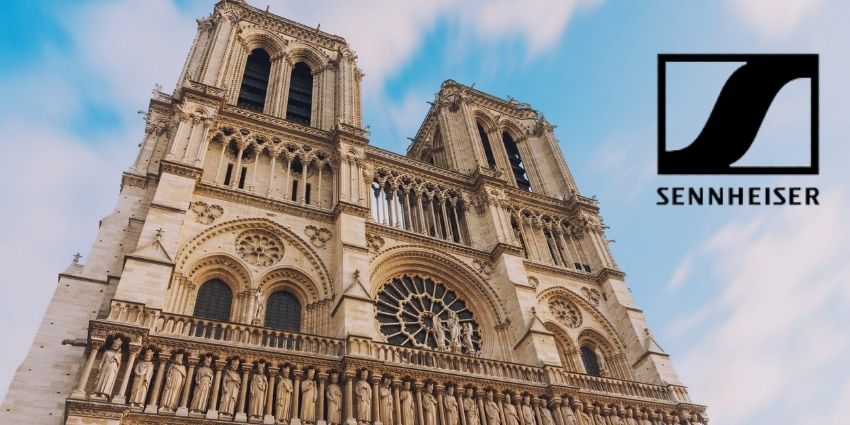

Notre-Dame is getting a high-tech upgrade – and this time, it’s all about sound.
After a devastating fire in 2019, Sennheiser has installed a next-generation wireless audio system as part of the cathedral’s’ restoration, providing wireless coverage for microphones and transmitters.
The challenge wasn’t just reaching every corner of the building – it was doing so in a way that remains unobtrusive in one of the world’s most iconic and historically sensitive landmarks.
Novelty, the integrator responsible for re-equipping Notre-Dame, selected Sennheiser for the task.
David Créteur, Project Lead at Novelty felt the old system – an analogue two-channel Sennheiser 3000 series – was due an update.
“Instead of working only along the axis, we now had to cover almost the entire cathedral, which is just over a hundred metres long from the entrance to the back and almost 50 metres wide at the transept.
“With the digital wireless technologies we were familiar with, we could have done it, but we would have had to multiply the number of antennas to a total of at least eight to be placed throughout the building, and then connect them with long lengths of cable.
At more than 100 metres long and nearly 50 metres wide at the transept, Notre-Dame is a highly challenging environment for wireless signals. It has thick stone pillars, wooden partitions and constantly changing audience layouts.
Just as importantly, the system had to be discreet and simple to operate. Services take place alongside visitor tours.
Clergy, technicians and broadcasters all share the same space. Any solution would need to work reliably in the background, without constant manual intervention.
Moving Beyond Traditional Wireless
Notre-Dame’s previous wireless system relied on an analogue two-channel receiver and centrally positioned directional antennas.
While adequate for more limited use cases, it was no longer sufficient for the expanded coverage required following the restoration.
Achieving full wireless coverage using traditional approaches would have required at least eight antennas distributed throughout the building.
They would have been connected via long coaxial cable runs – which would introduce signal losses, increase complexity, and in a historic environment, pose significant installation and aesthetic challenges.
Fibre-based extension systems could have mitigated some of those issues. However, they would add expense, complexity and operational overhead, particularly when it came to antenna zoning and manual activation.
Instead, Novelty turned to Sennheiser’s Spectera system, the company’s implementation of WMAS (Wireless Multichannel Audio Systems).
The team could reduce the number of antennas from eight to four while still achieving consistent wireless audio coverage throughout the cathedral. Automatic antenna combining removes the need for manual zoning.
From Copper to Fibre
Given the long-term nature of the restoration, the Notre-Dame project team elected to go a step further by wiring the entire cathedral with fibre.
Once Sennheiser confirmed that Spectera worked reliably with approved fibre media converters, the system aligned with the cathedral’s future-focused infrastructure strategy.
For Alain Richon, Project Manager for the diocese’s sound system, the choice was as much philosophical as technical.
In a historic building, every cable route must be carefully planned. Any new installation also needs to anticipate decades of future use. A fibre-based, network-centric system offered durability, scalability and flexibility that traditional wireless systems could not.
Proven Under Real-World Conditions
Before final deployment, Spectera underwent extensive on-site testing during 2024, with the cathedral still under construction.
A temporary, pre-production Spectera configuration was initially installed, supported by a Sennheiser Digital 6000 system for handheld microphones while Spectera handheld transmitters were finalised.
For unobtrusive altar capture, the cathedral uses boundary microphones selected for both aesthetic discretion and consistent directivity – a critical factor in a reverberant space like Notre-Dame.
Behind the scenes, the technical rack remains compact. The Spectera Base Station occupies a single rack unit while supporting up to 32 wireless microphones and 16 stereo IEMs.
Audio is transported over Dante and integrated directly with a DiGiCo console.
What This Means for AV and Workplace Tech
While Notre-Dame is a unique environment, the technology decisions behind its wireless audio system reflect trends that are increasingly relevant to enterprise, education and large-campus deployments.
For AV and UC leaders, the project highlights the shift from hardware-centric wireless design towards network-based, software-defined audio systems.
These integrate cleanly with existing IP infrastructure. Reducing antenna counts, eliminating manual zoning and moving from copper to fibre can significantly simplify deployment and ongoing management – especially in large or complex spaces.
The Notre-Dame installation also demonstrates the value of future-proofing.
By adopting fibre and network-centric design principles, the cathedral has created an AV foundation that can scale with new requirements, additional users and evolving broadcast needs without major rework.
As collaboration, broadcast and live events increasingly converge, audio systems must be as flexible, scalable and IT-friendly as the networks that support them – even when deployed in the most demanding environments imaginable.