
Even if we’re not there yet, most of us are probably tired of the phrase ‘new normality’ already. Perhaps more so because of the lack of consensus around what it means. With statutory guidance thin and woolly in most jurisdictions so far, it looks like it will be down to individual workplaces and employers to assume responsibility for keeping their teams safe and socially-distanced as and when they return to the office — and that undoubtedly means that business-as-usual will be very different to what we knew before.
We’re all still remote teams

I spoke to Nic Milani, Executive Director, Commercial Product Marketing at Crestron, who pointed out that every team will now effectively be a distributed team, because at least some proportion of them will be working remotely going forward:
“The old world won’t exist, everywhere will be a blended environment. Even if you just remove the immune-compromised and everybody else goes back, you can’t work the old way unless 100% of the people are there to work the old way. So you will get an inversion of video conferencing use, it will go from 7% to something like 90%”, he explained.
Because we’ve all worked from home and developed comfort and aptitude with video conferencing, the way we meet might be changed forever anyway — because it’s easier to maintain social distancing at our desks, and we no longer need to gather in meeting rooms to collaborate. Instead, we can develop a remote-first mindset and approach, which removes the need to move around and put others at risk.
Professional bubbles
Milani predicts that businesses will seek to silo and containerise teams physically by role or activity, to minimise contacts on a daily basis, and make any tracking and tracing easier. When cross-team collaboration is needed, there the technology will come in, and new products will make this easier.
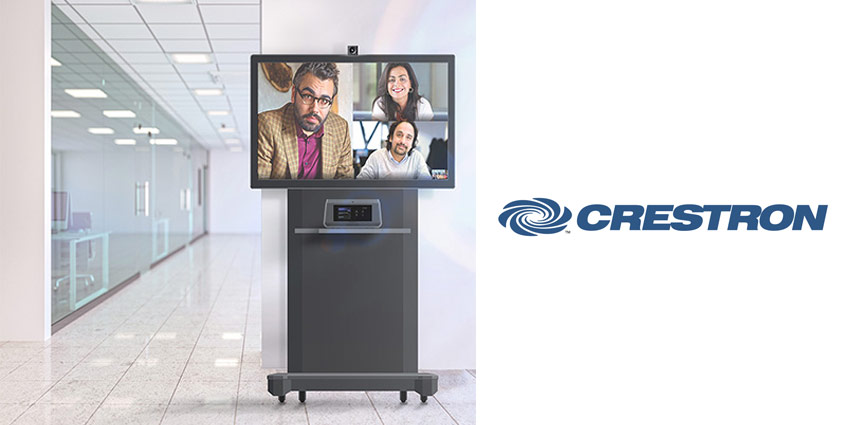
For example, Crestron has just launched the Crestron Flex R-Series mobile UC cart, to put meeting room technology right where it’s needed in the moment.
Making the UC tech move instead of the personnel will enable social bubbles to be maintained, as Milani pointed out: “We’re now designing for scenarios people have never had to think about, as teams will lock into little communities, we’re all going to be much more tribal. So we conceived of and launched this product in response to this need, within 6 weeks.”
“The other thing is that it’s all standard equipment, so if in a year from now things settle back down, there’s no reason why we can’t install it all back in the walls and revert to a traditional meeting room solution”
Smart and responsive UCC solutions
It’s clear that this kind of fluid and agile technology is what we’re going to need through this unpredictable transitional time, when the only certainty is change. That’s the kind of flexibility underpins the Crestron Flex MX architecture by design, supporting every type of meeting on any platform, including one-touch join for Microsoft Teams or Zoom Rooms applications, and BYOD for all other software.
And just as the explosion in use of unified communications and collaborations software kept the world working through the height of the lockdown, its tactical deployment as we return to the workplace will facilitate safe and effective productivity and teamwork.