
At Johns Hopkins University, decisions about classroom technology carry unusual weight.
The prestigious institution trains some of the world’s best doctors, engineers and policymakers whose work shapes global systems – and it expects its teaching environments to meet the same standard.
Speaking to UC Today at ISE 2026, Erin Maher-Moran, IT Manager, Classroom Technology at Johns Hopkins University explained that the focus now was less on gadgets and more on institutional discipline.
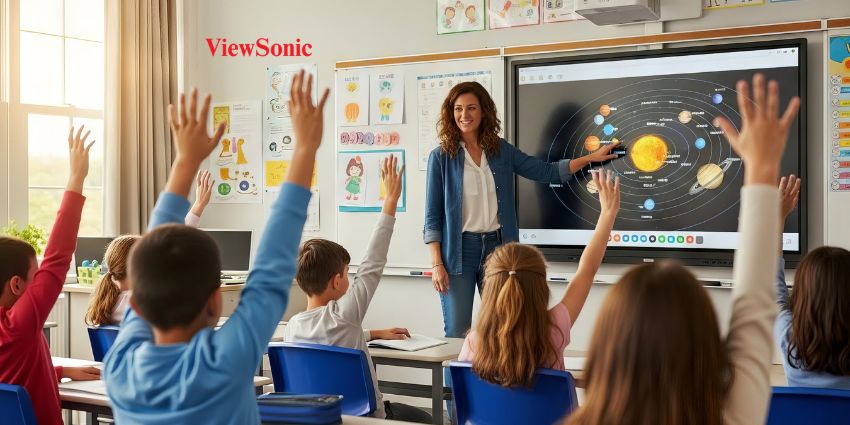
“It’s about making classrooms work for everyone, every day,” she said. “Technology shouldn’t call attention to itself – it should just let teaching and learning happen.”
Her argument is simple: accessible AV should be invisible. Students should not have to request it, notice it or think about it. They should just learn.
For decades, accessibility in higher education has essentially operated as a service request. If a student needs captions, transcription, assistive listening or recording support, they ask and the university responds.
It works, but can carry friction and stigma.
Maher-Moran’s view is more structural. Accessibility should be built into the classroom from the start, as routine as lighting or heating.
Captioning available by default, interfaces usable without specialist training and lecture capture that does not require technical intervention.
The logic is pragmatic as much as moral. Removing barriers early is cheaper and more effective than fixing problems later, and also reflects how students now expect to learn – flexibly, asynchronously and across devices.
The Hard Part Is Coordination
Technology itself is rarely the main obstacle – the real difficulty lies in alignment.
A university classroom often touches more departments than a corporate meeting room ever will.
Facilities teams plan renovations, network engineers manage bandwidth, academic departments define teaching needs and accessibility offices set compliance requirements.
AV teams must make all of it work together.
“You can’t put different things in every single room, and then expect that we’re going to be able to support that easily,” Maher-Moran said.
“So it really is about trying to stick to a standard, but not so rigid that it can’t evolve and change with the needs of the faculty and classes.”
A misstep in coordination can have immediate consequences: cameras blocked by furniture, microphones ruined by acoustics, or streaming systems crippled by network constraints.
The impact extends beyond inconvenience; it erodes confidence among faculty and students alike. “It’s less about choosing equipment and more about working with everyone who touches the room,” she explained. “If even one team is out of step, it can cascade into real problems for teaching and learning.”
To manage complexity, universities increasingly rely on standardisation.
When every classroom uses different equipment, support costs balloon and reliability drops, while faculty and students struggle with inconsistent experiences.
Yet rigid uniformity is equally unworkable. Teaching methods evolve, research disciplines demand specialised setups, and new tools emerge constantly.
Maher-Moran calls it a balancing act: “You need standards that give you stability but also leave room to grow.”
Modular design, interoperable platforms, and clear governance allow experimentation without chaos – an approach borrowed from software engineering that is still unevenly applied on campuses.
Students Vote With Their Dollars
Cost is the inevitable follow-up question.
AV upgrades can run into millions, and university budgets are already stretched thin. On this, Maher-Moran is blunt: students vote with their feet – and their tuition.
Prospective students expect classrooms that work reliably, whether in-person, hybrid, or remote, with intuitive tools and accessible content.
When technology fails, it shapes perceptions of institutional quality, and in a competitive recruitment market, outdated classrooms can become a reputational liability.
“Universities are judged by what students experience every day,” she said.
“If the systems fail, it’s not just an inconvenience – it affects confidence in the institution itself.”
Seen through this lens, AV spending resembles investments in laboratories or libraries.
Better student outcomes, fewer accessibility barriers, and more satisfied faculty all feed directly into institutional competitiveness.
The return on investment is reputational as much as financial, she added.
Artificial intelligence, meanwhile, is the sector’s fashionable frontier.
Vendors promise AI-driven classrooms, but Maher-Moran is sceptical of novelty for its own sake.
The real value lies in systems that quietly improve reliability: predictive maintenance, automated monitoring, better analytics, and smarter support workflows.
“AI should reduce downtime and lighten the administrative load, not just chase headlines,” she said. Universities adopt cautiously for good reason; governance, privacy, and support remain critical, and AI only has a place where it solves real problems.
Collaboration Across the Sector
One of higher education’s enduring strengths is its culture of collaboration.
Through networks such as HETMA, AV leaders share designs, standards, and lessons learned.
A community college in the Midwest may be smaller in scale than a major research university on the East Coast, but the technical challenges are often remarkably similar. Collaboration shortens learning curves and prevents costly mistakes.
“You learn faster when you see how other institutions are solving the same problems. It doesn’t matter if you’re large or small – the challenges overlap.”
From this perspective, AV becomes more than infrastructure; it becomes pedagogy.
Accessible classrooms allow students with disabilities to participate fully.
Standardised systems free faculty to focus on teaching rather than troubleshooting. Reliable hybrid tools widen access for remote learners and automation enables support teams to concentrate on improvement rather than repair.
Invisible, Yet Essential
Innovation in education rarely looks glamorous. It doesn’t involve flashy gadgets or headline-grabbing technology; it manifests in better planning, clearer standards, quieter systems, and fewer barriers.
For institutions serious about their future, these incremental improvements are transformative.
“In the end, the best technology is the kind you barely notice,” Maher-Moran said. “It just works, every day, for everyone.”