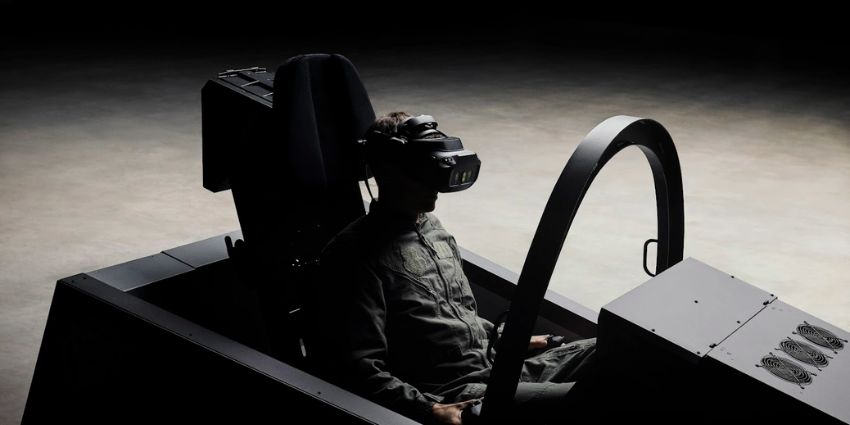

Apple Vision Pro has gained native support for NVIDIA CloudXR following the visionOS 26.4 update.
The integration brings CloudXR 6.0 into visionOS, enabling spatial computing applications to stream rendered content from remote NVIDIA RTX-powered systems to the headset over a wireless connection.
Rendering is performed on external workstations or cloud-based infrastructure, with compressed video frames, spatial data and tracking information transmitted to the device in real time.
The change is aimed at graphics-intensive workloads such as 3D simulation, engineering visualisation and design review, where local compute constraints typically limit scene complexity and fidelity.
“Apple Vision Pro is redefining what professionals can do with spatial computing, enabling teams to visualize, collaborate and work with extraordinary fidelity in entirely new ways,” said Jeff Norris, Senior Director of the Vision Products Group at Apple.
“With NVIDIA, we’ve brought together the powerful capabilities of visionOS with CloudXR streaming technology to deliver high-fidelity experiences to accelerate work across industries ranging from automotive design to healthcare, aviation and beyond.”
Remote Rendering Architecture
CloudXR is a low-latency streaming framework designed to deliver XR content over standard IP networks. In the Vision Pro implementation, it effectively separates rendering from display, allowing the two to operate across different systems.
Applications execute on remote systems fitted with RTX-class GPUs.
These systems generate fully rendered frames, which are encoded and transmitted as video streams to the headset.
On the device, the stream is decoded and presented within visionOS, while user inputs and head tracking data are sent back to the remote system to update the scene in real time.
This model shifts the computational burden away from the headset and onto external infrastructure, including on-premise workstations and cloud-based GPU instances.
It also reflects a broader pattern in high-end visualisation, where datasets used in industrial design, simulation and digital twins routinely exceed the processing capacity of standalone devices.
A key element of the system is dynamic foveated streaming.
This adjusts rendering resolution based on the user’s gaze direction, using Vision Pro’s eye-tracking capabilities. Areas in the focal region are rendered at higher fidelity, while peripheral regions are rendered at reduced resolution.
The approach reduces bandwidth and encoding requirements without significantly affecting perceived visual quality.
NVIDIA says gaze-related data is used solely for rendering optimisation and is not exposed to applications running on the remote system or external services.
Enterprise Use Cases And Developer Integration
The primary deployment context for CloudXR on Vision Pro is enterprise and professional environments.
In automotive design, manufacturing and architecture, spatial computing systems are increasingly used to review full-scale digital models before physical production begins.
In these workflows, remote rendering allows organisations to work with far larger and more complex datasets than would be feasible on standalone headset hardware.
It also reduces the need to simplify models or compromise on visual fidelity to accommodate local processing constraints, instead shifting computational load to GPU clusters or cloud infrastructure.
Software ecosystems referenced in relation to CloudXR include industrial design, simulation and digital twin platforms used in engineering-heavy sectors. These tools rely on high-fidelity rendering, which is streamed to Vision Pro through the CloudXR pipeline rather than generated locally.
For developers, CloudXR integrates into Apple’s existing toolchain for visionOS, iOS and iPadOS. Applications can be built using Swift and configured in Xcode to connect to remote rendering systems.
This allows a single codebase to be deployed across Apple devices, with system-level handling of input, display and streaming behaviour.
The integration also includes simplified pairing mechanisms, including QR code-based authentication, designed to establish a secure link between headset and remote rendering host without custom networking layers.
Performance Constraints And Industry Direction
Performance in the system is dependent on network quality, latency and the available compute capacity of backend GPU infrastructure.
While offloading rendering enables significantly more complex scenes than would be possible on-device, it introduces reliance on stable, high-bandwidth connectivity and predictable network conditions.
Foveated streaming is used to manage these constraints by prioritising resolution in the user’s focal area and reducing detail in peripheral regions. This helps reduce overall bandwidth consumption while maintaining perceived visual fidelity during continuous movement and interaction.
The integration reflects a broader shift in spatial computing architectures towards hybrid rendering models.
In this approach, rendering is distributed between local devices and remote systems depending on workload requirements, with headset hardware functioning primarily as an interface and display endpoint.
For enterprise users, this reduces the need to aggressively optimise assets for device limitations.
But it also increases dependence on networked infrastructure and introduces new constraints around latency, bandwidth and system reliability.
The direction mirrors established practices in high-end simulation and digital twin environments, where compute-heavy rendering is increasingly centralised and delivered to lightweight endpoints over managed networks.