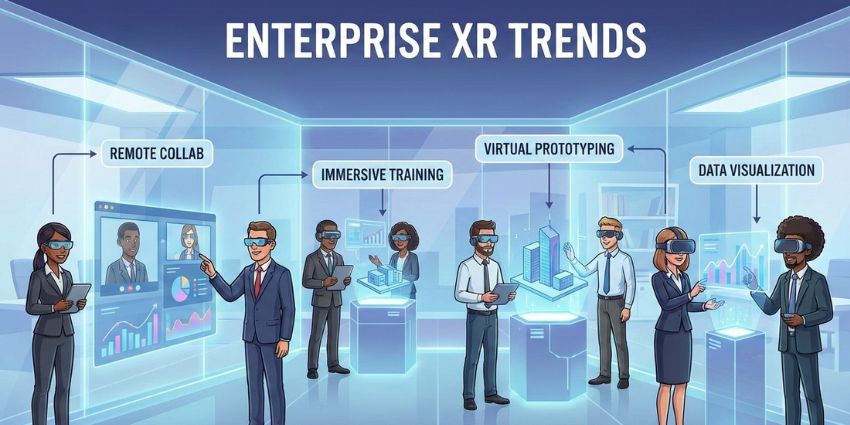

Enterprise XR trends in 2026 are defined by operational discipline rather than experimentation. Extended reality is no longer positioned as a “metaverse” vision project. Instead, organisations evaluate XR against enterprise benchmarks: measurable ROI, secure deployment, governance maturity, and integration with existing IT ecosystems.
According to Nicole Kobie, editor at Wired, the metaverse conversation has already shifted away from consumer VR fantasies and toward real industrial value:
“Forget Mark Zuckerberg’s vision of VR meetings; the industrial metaverse bridges digital and physical worlds in a way that’s actually useful.”
For CIOs, UC leaders, and digital workplace strategists, the central question has changed. The issue is not whether immersive technology is compelling. It is whether enterprise XR measurably improves workforce performance across training, collaboration, and frontline operations.
This analysis explains where XR is delivering value in 2026, how deployment models are evolving, and what decision-makers should prioritise to scale successfully.
Navigation
- Is enterprise XR infrastructure-ready in 2026?
- How does enterprise VR training deliver ROI?
- Why is AR remote assistance expanding in 2026?
- Is spatial collaboration replacing virtual meetings?
- What governance framework is required for enterprise XR?
- How have hardware improvements reduced adoption barriers?
- The broader tech trends shaping XR roadmaps
- What should UC and IT leaders prioritise in 2026?
- What leaders need to know
Is Enterprise XR Infrastructure-Ready in 2026?
Yes — but only when deployed as managed infrastructure rather than an isolated innovation initiative. Matthew Finnegan, Senior Reporter at Computerworld, sums it up:
“Despite evidence of the effectiveness of AR, VR and mixed reality (referred to collectively as XR) tools, companies still face a variety of technical, cultural and organizational challenges.”
One of the most significant enterprise XR trends in 2026 is structural maturity. Early proof-of-concept pilots are increasingly transitioning into IT-led rollouts governed by procurement, security, and endpoint management standards.
Vendors such as Pico continue expanding enterprise pricing models and device management ecosystems, positioning hardware like the Pico 4 Ultra and Neo3 Pro Eye for scalable training programmes. HTC VIVE maintains traction in simulation-heavy environments, particularly engineering and design validation workflows using devices such as the VIVE Pro 2.
However, hardware maturity alone does not define infrastructure readiness. In 2026, IT teams assess XR using the same criteria applied to collaboration suites and mobile endpoints:
- Integration with Microsoft Teams and Zoom
- Compatibility with mobile device management (MDM) systems
- Identity and access management (IAM) integration
- Endpoint security and encryption compliance
- Demonstrable workflow impact (not “engagement”)
In short: XR qualifies for scale only when it behaves like enterprise infrastructure—secure, interoperable, and supportable.
How Does Enterprise VR Training Deliver ROI?
Enterprise VR training remains the most mature and measurable XR use case in 2026. Organisations in manufacturing, energy, healthcare, and logistics deploy simulation-based learning to replicate hazardous or complex procedures before employees enter live environments.
This approach standardises training across distributed teams while reducing operational risk. As a result, enterprise buyers typically evaluate VR training against four practical indicators:
- Reduced time-to-competency
- Lower travel and instructor costs
- Fewer safety incidents
- Faster certification or validation cycles
Platforms built around HTC VIVE, Pico, and Meta’s Quest ecosystem increasingly support multi-user simulations, performance analytics dashboards, and instructor oversight tools.
What’s changing in 2026 is the content pipeline. Instead of treating immersive training as a one-off build, more teams are moving toward adaptive training: content that’s updated more frequently, tailored to role requirements, and easier to iterate on without restarting from scratch. That shift is where long-term VR ROI becomes sustainable.
However, ROI extends beyond productivity metrics. Strong programmes account for accessibility, ergonomics, and wellbeing. Session duration limits, device comfort, and inclusive design directly influence adoption rates. When organisations ignore the “people” dimension, pilots often plateau.
Enterprise VR training delivers ROI when performance metrics, user experience, and governance controls are designed together.
Why Is AR Remote Assistance Expanding in 2026?
AR remote assistance is accelerating because it directly addresses skilled labour shortages and distributed workforce challenges.
In 2026, “see-what-I-see” collaboration models allow frontline technicians to receive contextual overlays and live expert guidance without leaving physical tasks. Smart glasses and lightweight AR devices enable real-time visual support while preserving hands-free operation.
Importantly, the growth of workplace AR is being boosted by a broader shift toward “in-view” computing—where useful guidance appears in the worker’s line of sight instead of on a separate screen. That makes AR feel less like a new tool and more like a natural extension of the job.
While consumer smart glasses generate media attention, enterprise adoption prioritises durability, battery life, field-of-view clarity, and integration with unified communications platforms.
For IT and UC leaders, readiness still depends on three operational questions:
- Can network infrastructure support stable, low-latency video streaming?
- Are AR devices centrally managed and secured through MDM systems?
- Does the solution integrate natively with Teams, Zoom, or existing collaboration platforms?
When properly deployed, AR remote assistance improves first-time fix rates, reduces equipment downtime, and shortens escalation cycles. These outcomes translate into measurable KPIs aligned with operational efficiency and service performance.
AR adoption grows not because it is novel, but because it removes friction from frontline work.
Is Spatial Collaboration Replacing Virtual Meetings?
No. In 2026, spatial collaboration complements rather than replaces traditional meetings.
The strongest deployments focus on complex 3D workflows rather than general-purpose conferencing. Engineering, construction, and product development teams use XR to interact with digital twins, CAD models, and spatial simulations in shared environments.
Devices such as the HTC VIVE Pro 2 enable high-fidelity visualisation prior to physical production, reducing the need for iterative prototyping. In the best cases, the “meeting” becomes a workflow: teams manipulate the asset, agree on decisions, and capture actions immediately.
Organisations adopting spatial collaboration often report improvements in:
- Design validation accuracy
- Prototype waste reduction
- Cross-site collaboration efficiency
- Approval cycle duration
In other words, spatial computing works when it’s applied to problems that 2D screens can’t represent well. The shift is from immersive meetings to immersive workflows.
What Governance Framework Is Required for Enterprise XR?
Governance maturity is now a primary adoption gate.
Enterprise buyers increasingly begin XR evaluations with security and lifecycle questions rather than hardware comparisons. Core governance requirements include:
- Secure device provisioning and update management
- Ownership and protection of immersive content and 3D assets
- Clear policies for user data storage and analytics
- Defined refresh and lifecycle strategies
What’s changing in 2026 is the wider security context. As workplace systems become more autonomous and more immersive, trust becomes the bottleneck. Organisations are starting to plan for a world where security is not only “endpoint + network,” but also identity, sensor data, and model-driven automation.
That is why conversations about post-quantum security are entering long-term XR roadmaps. Quantum computing is still early for most enterprises, but it is already shaping how leaders think about encryption longevity and future-proof security planning.
In 2026, governance is not a barrier to XR adoption. It is the enabler of scale.
How Have Hardware Improvements Reduced Adoption Barriers?
While XR hardware growth experienced plateaus in previous cycles, incremental improvements in 2026 directly address enterprise concerns around comfort, cost, and usability.
Samsung’s Galaxy XR ecosystem, Pico’s continued enterprise expansion, and sustained R&D across major hardware providers focus on improving:
- Device ergonomics and weight distribution
- Battery life for longer sessions
- Cost per unit for scalable pilots
- Display clarity and visual fidelity
Alongside those improvements, more intelligence is shifting closer to the device. Privacy-first, low-latency processing—where more functions run on-device or at the edge—reduces reliance on constant cloud connectivity. For frontline work, that can be the difference between “useful” and “unusable.”
Hardware innovation in 2026 is evolutionary, not disruptive — but operationally significant.
The Broader Tech Trends Shaping XR Roadmaps in 2026
Some of the biggest XR business trends in 2026 sit adjacent to XR itself. They’re not “XR features,” but they directly influence what XR can deliver at scale.
- AI copilots inside workflows: enterprise AI is moving beyond simple chatbots into assistants that can plan, recommend, and act within real processes—especially in training, remote support, and knowledge capture.
- Everyday spatial computing: more value is shifting toward lightweight AR and glanceable interfaces that fit day-to-day work, not just specialist sessions.
- Edge and on-device intelligence: running more capabilities locally reduces latency and strengthens privacy—critical for field work and sensitive environments.
- Generative creation for XR: faster production of 3D assets and environments makes training and simulation content cheaper to update and easier to personalise over time.
- Security as a design constraint: as XR expands data capture (visual, spatial, behavioural), governance and security requirements become central to procurement.
- Long-term crypto planning: quantum computing may be early, but it is already influencing encryption and risk conversations—especially for programmes designed to last through 2030.
- XR as a spatial ecosystem: the “XR endpoint” is expanding beyond a single headset into multi-device, multi-surface spatial workflows that connect training, collaboration, and simulation.
These trends matter because they shift enterprise buying from “which headset” to “which capability stack.” That’s the real maturity milestone.
What Should UC and IT Leaders Prioritise in 2026?
Enterprise XR succeeds when organisations align people, process, and technology from the outset.
Leaders evaluating immersive workplace trends should begin with a clearly defined business outcome. Whether the goal is training acceleration, downtime reduction, or spatial design collaboration, the use case must map directly to measurable KPIs.
Deployment strategy should then address infrastructure readiness, including network capacity, identity integration, and endpoint security compliance. Structured pilot frameworks with predefined performance metrics prevent stagnation.
Finally, governance must be embedded from day one. Lifecycle planning, content ownership, and user data policies determine whether XR remains a pilot or becomes infrastructure.
Organisations that treat XR as a managed capability — rather than a gadget or marketing initiative — consistently achieve sustainable operational impact.
What Leaders Need to Know
The top enterprise XR trends in 2026 reflect a shift from experimentation to structured deployment. Organisations are prioritising scalable VR-based training programmes, AR-powered remote assistance for frontline teams, and spatial collaboration tools that support complex 3D workflows. Just as importantly, governance-first deployment models are becoming standard, with IT leaders demanding security, device management, and infrastructure alignment before scaling immersive technologies.
Enterprise VR training continues to lead adoption because it delivers measurable results. Businesses are using simulation environments to replicate high-risk or technically complex tasks in controlled settings. This approach reduces onboarding time, improves knowledge retention, and lowers operational risk — while ensuring consistent instruction across global teams.
For organisations questioning whether XR is ready for enterprise adoption in 2026, the answer depends less on hardware and more on strategy. XR delivers value when tied to clearly defined use cases, integrated into existing IT infrastructure, and governed by robust security and lifecycle management frameworks.
Industries with complex procedures and distributed workforces are seeing the strongest ROI. Manufacturing, healthcare, energy, logistics, construction, and engineering environments benefit most from immersive simulations, digital overlays, and spatial collaboration. In these sectors, reducing error rates, shortening training cycles, and improving remote support capabilities directly impact the bottom line.
Taken together, the 2026 XR landscape is defined by practicality. Extended reality is no longer a futuristic concept for enterprise — it is an emerging infrastructure layer designed to improve training, collaboration, and operational performance at scale.
The Strategic Reality of XR for Business in 2026
XR for business in 2026 is no longer speculative. It is strategic infrastructure.
For unified communications and digital workplace leaders, competitive advantage does not come from acquiring the newest headset. It comes from understanding how XR trends can optimise training, enhance collaboration, and improve frontline performance in measurable ways.
The organisations generating sustained value from immersive technology are not experimenting with isolated pilots. They are operationalising XR as part of the digital workplace stack.