
If you’ve spent any time on a conference floor in the last two years, you’ll have heard the same conversation on loop. AI is transforming the workplace, boosting productivity, changing everything. The problem, as many business leaders have come to realise, is that it’s been remarkably hard to prove any of that on a balance sheet.
John Bailey thinks 2026 is the year that changes, and he has a clear idea of what’s driving the shift.
“I think 2026 is the year of the agents,” said Bailey, speaking to UC Today at ISE 2026 in Barcelona.
“Agentic AI is the buzz for this year, and really it’s generating the kind of outcomes that customers want.”
Why Enterprise AI Has an ROI Problem
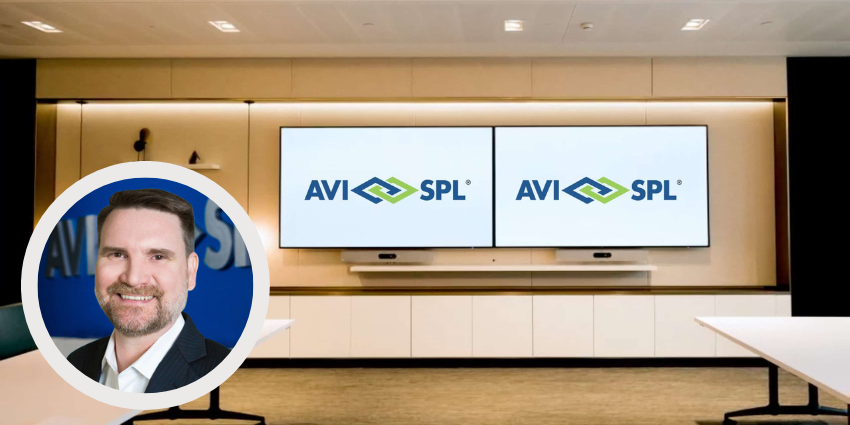
Bailey knows the frustration well. As Senior Vice President of Technology and Innovation at AVI-SPL, one of the world’s largest audio-visual and unified communications integrators, he works closely with enterprise customers navigating the gap between AI’s promise and its value. For a while, he says, that gap has been significant.
“Knowledge base and LLM AI — things that generally help productivity — are great in the workplace, but it’s hard to measure return on investment as a business. Am I actually getting back the efficiency, the output, the goals from the investments I’m making?”
It’s a question that has undermined confidence in enterprise AI adoption. Businesses have invested in tools that make individuals marginally faster, but translating that into board-level ROI has proven elusive. The productivity gains are real but diffuse — spread across hundreds of employees in ways that resist clean measurement.
How Agentic AI Changes the Equation
Agentic AI, Bailey argues, is structurally different. Rather than augmenting a human’s workflow in the background, agents can be given discrete, defined tasks, and then watched.
“With agents, we can give them a purpose. We can give them a workload, assign them a task, and we can watch them work and complete the task, and then repeat that task over and over again,” he says.
“Now there’s something we can actually hang on to in terms of value, and we can prove these things out.”
Automation as Amplifier, Not Replacement
Bailey is careful to define what agentic AI is for, and what it isn’t. There’s a version of this conversation that veers into anxiety about automation replacing human judgment, creativity, or collaboration. That’s not the story he’s telling.
“We’re not trying to offload creativity. We’re not trying to offload collaboration,” he says. “It’s just the mundane work that we all have to put up with — those are the things we’d like agents to handle for us, so we can really focus on engaging with each other, with our colleagues, and creating more solutions for our customers.”
It’s a distinction that matters for how organisations communicate AI adoption internally. The productivity case for agentic AI is strongest precisely when it’s positioned not as a replacement workforce, but as an amplifier: freeing human teams to spend more time on the work that actually requires them.
What This Means for the Digital Workplace
That framing also informs AVI-SPL’s broader strategic direction. The company is pushing a new portfolio concept at ISE this year called DWX, Digital Workplace Experience, which reframes its technology offering around business outcomes rather than product categories. Bailey explains:
“Why are we doing this? What are we trying to achieve with technology? Because there are a lot of things in our toolkit that may not even be traditional AV-type technologies.”
It’s a telling signal from a company of AVI-SPL’s scale. When one of the industry’s largest integrators starts leading with outcome-first questions rather than technology categories, it reflects a maturation in how enterprise customers are buying, and what they expect to be able to show for it.
The AI hype cycle has been long, and patience in some quarters is wearing thin. But if Bailey is right, the tools to finally justify the investment are arriving — and their impact will be felt well beyond the productivity dashboard. He says:
“Agentic AI will change not only the way we get work done, but the way we organise our work and the way our employees interact with AI and come together to form teams. It’s not about offloading, it’s about how do we accelerate, how do we amplify the things that we’re working on.”