
Workflow Automation: The Next Chapter for UC Innovation
Unified communications (UC) platforms have spent the last decade perfecting meetings, chat, and calling. But the next phase is less about communication quality and more about execution quality – in the form of workflow automation.
Buyers are increasingly asking what productivity boosts they get from their UC investment, as they search for a tool that reduces friction, speeds up decisions, and turns conversations into business action.
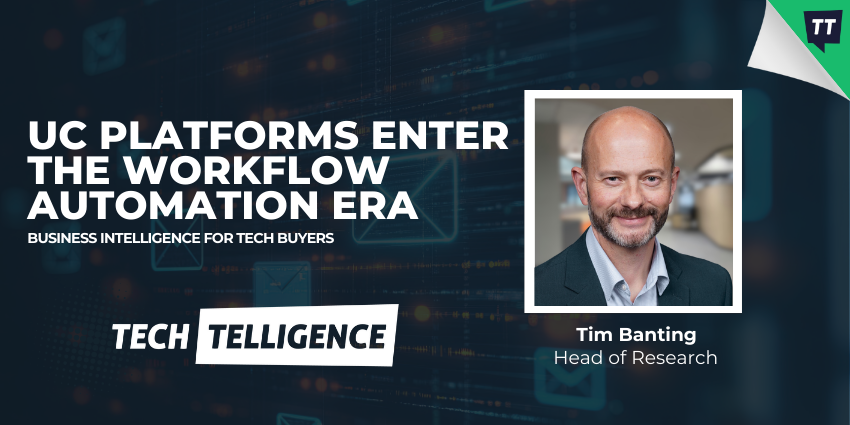
In the view of Tim Banting, Head of Research at Techtelligence:
“UC is being dragged out of the category of collaboration software and into something that becomes more of an organizational layer”.
In plain terms, UC is increasingly being asked to do more than connect people, it must deliver workflow automation to help get work done.
Related Analysis:
- Is Interest in UC Truly Rising? An Expert’s Perspective
- 5 UC Trends Every Enterprise Buyer Needs to Know
- Stop Treating CPaaS as a CX Tool – It’s the Secret Weapon in UC
Workflow Automation as a New Expectation
Banting frames UC’s evolution as a steady consolidation from “very monolithic different types of bolt-on solutions” into cloud-based platforms. But as vendors converged on similar core capabilities, the differentiator moved.
“Buyers are now really asking the question, everyone’s the same. What am I actually getting now?”.
The new expectation is workflow automation that reduces day-to-day drag. Enterprises are seeking platforms that speed up execution, with a growing focus on shrinking “human latency”.
He defines this as “the time it takes to make a human decision.” In that context, communication becomes the trigger for an automated action to push forward the business action.
For example, a meeting that ends with a ‘next steps’ plan should automatically become a to-do list for the relevant team members.
For UC buyers, this reframes procurement conversations. The question is no longer “How good are meetings?” It becomes: how well does the platform move work forward after the meeting ends?
What is the Value of Workflow Automation?
“Enterprises are drowning in administrative overhead.”
This challenge is why workflow automation has a growing role to play in business processes. Employees face an avalanche of meeting follow-ups, approval chasing, logging outcomes, and updating case records.
The problem is not complexity; it is repetition and volume. “None of this is hard work, but it seems to be relentless,” Banting says.
That relentlessness creates measurable business pain: “it’s that exact kind of friction that makes organizations slow and expensive and inconsistent.”
This is where workflow automation in UC starts to matter. His most useful framing for buyers is the conversion of communication into structured output:
“Workflow automation is now turning meetings into tasks and chat into escalations and calls into structured outcomes”.
How to Navigate Adoption Hurdles When Adopting Workflow Automation
Banting expects workflow automation adoption to face certain speed bumps.
Certain departments, such as customer-facing teams, may see immediate value from adopting one of these tools. With the rise of ‘citizen developers’, specific teams may be able to implement automation into small pockets of the enterprise workflow.
But this is where issues will start to emerge. Banting warns: “A lot of the automation is easy to create, but it’s hard to sustain.”
Making sure automation is a dependable infrastructure will ensure it scales responsibly across the enterprise.
To avoid technical debt and a tool sprawl across the office, Banting reminds buyers:
“The market doesn’t need more AI hype. It just needs fewer manual steps and fewer broken handoffs.”
Conclusion
UC platforms are moving from connecting people to accelerating execution.
The next competitive edge is workflow automation that reduces friction, cuts administrative overhead, and shrinks human latency by turning conversations into structured outcomes.
For buyers, the opportunity is productivity that actually shows up in day-to-day operations. The risk is adopting workflow automation that is easy to build but hard to govern and sustain.
If you want more buyer-first insight from Techtelligence, drop them a follow on LinkedIn for ongoing analysis of UC, collaboration, and workflow automation trends.