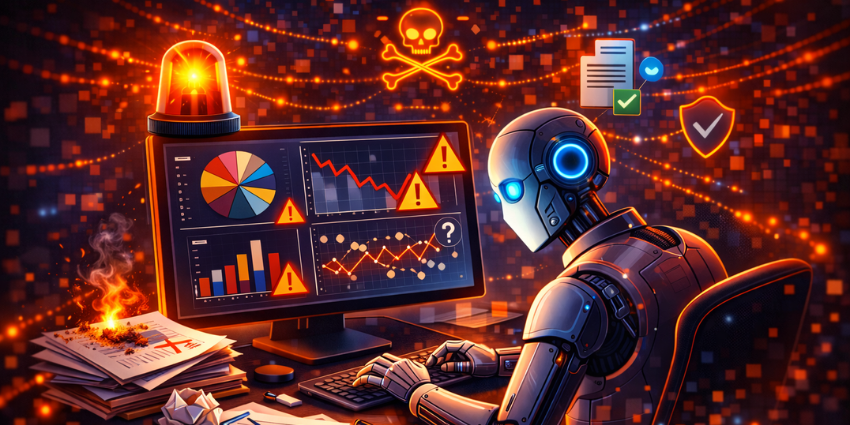

“AI workslop” was the buzzword for 2025, showing up in every conversation about how AI was damaging efficiency, productivity, and even human creativity. Some analysts even predicted that low-quality AI summaries, drafts, and outputs could end up costing $9 million per year in extra work.
Obviously, that’s a serious problem, particularly since about 40% of employees say they’ve received “workslop” in recent years, and another 53% think their own AI-generated content is less than perfect.
But if you think AI workslop risk stops there, you’re in for a rude awakening.
The real threat shows up when that output stops being “helpful text” and starts behaving like a record. In UC environments, that shift happens fast. A meeting summary gets pasted into a CRM. A drafted message becomes customer-facing. An auto-generated action item turns into proof that someone approved something. Now you’re not dealing with bad writing. You’re dealing with compliance.
Just look Deloitte Australia, workslop for them didn’t mean bad content. It meant apologizing for AI-generated errors in a government report worth hundreds of thousands of dollars. Once workslop escapes into formal deliverables, cleanup turns into accountability.
Further reading:
What Is AI Workslop Risk?
AI workslop risk describes what happens when low-quality AI output stops being a harmless draft and starts shaping real work. The term “workslop” was popularized by developers and analysts describing the flood of mediocre AI-generated content, summaries, drafts, and automated replies, that organizations now have to clean up.
The real risk appears when that content enters operational systems. A rough meeting recap becomes a CRM note. A generated email goes out to a customer. An AI-written action item lands in a task system and quietly implies approval.
Research from sources like Gartner and McKinsey & Company shows the same pattern: generative AI boosts productivity, but the volume of generated material also increases the amount of time employees have to spend verifying outputs. If they’re already overwhelmed, they tend to skip the “fact-check” step completely.
Why Does Poor AI Output Create Compliance Risks?
If you want to see AI workslop risk in the wild, don’t start with marketing copy or long reports. Start with meetings, chat, and collaborative sessions.
UC platforms don’t just host conversations anymore. They crystallize them. Meetings don’t end; they become summaries, transcripts, action lists, and follow-ups. Chat threads don’t fade out. They get searched, screenshot, pasted into tickets, and forwarded to people who weren’t there.
Meeting summaries are the obvious culprit. AI compresses an hour of half-formed thinking into a few confident paragraphs. Tentative ideas turn into “decisions.” Pushback disappears. Nuance gets shaved off because nuance doesn’t survive summarization well. People forward those notes because they’re convenient, not because they’re accurate.
Then there are drafted messages and suggested replies. They sound professional, but they also slip incorrect details into customer conversations and partner emails because nobody wants to slow down to second-guess something that reads clean.
Action items might be the most dangerous. Once an AI-generated task exists, it implies agreement. It implies approval. Undoing it later feels awkward, sometimes political.
AI Workslop Risks: How Can Inaccurate AI-Generated Content Affect Business Decisions?
The most dangerous AI issues aren’t the goofy errors you chuckle about at lunch. The dangerous ones are the pieces of AI output that sound right enough to act on but are fundamentally unreliable. That’s why AI workslop risk matters.
One recent study found nearly half of all AI assistant replies studied in a major cross-platform analysis contained at least one significant error, and more than 80% had some form of problem, from outdated facts to plain misattribution.
Workslop risk thrives on misplaced confidence. When AI stitches together something that sounds reasonable, people stop questioning it. And that’s showing up fast. About 95% of executives running AI systems say they’ve already dealt with at least one AI mishap, while only 2% of organizations meet basic responsible-use standards. That gap is doing real damage.
Senior risk and audit leads aren’t kidding when they say loose AI practices can directly trigger compliance and legal violations, whether false statements in client communications, breach of fiduciary obligations, inaccurate regulatory reporting, or weak official logs. When AI output is reused without human validation, what was work assistance becomes business evidence.
Most companies aren’t set up for this yet. Not properly. Only 32% of organizations have a consistent way to introduce AI across the business, and fewer than half treat AI as something that belongs inside their compliance framework. You can hear the shift in leadership conversations too. AI isn’t just an opportunity anymore. For a lot of executives, it’s starting to feel like a risk they don’t fully control.
The Propagation Issue: How AI Workslop Risk Spreads
The biggest problem with AI workslop risk is how fast it spreads.
Once an AI-generated summary or draft exists, it becomes frictionless to reuse. Summaries are shorter than transcripts, cleaner than chat logs, and feel safer than memory. People paste them into CRMs. Drop them into ticket histories. Forward them to stakeholders who weren’t in the room. In a lot of organizations, that summary becomes the only version of events anyone ever sees.
The numbers tell the story. Zapier’s enterprise AI survey found that employees spend around 4.5 hours every week fixing or reworking AI output. That’s not because the output is unusable. It’s because it’s almost usable. Close enough to spread. Wrong enough to cause damage once it does.
This is where AI workslop compliance issues compound. A single vague summary doesn’t just create confusion; it creates secondary artifacts. Follow-up emails. Tasks. Approvals. Customer responses. Each step adds distance from the original context. By the time someone spots the problem, it’s already embedded in systems that assume accuracy.
Shadow AI pours fuel on the fire. People copy transcripts, notes, or customer details into outside tools to “clean things up” and move faster. That single step breaks the trail. Compliance teams might see the final output, but they’ve lost sight of how it was made, what data went into it, or whether it changed along the way.
Regulators already punish weak recordkeeping even without AI in the mix. Billions in fines over off-channel communications prove that intent doesn’t matter nearly as much as evidence. Layer AI-generated artifacts on top, and the burden of proof gets heavier.
The Scale Problem: Why AI Workslop Risk Is Growing
What makes AI workslop risk hard to contain isn’t how bad the output is. It’s how quickly the volume adds up.
AI isn’t being adopted in neat pilot programs anymore. It’s embedded into everything. Meeting summaries are on by default. Drafted replies sit one click away. Copilots nudge people toward “send” instead of “think twice.” Every one of those moments produces another artifact that can be reused, copied, or treated as truth.
Most people just trust the tools automatically, because questioning them would mean slowing down, and businesses haven’t implemented policies that push teams to do otherwise. Global research shows about 66% of employees who use AI at work trust the output, without double-checking it.
The issue is just getting worse as regulations continue to evolve, shaping how companies should be using AI tools. Soon, AI output quality governance will have to scale at the same pace as AI usage. Right now, in many organizations, it isn’t. Output volume is growing exponentially. Oversight is growing linearly, if at all.
Reframing the Problem: AI Workslop as a Compliance Signal
At this point, it’s tempting to treat AI workslop risk like a quality problem. Better prompts, and training, maybe tighter usage guidelines. Really, companies should be looking more carefully at the early warning signs that are already there.
When low-quality AI output shows up more often, spreads more widely, and takes longer to unwind, that’s a control issue. It means AI is being trusted earlier in the workflow than governance can safely support. You can spot the signs through:
- AI-generated summaries being reused verbatim in CRMs, tickets, or reports
- Drafted messages making it to customers with incorrect or missing details
- Action items appearing without clear human agreement
- Teams “fixing forward” instead of correcting the original record
- Growing confusion about where decisions actually came from
This is where AI compliance needs a mindset shift. Instead of asking whether the model is accurate, the more revealing question is where accuracy stops being questioned. Once AI output becomes the fastest path to closure, quality decline becomes visible long before regulators show up.
Discover:
- Why Unified Communications is Your Next Security Blind Spot
- Unified Communications Compliance 101
- AI Data Risks in UC
How Can Companies Reduce AI Workslop Risk?
Most organizations respond to AI workslop risk with the wrong reflex. They reach for heavier approvals, more policy language, or vague training decks that nobody remembers a week later. That doesn’t reduce risk. It just pushes AI use further underground.
A few moves actually make a difference.
First: Treat AI Output As Governed Content, Not Helper Text
Summaries, drafted replies, auto-generated actions, and recaps behave like records once they’re reused. That means AI output quality governance has to cover:
- Where those artifacts can travel
- How long they persist
- Whether provenance is visible
- How easily they can be corrected or withdrawn
If your compliance tooling can capture chats and meetings but loses visibility the moment a summary is copied, that’s a clear systems gap.
Second: Reduce Confident Wrongness at the Source
Not every workflow deserves free-form generation. Regulated contexts need constraints. That includes:
- Grounding AI output in approved, maintained knowledge
- Limiting open-ended drafting in customer-facing or disclosure-heavy interactions
- Making context explicit so the system knows when accuracy matters more than speed
This isn’t about neutering AI. It’s about not letting it guess when those guesses could lead to risks you simply can’t afford.
Third: Make AI Participation Visible
Hidden AI is where AI workslop risk grows the most. If people can’t see where AI stepped in, they can’t question it. Labeling AI-generated artifacts is how you preserve judgment. Visibility also discourages reckless reuse, which matters more than most teams expect.
People tend to feel more confident sharing when they used AI systems when they know that copilots and apps are just a standard part of the workflow.
Fourth: Measure Outcomes, Not Adoption
License counts and feature usage don’t tell you anything about risk. What does:
- How often ai-generated artifacts are edited after reuse
- How long incorrect summaries circulate before correction
- Whether AI-created actions complete at the same rate as human-created ones
- How fast teams can reconstruct a decision when asked
Those metrics expose whether AI is helping or quietly distorting work.
Finally: Stop Treating Trust as a Given.
Collaboration platforms feel safe, familiar, and internal. That trust is exactly why errors spread. Designing for AI means assuming non-human participants are now shaping outcomes and building guardrails accordingly. Double-check outputs, hold bots to specific rules, and stop treating AI workslop as a minor problem.
Reduce AI Workslop Risk Before It Becomes Evidence
What makes AI workslop risk really worrying isn’t that AI gets things wrong. Humans do that all the time. It’s that AI gets things wrong confidently, and then hands those mistakes a microphone, a filing system, and a fast lane into the rest of the business.
Once AI output starts behaving like truth, compliance changes in everyday work. Summaries replace memory. Drafts replace judgment. Action items replace explicit agreement.
That’s why AI workslop risk can’t be treated as a future problem or a policy footnote. It’s already showing up in the form of cleanup time, confused decisions, and records no one feels comfortable defending. The organizations paying attention aren’t waiting for a regulatory letter to prove it. They’re watching the signals now. Rising correction rates. Faster reuse. Slower reconstruction when someone asks, “Why did we do this?”
AI isn’t going away, and neither is workslop. The difference between a manageable annoyance and a compliance problem comes down to whether you notice the slippage early or explain it later.
If you need help getting ahead, our complete guide to UC security, compliance and risk is a good place to start.
FAQs
What risks arise when employees rely on low-quality AI output?
The risk isn’t just bad writing. It’s quiet drift. A summary from a meeting gets copied into a ticket. A generated reply goes to a customer. The text sounds confident, so nobody checks it closely. If the interpretation was off, that version of events can spread through systems and influence decisions.
How can organizations train employees to evaluate AI outputs?
Useful training focuses on practical habits. Employees should check whether a generated summary matches the original conversation, confirm key facts before sending drafted replies, and correct AI-created tasks that don’t reflect what was actually agreed. The goal is normalizing a quick verification step.
What governance controls reduce AI output risks?
A lot of this comes down to treating AI output less like a disposable draft and more like working material. Teams usually set expectations around who checks summaries before they’re reused, where those summaries can be stored, and when they should be corrected. Even simple labels showing AI involvement can help slow down blind reuse.
What tools help detect unreliable AI-generated content?
There isn’t usually a single tool that solves this. Some organizations rely on monitoring systems that review collaboration activity for unusual behavior, while others use AI governance tools that show where generated text moves across applications. Basic features like change history can also reveal when content has been reused without anyone checking it first.