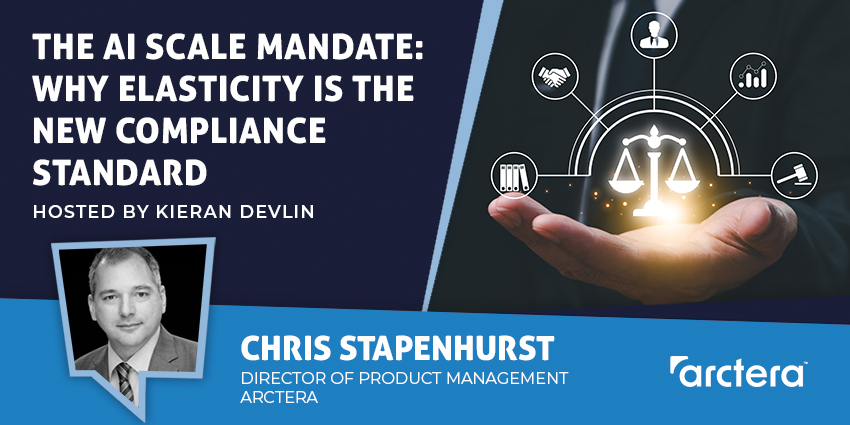

There is a pragmatic struggle at the heart of compliance leadership today. As data sovereignty rules diverge and enforcement tightens, a narrative has taken hold that the “cloud-only” era is hitting a ceiling. Industry analysis, including data from Opimas, points to a market increasingly considering hybrid models in competitive bids to satisfy local mandates.
However, the shift toward hybrid architectures is not occurring because they are more efficient or offer better oversight. Rather, it is occurring because organizations are trying to mirror the fragmentation of global regulations in their infrastructure. It is a design choice driven by the assumption that the only way to satisfy local sovereignty is to physically localize the data.
That assumption is the trap. The most productive (and cost-effective) answer to regulatory complexity isn’t to fracture your estate into a dozen local silos, but to adopt a SaaS foundation that governs that complexity from a single layer. We are at a stage where global organizations can run compliance in the cloud with complete conviction. But that can only happen if they build on a foundation proven to deliver the governance, proof, and granular control that complex regulations demand.
The “Sovereignty Trap” Requires Intelligence, Not More Infrastructure
The Resilient Compliance Strategy (2025–2027) report highlights a critical new reality: the dream of regulatory harmonization is dead. Instead, we face a splintered world where new data and hosting requirements are emerging globally, from the GCC to China.
The “Sovereignty Trap” is the belief that complying with these diverse rules requires a hardware presence in every jurisdiction. This leads to architectural sprawl, a patchwork of on-premises and cloud silos that checks the residency box but kills global visibility.
Arctera challenges this reflex. Sovereignty is a governance problem, not just a hardware one. By delivering clarity, confidence, and control, a robust SaaS platform can satisfy residency and access requirements without breaking the estate apart. The cloud becomes viable for global compliance because the platform provides the granular control to prove exactly where data lives, how it is retained, and who sees it. Rather than an elaborate hybrid ecosystem, Arctera’s SaaS platform intelligently maps to the rules.
Efficiency Has Become the Only Credible ROI
The new economic reality is stark. Opimas’ research confirms that “technology and headcount budget are under pressure,” even as AI and LLMs explode the volume of communications requiring review.
A fragmented hybrid model risks splintering your workforce alongside your servers, creating data silos, duplicating workflows, and forcing teams to toggle between legacy tools and modern apps. With tech budgets as stretched as they are, it is financially impossible to solve this by throwing bodies at the problem. Efficiency is the new ROI.
True efficiency requires a single source of truth, such as Arctera’s Unfiied Platform. It can ingest data from over 130 content sources and apply policy instantly worldwide. This scale of automation and discovery is native to the cloud. The only way to deliver the ROI the board demands is to maintain a unified cloud posture, enabling streamlined audits and automated reporting that hybrid models simply cannot match.
Defensible AI Needs a Unified Estate
The regulatory conversation has shifted from “Why are you using AI?” to “Why aren’t you?” However, that comes with the massive caveat that governance, explainability, and model oversight must be robust.
This is where the hybrid model struggles to adapt to the future. To run effective AI, you need data gravity. You need a centralized dataset that can be analyzed by a single intelligence engine.
If your data is scattered across on-premises servers and various cloud buckets to satisfy sovereignty mandates, your AI is partially blind. You cannot explain a decision if the data lineage is broken across silos. The only way to use AI defensibly is to have all your data in a governed, unified environment. This is where Arctera comes in, and with it, 280+ AI policies. This capability turns the cloud from a regulatory challenge into a competitive advantage. Organizations can run compliance in the cloud because the platform guarantees the regulatory defensibility that fragmented models struggle to prove.
What Resilience Looks Like for CISOs in 2026
The industry drift toward hybrid is a signal that many organizations are struggling to align global rules with their current architecture.
However, fragmenting your infrastructure is a coping mechanism rather than a sophisticated strategy. The fragmentation of global regulation is real, but the answer is to demand more governance from your SaaS provider. Global compliance works in the cloud, but only when it is built on a foundation, such as Arctera’s, that delivers absolute proof of control.
On February 19, Arctera and Opimas will unpack what the next compliance cycle demands in “The 2026 Compliance Lookahead — Implications for Surveillance Leadership.” The session is built around new research from Opimas and will cover what’s keeping compliance leaders up at night, how the rules and the tools are changing, where FSIs can get ahead, and what resilient leadership looks like in 2026 and beyond.
If you’re shaping strategy across IT, security, compliance, risk, legal, or the C-suite, and you’re being asked to do more with flat resources, this is the conversation to have. Register and find out more here.