
You’ve probably noticed the contradiction in HR lately. Business leaders are talking endlessly about culture, fairness, and employee experience, yet the tools running people operations look like a pile of mismatched parts. A half-retired HR database here, a stubborn payroll module there, a collection of niche apps, and a few spreadsheets everyone pretends not to see.
Those disconnected HR systems are doing far more damage than you might want to admit. Approvals slow down, records conflict, and teams spend more time hunting for information than getting things done. All the while, frustration among staff builds. Teams start creating their own workflows, adopting unapproved tools, or just disappearing from the workplace entirely.
All the while, executives are wondering why their grand plans for AI transformations aren’t paying off. But when your people layer is a mess, adding AI doesn’t solve the problem.
The real problem with disconnected HR systems isn’t a bit of wasted time. It’s the slow grind they put on everything: how people work, how teams feel, and how reliably the organization stays within the rules. That drag builds quietly, and before long, it affects far more than anyone expected.
Further reading:
What Are Disconnected HR Systems?
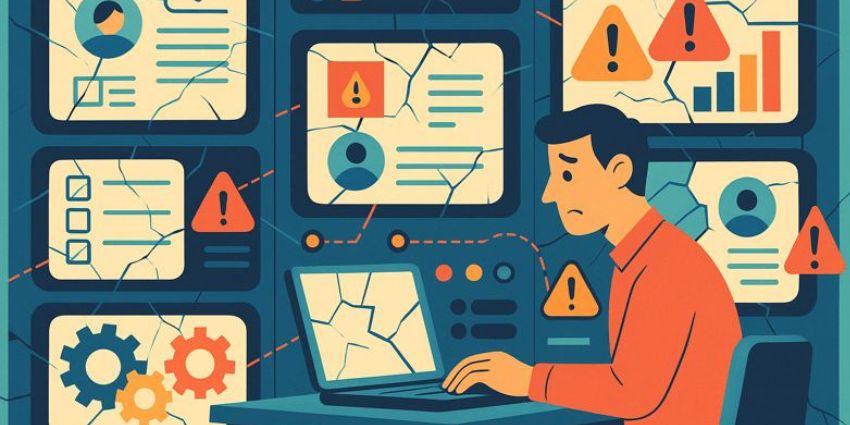
Most workplaces look organized from the outside. Then you poke around a bit, and the whole picture changes. People are bouncing between old tools nobody remembers choosing and newer ones that never quite line up. HR teams keep a mental map of what lives where, and half the company relies on assumptions just to complete routine tasks.
We’re trying to build aligned teams with:
A patchwork that never stays in sync
A typical setup includes an applicant tracker from one vendor, training software from another, payroll running on a completely different schedule, benefits on a separate platform, plus a handful of random add-ons for surveys or recognition. Somewhere in the background sits an Excel file that refuses to retire. Job titles drift across systems. Reporting lines don’t match. Even dates get mixed up.
Too many tools, too little flow
Most employees move through 10 to 13 tools a day, switching around far more than they realize. A surprising number admit to losing up to two hours daily searching for information that should have been obvious. It’s not incompetence. It’s what happens when the digital environment feels like a maze built over several years with no shared blueprint.
Secret workarounds
When the official HR systems can’t keep up with everyday work, people start patching the holes themselves. Someone spins up a quick spreadsheet. Someone else builds a form nobody asked for. A few teams lean on little Slack shortcuts to get around slow processes. These fixes feel practical in the moment, but they create a second, invisible system that nobody’s really monitoring.
AI upgrades that can’t keep up
A lot of companies want smart assistants and predictive insights, but AI needs stable, reliable information. If five tools disagree on someone’s job history, no algorithm can magically resolve it. Our insights into AI in human capital management echo this: messy foundations lead to confusing automation, and ROI disappears.
What Are The Costs Of Disconnected HR Technology?
If you break it down, the real cost of disconnected HR systems stems from far more than just efficiency gaps. The less alignment you have, the more you feel the impact in productivity, culture, and compliance, not to mention future growth.
The Productivity Hit
When HR platforms don’t line up, the work multiplies. HR ends up re-entering data, reconciling inconsistencies, and chasing information that should’ve been waiting for them. HR teams spend more time “reacting” than they do acting.
Employees feel the strain too. Many bounce through 10 to 13 tools a day, switching so often it breaks their focus. Surveys in the US and UK keep showing the same painful pattern: workers lose as much as two hours daily searching for basic information.
For a real-world example, look at BT Group. It eliminated more than one million wasted hours after replacing a maze of legacy tools. Elsewhere, AEON Thana Sinsap regained 2,000+ hours by cleaning up workflows and eliminating redundant steps.
Culture & Employee Experience
We all know culture matters. 83% of employees who rate their company culture highly say they’re more motivated to excel in their roles. Unfortunately, a lot of companies are still overlooking the small issues that eat away at culture like termites.
Disconnected HR systems are the source of a lot of those problems. A scattered setup with one tool for onboarding, another for learning, and something else for feedback creates this odd feeling of disjointedness. A new hire might start their first week bouncing through five different platforms before they even meet their manager. That “first impression energy” everyone talks about doesn’t stand a chance when the welcome process feels like assembling furniture without the instructions.
Employees pick up on the chaos quickly. A lot of the burnout showing up in surveys isn’t tied to workload; it’s tied to the mental load of navigating messy systems.
You also see culture crack in subtle ways. Recognition tools that don’t link to performance systems. Learning platforms operate in their own orbit. Team leads are improvising side documents to keep everyone aligned. When basic processes require detective work, the message people receive is simple: the company isn’t as organized or supportive as it claims to be.
The irony is that a true unified HR platform really does create emotional coherence. People feel grounded. Expectations feel clear. That shows up directly in trust, morale, and the overall experience of working there.
Compliance: The Hidden Risk
Compliance issues often start smaller than you’d expect, with mismatched records buried somewhere inside disconnected HR systems. By the time anyone notices, the cleanup is painfully public.
When employee data is scattered across multiple platforms, each with its own versions of pay details, job codes, or documentation, you end up with a fragile system that can’t reliably answer the simplest questions.
Payroll shows the cracks clearly. One tool still lists an outdated title, another holds the correct pay rate, and a third claims the employee reports to someone who left ages ago. That mix-up leads straight to overpayments, missed earnings, and some very awkward corrections later. Plenty of payroll teams spend nearly a quarter of their time just cleaning up these system discrepancies.
The compliance story gets even more complicated once AI enters the picture. Employees already feel uneasy when automated decisions lack clarity. Now imagine those algorithms fed with inconsistent job data or incomplete histories. You end up with decisions that are impossible to defend.
Shadow workflows deepen the risk. When people are forced to use unsanctioned tools or personal AI apps to fill process gaps, sensitive information drifts into places where HR has zero visibility. That’s how minor inconsistencies turn into genuine regulatory exposure.
How Do Unified HR Platforms Improve Decision-Making?
When a company shifts from scattered tools to a real unified HR platform, everything starts to click at a deeper level. Suddenly, the friction that everyone assumed was “just part of work” isn’t there anymore. Tasks move cleanly, and data lines up.
Today’s human capital management tools ensure all your people data lives in one reliable structure. Your HR management system, payroll, time, benefits, learning, performance, and service flows all sit on a shared model instead of living scattered across digital islands. Everything pulls from the same source, so nothing drifts or gets quietly rewritten.
This isn’t about buying a monolithic product. Some companies keep specialized tools they love. The difference is that those tools plug into a stable backbone rather than causing new silos every time a feature is added.
When data stops fighting itself, the improvements show up fast. Work moves with fewer pauses. HR gets out of the business of constant reconciliation. Employees finally stop bouncing through endless logins just to update a tiny detail. Even something as simple as promotions or pay changes feels smoother because every system already knows who’s who.
The cultural impact is huge, too. The experience feels consistent for once, with onboarding, recognition, learning, and performance reviews all moving along the same rails.
Need more insights into the benefits of HCM solutions? Check our guide to the top HCM use cases in 2026.
How Can Companies Integrate HR Systems Effectively?
Moving from scattered tools to a cleaner setup sounds complicated, but honestly, most companies make real progress one step at a time.
- Map the mess honestly: Before choosing any new HR system software, take a simple inventory. What systems hold people’s data? Which ones overlap? Where are the unofficial files hiding? Put it all on the table. Clarity always beats assumptions.
- Put numbers on the waste: Estimate how much time HR and managers spend reconciling mismatched records, hunting down documents, or repeating tasks. When employees lose hours each week navigating disconnected HR systems. A rough calculation of lost time is usually enough to get leadership’s attention.
- Fix the highest-friction paths first: Most pain comes from a handful of workflows: hiring to onboarding, payroll updates, promotions, offboarding, and access changes. Start there. Connect those systems cleanly, and the payoff is immediate.
- Protect people from tool overload: Strip out redundant apps. Consolidate logins. Aim for fewer clicks, not more features. Digital well-being matters just as much as efficiency, maybe more.
- Prepare the ground for AI: Before adding any AI assistants or analytics features, make sure the underlying data is stable. People won’t put faith in automation if the basics feel unreliable. Once the core HR systems are running smoothly, AI actually helps instead of creating more confusion.
Aligning Disconnected HR Systems
The thing about disconnected HR systems is they rarely look disastrous at first. They look “fine.” Familiar. Maybe a little annoying, but manageable. That’s exactly how they get away with draining an organization for years.
But once the problems become clear, you can’t unsee them. Productivity slips. People lose patience. Shadow tools start appearing. HR turns into a safety net for broken workflows. And every improvement, from better onboarding to AI-enabled insights, runs straight into the same wall.
A better foundation starts with a unified HR platform that stops rewriting the same data in five places, supports accurate reporting, and finally gives automation something solid to stand on.
If you’re ready to see what HCM systems can really do for your team, check out our full guide here.
FAQs
Why do fragmented HR systems create operational problems?
Because the same employee record gets rewritten in several places. HR changes a salary in one system. Payroll still shows the old number. Finance pulls a report and suddenly nothing matches. Someone spends half the afternoon checking three systems just to confirm what should have been obvious.
How do disconnected HR platforms affect employee experience?
It shows up during ordinary moments. A new hire receives links to four different portals before their first meeting. Benefits sit in one system. Training sits in another. Time off lives somewhere else again. By the end of week one, people aren’t thinking about culture or engagement. They’re thinking, why is this so messy?
How can organizations identify HR system fragmentation?
Watch what happens when something small changes. A manager updates an employee’s title. HR corrects it somewhere else. Payroll still shows the old one a week later. When teams start asking “which system is right?” or keeping side spreadsheets to track updates, the tools have already drifted apart.
What role does data integration play in modern HR strategies?
It keeps everyone working from the same employee record. Change someone’s role or pay once and every connected system reflects it. Payroll stays accurate, reporting lines stay current, and HR isn’t chasing mismatched records. Without that shared data layer, every platform slowly builds its own version of reality.
What steps help organizations fix fragmented HR systems?
Most teams start by laying out every tool that stores employee information. The list usually surprises people. After that, attention goes to the workflows that cause daily headaches: onboarding, payroll updates, and role changes. Connecting those pieces first removes a large chunk of the confusion.