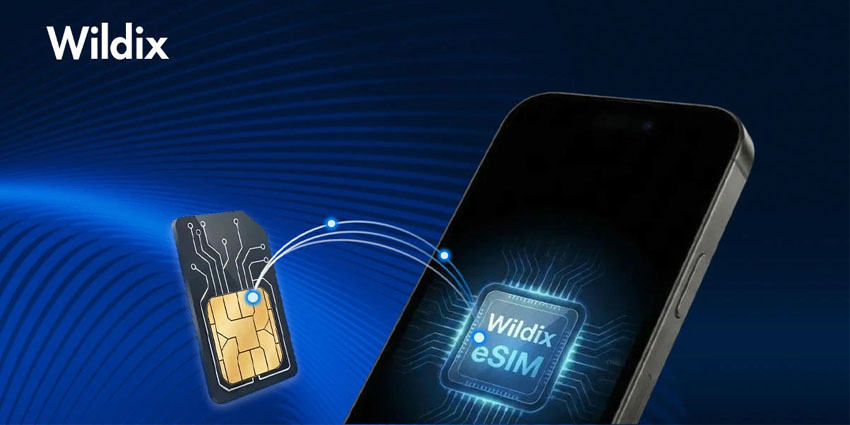

Wildix has announced the launch of Wildix eSIM, a significant expansion of its Mobility Cloud offering that promises to eliminate the long-standing “blind spot” in enterprise data. It also marks a significant step forward for Wildix’s mobile communications, positioning the company to solve the fragmentation that often occurs when employees work outside the office.
The new capability is designed to integrate business mobile calls directly into corporate workflows, effectively removing the barrier between a user’s personal mobile device and the company’s central infrastructure.
The core of the announcement centers on integrating enterprise identity at the SIM level. Historically, mobile business calls have existed in a silo, disconnected from the central data systems that businesses rely on. The Wildix eSIM changes this architecture by routing calls made via the phone’s native dialer through the Wildix Mobility Cloud. This ensures that every interaction is treated as a SIP-based enterprise call, regardless of the device’s physical location.
By anchoring the business identity to the SIM, Wildix’s mobile communications can now ensure that availability, routing, and policy controls are maintained even when the user is miles away from their desk.
Dimitri Osler, Co-founder and CIO at Wildix, commented:
“Work is fluid, and conversations move with it. Mobility Cloud ensures that context moves too. We built it so conversations do not reset every time someone changes device, location or role, but instead continue with the business, intact and actionable.”
Crucially, this integration is about data capture as much as it is about voice transport. Wildix has confirmed that the eSIM solution can be powered by voice AI, meaning mobile conversations are no longer lost to the ether. Instead, they can be enriched with real-time transcription, summaries, sentiment analysis, and structured outcomes.
These insights feed directly into the company’s sales intelligence layer, transforming what was once a black box of mobile activity into actionable follow-ups. The solution is available immediately through the company’s global partner ecosystem.
- When Free Isn’t Free: The Hidden Dangers of WhatsApp in the Workplace
- Is Wildix’s ‘Industry First’ Embedded Agentic AI the Next Big Leap for UCaaS?
A New Era for Wildix
From a market perspective, this launch is another signal of the maturing of the UC sector and a potential shift away from the “Over-The-Top” application model that has dominated for much of the last decade.
For years, UC vendors have attempted to solve the mobility problem by building smartphone apps that mimic desk phones. While functional, these apps have frequently suffered from poor adoption rates due to interface fatigue, battery drain, and connectivity latency. Users simply prefer the native dialer, the green button they have used for years.
The strategy behind Wildix’s new update acknowledges this reality, where friction is the enemy of compliance. Mobile calls routed through the Wildix eSIM follow enterprise-grade logic usually reserved for contact center environments.”
By moving the intelligence from the application layer to the network layer, Wildix is tackling a fundamental truth of the post-pandemic workplace. If a solution requires a user to unlock a phone, open a specific app, and wait for it to load, they will often bypass it in favor of a standard cellular call. When they do, the enterprise loses visibility.
This move places Wildix’s update squarely at the center of the Fixed-Mobile Convergence (FMC) trend. This market segment is rapidly becoming a priority for CIOs who are less concerned with providing new tools and more focused on securing the data generated by the tools their teams already use.
Real-World Benefits of Wildix’s Updated Mobile Communications
For the enterprise tech buyer, whether a sales director on the road, a healthcare provider, or a field technician, the impact of this technology is paradoxically defined by what disappears. The need to toggle between personal and business identities vanishes. A real estate agent can now use their personal device to call a client. Yet, the client sees the office landline number, and the call is routed according to professional availability rules. This seamlessness is the primary goal.
The most tangible benefit for the end user, however, is likely to be the reduction in administrative burden. Because the Wildix eSIM anchors the call within the enterprise workflow, the days of manually logging calls or typing up notes after a client conversation are numbered.
The integration with AI means that a salesperson can conclude a call while driving, and by the time they park, the conversation has been transcribed, summarized, and logged in the CRM. It transforms the mobile phone from a simple comms tool into a connected node of the enterprise network, allowing professionals to utilize the full power of Wildix without sacrificing the sophisticated routing and support structures usually reserved for the head office.
We often talk about “meeting the user where they are.” Usually, that means giving them a better app. But in mobile, the “user” is already in their native dialer. It’s muscle memory. By moving intelligence from the app layer to the network layer, Wildix is acknowledging that the best user interface is often the one that requires the least change. If your sales team is closing deals on the highway but your CRM thinks they haven’t worked all day, you have a visibility problem, not a personnel one.