
ISE 2026 in Barcelona was big in every sense: 92,170 visitors over four days, 1,751 exhibitors, and more than 101,000 square metres of show floor.
The official theme was “Push Beyond”. The unofficial theme, if you spent any time on the stands, was more simple: “stop selling me products, start solving my problems”.
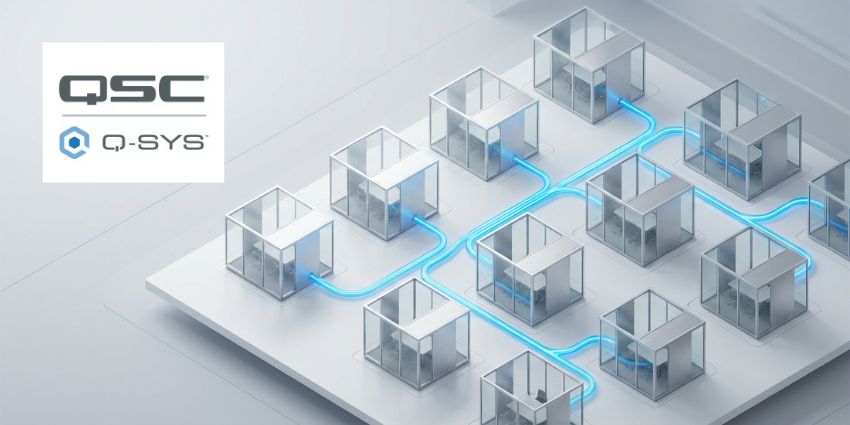
That’s why QSC’s message landed. President Jatan Shah argued that standardised meeting rooms only stay standard if they’re built and managed as part of a platform, not a patchwork of devices and one-off integrations. The payoff isn’t glamour—it’s fewer variables, faster rollouts, and less support friction.
QSC’s “places, spaces, applications” argument (and why it matters)
Speaking with UC Today on the QSC stand at ISE, Jatan pointed back to a framework the company introduced at its Activate launch event in January.
“A lot of the solutions in AV are thought of in terms of applications—specific applications based on different products doing audio, video, control, and so forth,” Shah said. “But those applications, while solving specific problems, exist in the context of a specific space. They aren’t discrete. They don’t exist in their own silos.”
It’s a problem most enterprises already feel. Meeting rooms don’t live in isolation; they sit on corporate networks, under security policies, with helpdesks expected to support them remotely. The more rooms you deploy, the more those “little exceptions” turn into daily operational drag.
This is why Shah keeps talking about platforms. The value isn’t just in what happens during the meeting. It’s in what happens the rest of the time: deployment, monitoring, configuration drift, and what you can (or can’t) automate.
Where RoomSuite fits: repeatable rooms without going full bespoke
Q-SYS has a reputation for handling complex spaces. The trade-off, historically, is that the flexibility can feel heavyweight if what you really need is repeatability.
Q-SYS RoomSuite Modular Systems is QSC’s response to that gap. It’s designed to make medium-to-large rooms easier to deploy consistently, using a web-based, no-code workflow. Instead of building each room from scratch in Q-SYS Designer Software, teams can lean on repeatable configurations, with central management through Q-SYS Reflect. Shah said:
“Q-SYS RoomSuite Modular Systems basically extend the Q-SYS solution beyond the types of applications and spaces we’ve been targeting, so that we’re providing full solutions to cover the whole place.”
QSC isn’t abandoning custom rooms. It’s trying to make sure the “normal” rooms don’t require custom work to achieve a predictable outcome. For IT teams chasing standardised meeting rooms across multiple sites, that’s the difference between scaling and permanently catching up.
Shah said that’s exactly what he’s hearing on the stand: “People are finally seeing what’s been asked of us… ‘you guys are doing great in these applications and these spaces, but we’d like to see more from you.’”
AI at ISE 2026: from clever features to productivity and automation
ISE has had plenty of AI demos over the last couple of years. This year, the more interesting AI conversations were about operations: how to remove steps, reduce failure rates, and make rooms feel “ready” more often than not.
“Instead of thinking about AI as a buzzword, people are thinking about what problems you’re solving and what more you can do with AI.”
Then he pointed to where he sees the conversation heading:
“What about agentic AI? Can a workplace be smart enough to detect whether a room is ready or not? Can we provide solutions that make it easier for end users… where the AI is helping and making those experiences significantly better?”

That “room readiness” idea is important for productivity. A meeting that starts 90 seconds late because the room is in the wrong state, the wrong mode, or the wrong configuration doesn’t sound dramatic in isolation—until it happens multiple times a day across an estate. In that sense, AI isn’t a feature you show off but a way of taking friction out of the system: fewer manual checks and fewer support calls.
The catch is that automation needs consistency. If rooms are built as a patchwork, AI doesn’t have a stable foundation: no consistent telemetry, no consistent management, and no consistent policy model. If rooms are standardised under a platform, AI becomes easier to apply in a repeatable way.
What QSC says comes next
For Shah, the industry direction is already set:
“The conversation has gone from products to applications, from applications to full, broad solutions… people want to see us just deliver the outcomes.”
And he’s positioning QSC’s next steps in that context:
“We have more exciting solutions coming out—not just for collaboration applications, but also in commercial and entertainment. That’s how we think about Q-SYS as a full stack AV platform for audio, video, and control, enabled with cloud, with AI layered in, leveraging the data.”
ISE 2026 made one thing clear: the productivity story in meeting rooms is increasingly an automation story. And automation, as usual, is won or lost on the platform underneath.