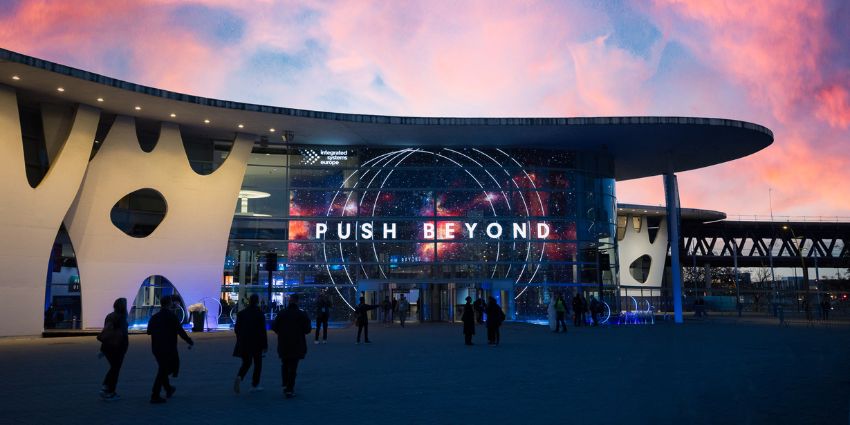

Integrated Systems Europe (ISE) 2026 may not have delivered a single breakout “must-have” device, but the Barcelona show floor was packed with incremental – and increasingly AI-driven – updates across meeting room hardware, collaboration platforms and workplace displays.
While much of the industry attention focused on major LED, projection and immersive AV launches, a steady stream of enterprise collaboration vendors used ISE to showcase new hardware, platform integrations and hybrid work tools aimed at making meeting rooms smarter, simpler to manage and more consistent across room sizes.
Lenovo deepens its intelligent meeting room ecosystem
Lenovo used ISE 2026 to expand its ThinkSmart portfolio, announcing deeper integration between its ThinkSmart Core Gen 2 compute platform and Huddly’s AI-powered camera and videobar range.
The company unveiled new bundled meeting room solutions combining ThinkSmart Core Gen 2 with Huddly devices including the Huddly C1 videobar and Huddly Crew multi-camera systems. The aim is to provide a more tightly integrated, full-room collaboration experience across Microsoft Teams Rooms and Zoom Rooms deployments.
Lenovo positioned the updated ThinkSmart Core Gen 2 as an AI-optimised meeting room compute device, powered by Intel Core Ultra processors with integrated NPUs. The company said this enables more advanced on-device AI processing for camera framing, speaker tracking and room intelligence features, while maintaining consistent performance across different room types.
Through Lenovo ThinkSmart Manager, IT teams can centrally manage devices, monitor room health and deploy updates across fleets of meeting rooms – a growing priority for enterprises standardising hybrid collaboration environments.
The Lenovo-Huddly bundles are designed to scale from huddle rooms through to larger, multi-camera spaces, with Huddly Crew acting as an “AI director” that dynamically selects camera angles based on speaker location and room activity. Lenovo said the new bundles will be available directly through its channel partners from Q2 2026.
- ISE 2026: NetSpeek’s AI Can Fix Your Broken Meeting Room Before You Call IT—And That’s Just the Start
- ISE 2026 Event Roundup: Interoperability, Invisible AI, and the Fight for Scalable Rooms
MAXHUB expands unified collaboration and management
MAXHUB arrived at ISE 2026 with one of the busiest product slates in the unified collaboration category, launching multiple new devices alongside expanded partnerships with Microsoft and NDI.
At the centre of MAXHUB’s announcements was the new XBar Series videobar, an all-in-one collaboration device that combines four cameras and a Windows-powered system into a single unit. Designed for Microsoft Teams Rooms, the XBar supports flexible installation options intended to suit different room sizes and layouts.
MAXHUB also introduced its Universal Console, described as the industry’s first touch console designed to work across Surface Hub and MAXHUB XBoard environments. The company positioned the console as a way to simplify room control and create a more consistent user experience across mixed hardware estates.
On the display side, MAXHUB showcased its new Digital Signage CMB Series, which it claims is the world’s first NDI-certified smart display optimised for Microsoft Teams Rooms. The displays are designed to automatically switch between digital signage and meeting room modes, lighting up when meetings begin and returning to signage when rooms are idle.
In large-format displays, MAXHUB unveiled the Raptor Series V3 Lite LED all-in-one display, focusing on ultra-slim design, wireless screen sharing and BYOD functionality. The company also launched Pivot+, a new web-based platform for unified device management across its product range.
Alongside hardware, MAXHUB announced the “Co-Create 100” initiative with Microsoft, which will provide fully equipped Microsoft Teams Rooms to selected Global 3000 companies as part of a wider programme to showcase best practices in modern meeting room design.
Owl Labs targets larger rooms with Meeting Owl 5 Pro
Owl Labs used ISE 2026 to introduce the Meeting Owl 5 Pro, expanding its popular 360-degree camera portfolio further into enterprise-grade and larger-room use cases.
The Meeting Owl 5 Pro builds on the company’s signature panoramic camera design, combining 360-degree video capture with AI-driven speaker detection and auto-framing. The company said the new Pro model is designed for bigger meeting spaces and more complex hybrid collaboration scenarios, with improved audio pickup, higher video quality and enhanced integration with major conferencing platforms.
While earlier Meeting Owl models gained popularity in smaller rooms and huddle spaces, the 5 Pro is positioned as a more scalable enterprise option, aimed at organisations looking to standardise room technology while maintaining a familiar user experience.
The company highlighted improved processing performance and expanded compatibility with room systems, as well as tighter integration with Owl Labs’ broader ecosystem of expansion microphones and companion cameras.
Promethean moves further into workplace communication
Known primarily for its education technology, Promethean also used ISE to push further into workplace communication and corporate collaboration displays.
At the show, Promethean showcased new workplace-focused communication displays designed for internal communications, digital signage and collaboration in office and shared spaces. The company is increasingly positioning its large-format interactive displays as multi-purpose workplace tools, combining meeting room use with company-wide messaging and content delivery.
Promethean’s workplace messaging displays are designed to support hybrid work environments, where organisations want to keep distributed teams aligned through shared content, announcements and visual collaboration tools.
While the company has traditionally been associated with classroom environments, its ISE presence underlined how education and corporate collaboration technologies are continuing to converge, with many vendors targeting both markets with similar hardware platforms.
Incremental innovation, not radical reinvention
Across all these announcements, a common theme at ISE 2026 was incremental improvement rather than radical reinvention.
Vendors focused heavily on tighter ecosystem integration, AI-powered camera and room intelligence features, and simplified management for IT teams overseeing large meeting room estates.
Rather than launching entirely new device categories, most suppliers refined existing product lines with better AI processing, more flexible installation options and stronger platform partnerships — particularly around Microsoft Teams Rooms.
For enterprises, this steady evolution may be more valuable than headline-grabbing hardware, as organisations look to standardise hybrid collaboration environments that are easier to deploy, monitor and scale.